Despite plummeting budgets for transit agencies across the country, officers are still tasked with finding ways to provide secure environments for transit workers and passengers. Each transit authority faces its own unique challenges in providing a secure environment and must be handled differently due to different climates and budget constraints.
In the past 10 years, many transit systems have turned to cameras to provide security to stations, trains and buses, but transit leaders and security officials are then stuck determining how to monitor the cameras and what to look for.
However, a new era in video surveillance is sweeping into transit authorities with the advent of more IP camera systems replacing the old analog systems and how transit systems monitor for problems. And according to Anthony Incorvati, business development manager for transportation at Axis Communications, he’s finding a lot of the same reaction to transit operators when they switch to the new systems.
"It just works," Incorvati said. "You plug it in and it just works."
Video surveillance on transit systems have been around for more than a decade and required significant investment in analog technology for agencies when they came around, which can scare some from switching to the new technology. However, many of the older systems can be used with newer technology and those in the industry say they need to keep solutions cost effective.
"One of our challenges is that the cost of an analog system is less than an IP system, so when we offer an IP-based solution, we need to be within the price range expected," said Danny Peleg, director of marketing development for transit at Genetec. "And serverless solutions allow us to meet that price expectation and to be below it."
Peleg said many customers in the rail industry are looking for software solutions when it comes to running both fixed and cameras that move, which they provide in order simplify their operations. Genetec is also providing a solution allowing for transit operators to get rid of servers for their camera systems in favor of delivering data wirelessly.
"You don't need to install a server and you don't need to maintain a server and in most cases the server is the weakest piece in the puzzle," Peleg said. "When there are issues, it's usually the server."
Analog Cameras March to Extinction
Unlike its analog predecessors, IP camera networks are not closed systems. The systems can be opened and viewed by multiple agencies if necessary and upgrade costs are slashed due to less of a need to replace the physical system. Incorvati said software upgrades can be performed upgrades to the systems and unlike old camera systems they don't need to manually adjusted. The IP cameras themselves can also last up to seven years, further reducing replacement and upgrade costs.
The analog system providers were all very closed," Incorvati said. "Once a transit authority put in a certain provider, well guess what? They were married to that provider, but in this world we're going into it's not the case at all.
After the bombing of commuter trains in London in March 2003, safety officials had to wade through hours of video surveillance and find ways to piece together evidence of the incident, which took days to complete. With the IP systems, investigators looking into incidents on mass transit systems could now instantly get the evidence they were looking for. However, with the push towards IP systems after the London bombing, Axis Communications public relations specialist Domenic Locapo said it created a situation where the new systems were "oversold and underperformed," what they were promised.
"It created a skepticism at the time," he said. "But what I will tell you is now the systems are getting better and better."
Because of all the challenges facing transit agencies, IP cameras are becoming an increasing popular solution to face new issues. Incorvati said airport authorities, port authorities, railway systems and other large agencies have latched onto the technology and right now about half of the transit agencies in the U.S. are at least moving towards IP cameras. By 2016, Incorvati said that number is expected to jump to 80 percent.
Wear and tear from IP cameras can also make some transit providers shy away from switching to the technology, so security system providers are finding ways to make sure IP cameras can not only withstand constant shock and vibration while on a transit vehicle, but also withstand vandals and a wide range of temperature extremes.
"There's no question we're going down this path," Incorvati said.
More Than Security
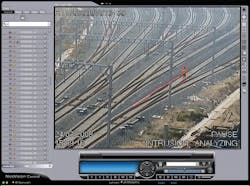
Moti Shabtai, vice-president of security operations for transportation with NICE Systems, said transit customers are looking for systems that will not only provide security for riders, but also help streamline overall operations. While some cameras are surveying tracks and trains to make sure no one is going onto the tracks, other cameras will count the number of riders in order to make sure trains lines are running as efficiently as possible and server busier lines to curb overcrowding. One area where transit operators will be looking into this will be the 2014 Super Bowl being held in New Jersey, Shabtai said, where transit operators will need to determine how to best get thousands of attendees to the game in an already busy system.
Shabtai said the main challenges software developers are handling with the systems is understanding what it is the customers want and then fine tuning the systems to get the maximum performance out of the systems. However, the single biggest challenge for the technology is detecting one incident in real time while overcoming environmental issues for the cameras. Shatai said some systems have to overcome snow and fog, shaking by passing transit and high winds.
With transit systems still working to get back on track in the Mid-Atlantic region of the country due to Hurricane Sandy, transit systems are also using the cameras to become fully operational.
"We're seeing in real time now in New York City they using it more and more right now," Incorvati said. "Right now they're probably not looking for pit pockets, but how much water is in the tunnels or how the operations are working after an incident like this."
Continued Evolution of Technology
The security systems have moved well past motion detection on cameras, Shabtai said, and are now working to create more analytics of what it is viewing. Cameras need to determine if movements are of animals or people and why the object is moving in order to understand what the system is seeing and reduce the number of false alerts.
The systems are using a self-learning set of algorithms as part of behavioral analytics, so the cameras can determine why someone is running in a station while others are walking and then learn what could be considered normal behavior.
"Anything can be calibrated, but there is a learning time," Shabtai said. "But it's pretty quick. It's not like days or months. It's minutes. It's basically minutes."
One of the leading companies in cutting edge security technology is BRS Labs, which created the AISight behavior recognition software, which not only films operational issues and potential safety risks, but documents and analyzes the behavior in order to allow transit providers to see a bigger picture of what is going on in its system. It also allows security and transit leaders to not only see what's going on in the system, but to understand why the actions are happening.
"It's really from the straightforward concept that where there's knowledge, there's power," Company President John Frazzini said.
Frazzini said the technology is being embraced by some of the largest transit providers in the U.S. and around the world because the new technology allows for safety and security while operating to provide for better efficiencies on the systems and finding ways to provide safer working environments. The software can be used with a lot of existing equipment as well and takes several days of training for employees, so Frazzini said it has made the new technology very attractive for transit agencies who have yet to invest in the technology.
Frazzini said right now there is a lot of discussion in terms of correlating data from the images with other security detection data, such as ground based radar and applying the same intelligence from video streams to other data structures.
Peleg said his company has also developed mobile accessibility to video on the systems, allowing transit workers or security officers to access data via smartphone and other handheld devices. It also allows for those devices to be turned into cameras to provide even more flexibility in what is filmed.
Axis has improved its cameras that now Locapo said the company has developed a camera that can film in color down to 0.05 lux. And cameras can now detect suspicious activities and automatically read license plates to look out for certain vehicles. Some users of the IP systems even brag there aren't any eyes viewing the cameras on a regular basis.
"It gets security personnel out in the stations where they need to be as opposed to sitting behind a computer," Locapo said.
About the Author
 Joe Petrie
Joe Petrie
Associate Editor
I came to Mass Transit in 2013 after spending seven years on the daily newsbeat in southeastern Wisconsin.
Based in Milwaukee, I worked as a daily newspaper reporter with the Waukesha Freeman from 2006-2011, where I covered education, county and state government. I went on to cover courts for Patch.com, where I was the main courts reporter in the Metro Milwaukee cluster of websites.
I’ve won multiple awards during the course of my career and have covered some of the biggest political events in the past decade and have appeared on national programs.
Having covered local government and social issues, I discovered the importance of transit and the impact it can have on communities when implemented, supported and funded.