BVG: Keeping Berlin Moving
The Berliner Verkehrs-AG (BVG) was founded in 1928 at the initiative of Ernst Reuter, who was the city councilor for transportation at the time. The corporation began operating on January 1, 1929. In 1938 it became a Berlin-owned enterprise operating under the name Berliner Verkehrsbetriebe. The abbreviation “BVG” was so popular, however, that the company has kept it to this day.
With the division of Berlin following World War II, a separate BVG administration was formed in 1949 in the eastern half of the city, and it began operating under the name VEB Kombinat Berliner Verkehsbetriebe (BVB) in 1969. After the reunification of West Berlin and East Berlin, the BVG and BVB merged on January 1, 1992 as the Berliner Verkehrsbetriebe (BVG) and in 1994, it was reconstituted as a public institution.
BVG is Germany’s largest local public transport company and by 2016, they aim to be a profitable company.
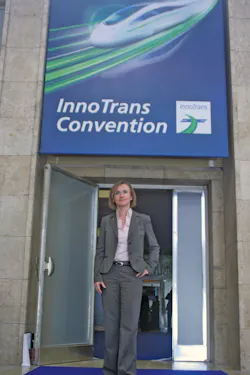
Dr. Sigrid Evelyn Nikutta is the chairwoman of the board/director of operations for BVG and prior to this, was the director of operations of the Deuthche Bahn subsidiary Schenker Rail Polska S.A. in Zabrze, Poland. “I was responsible for high-value rail technology and for more than 3,000 employees,” says Nikutta. “In such a situation, you learn to assert yourself and gain a great deal of technical and organizational knowledge.”
Two years ago she started at the BVG and she says an enterprise like the BVG is a completely new challenge, as ultimately, she is responsible for four operational divisions: Bus, Tram, Underground and Construction/Infrastructure.
BVG’s Services
[[[INSERT BVG SERVICES CHART]]]
With the Underground, buses, trams and ferries, the BVG’s vehicles circle the globe about 5,800 times a year with more than 900 million passengers using the vehicles every year. Nikutta says, “We are the biggest company in public transport in Germany.
“We are also the biggest bus transportation system, the biggest underground system and biggest tram system in Germany; we have the biggest.” She adds with a laugh, “And best, of course.”
When looking at a map of the service in Berlin, the division of the city resulted in a differing networks; the western part of the city is primarily bus and the eastern part is primarily tram. Nikutta explains, “In 1968 they stopped running the trams in the city and switched completely to buses.” At the time, they wanted to be modern and got rid of the old-fashioned tram system and got all new buses. She says, “But now we really regret this.
“We don’t have as many problems with the tram system as we do with the buses.”
Transport in the Black
BVG has several key performance goals it’s working toward: to be in the black by 2016, revenue increases of 3 percent annually to 2020, and 1 billion journeys annually from 2020, all while maintaining high customer satisfaction standards.
BVG reports to the state transport authority. “We are owned by the state of Berlin,” Nikutta says. “We have a contract with the state of Berlin, who gives us money. We have negotiations for the contract with the state.” She adds, “This situation is not so comfortable for us.”
The first company contract in 1993 was for $986 million (1€ = $1.2934) and has decreased more than 60 percent in the last 20 years, down to $323 million this year: $97 million for transport and $226 million for the maintenance of the infrastructure. “That’s all we get for the whole system,” Nikutta stresses.
Farebox revenue totaled about $711million last year. In recent years, ticket price increases in Berlin have been far lower than in other integrated transport networks.
“We fight very hard for the prices here,” says Nikutta. “This is due to the politicians in the city,” she explains. “We have a lot of not-so-well people in the city. At the end, the politician wants both. They want to have the money they need … but then they don’t want to have high prices.
“It’s a really big challenge for us.”
One area where they have made cost-reductions is in staffing. In 1991 they had nearly 28,000 employees and today they are just over 13,000. “But the transport capacity is at the same level,” says Nikutta. “This is really a point of productivity of the employees.”
The average age of the BVG’s vehicles are nearly 30 years and Nikutta says, that’s a problem. “We need hundreds of millions for new vehicles.”
“No company in the world is able to earn the money for the vehicle and for infrastructure by passengers; that's not possible.”
Nikutta says, “We want to be in the black by 2016 because it's not good when a company is not able to sustain, to earn her cost, even if the situation is very special in passenger transport business.
“Nevertheless, we must earn our own cost and then we can be independent from all of the politicians and all of the discussions.” She continues, “If you are dependent on the politicians, we have a problem because the politicians are not dependable with the money because every four or five years they change. You can’t run a company depending on these four or five years; that’s why we must get independent.”
Like other agencies, BVG is doing more with less and looks for ways to save money and to make money. Nikutta says there are some logical things to earn more money, such as getting more passengers in the system in the same amount of vehicles. “We don’t want to use more vehicles; we want to use capacity.” She also says, “The company used to spend money for things that are not really needed and it’s my job to find those.”
Rider Communication
Maintaining reliability is important to the customers, and it is important to BVG. For punctuality, the underground is at 97 percent, the tram system at 91 percent and bus is at 85 percent. Nikutta points out the bus system is much lower in punctuality than other modes due to congestion on the streets.
To keep things running on time and to keep riders up-to-date with the latest information, BVG uses a variety of technology. RBL is a computer-assisted operations control system that is used for a wide range of tasks, primarily information and communication links between vehicles and control centers; computer-assisted service operations; and passenger information in trains, buses, at stops and stations, via mobile and Internet.
The dynamic information system, DAISY, is used by BVG to provide passengers at stops and stations with information in imminent departures. “The relevant computer-assisted operations control system provides DAISY with the positions of the vehicles,” Nikutta explains. “DAISY then calculates the departure times and presents them on electronic displays. When a vehicle is due to depart, the destination text flashes.”
She continues, “Once it has left, the display line is deleted and another future departure moves up into the display. The bottom line of the display can be used to show general information as scrolling text. It is also possible to use the entire display for special text, such as information on service interruptions or construction work.”
BVG also has apps with their service information and next year, will include real-time data. With the use of QR codes, they have real-time data information access at every bus stop.
Sustainability at BVG
BVG is a signatory for the UITP’s Sustainability Charter and environmentally friendly practices are important. Of the passengers transported, 63.9 percent are by electric and 36.1 percent by diesel.
In Berlin, private transportation is responsible for about 15 percent of all CO2 emissions. The BVG’s services are responsible for only about 2 percent of all CO2 emissions.
Currently BVG is testing hydrogen internal combustion engines in its buses for reliability and efficiency. “BVG is among the early adopters in the field of hydrogen and started gaining experience as early as January 2006 as part of the EU-funded HyFLEET:CUTE project,” Nikutta explains. Since then, four single-decker buses equipped with suction – naturally aspirated – engines have been into service.
“The logistics, handling and productivity of gaseous hydrogen as a fuel are being tested under the tough, realistic conditions of Berlin city traffic, thereby gaining much important knowledge for the reliable and economical use of alternative propulsion systems in urban public transport.”
She also mentions that they are not very economical. “If you must pay everything on your own, then they are much more expensive than the other buses.” She continues, “At the moment, we are negotiating with the government about new contracts and they will give us a certain amount because we are testing these buses. But in comparison to standard diesel buses, they are a lot more expensive.”
For fueling its buses, the BVG works closely with TOTAL Deutschland, whose filling station on Heerstrasse, Berlin-Spandau handles the BVG buses as well as Clean Energy Partnership’s (CEP) fleet of cars. BVG is currently developing its hydrogen activities further and new fueling facilities and the shifting of hydrogen hotspots in Berlin and the surrounding area will enable additional fields of use and open up new prospects for BVG’s H2 bus fleet.
“While the four hydrogen buses with naturally aspirated engines will continue to operate as part of the CEP until 2014, new projects for the extension of the hydrogen fleet are currently negotiated with funding agency and technology partners,” Nikutta explains.
“Renewable hydrogen as a fuel of the future remains an important option for BVG for putting the company’s sustainability strategy into action, and a major contributor to improving the quality of life in Berlin.” She adds, “BVG is therefore actively working with producers and automotive partners in the CEP toward their shared goal of safeguarding future mobility while also conserving fossil resources.
The BVG is also testing electric buses, Nikutta says. There are currently no electric buses from a German producer. The first bus they tested was a bus from China. Nikutta says, “Of course there would be a revolution if we import the Chinese buses.” And adds, “At the moment we are [working with] Solaris, who has these buses.
“Perhaps this will be a way to get more efficient and more pollution free. This will be a good way because we need a lot of buses.”
Nikutta summarizes, “As the backbone of Berlin public transportation, our buses and trains make a significant contribution to the achievement of the climate protection targets set by the federal government and the state of Berlin. The BVG constantly works on the reduction of energy input.”
Examples include, the energy produced during braking of the trains and even of the elevators is converted into electricity and fed back into the grid, the use of photovoltaic systems, as well as a small cogeneration unit.
Expansion Underway
A project underway is a gap closure between two Underground lines, the U5 and U55. BVG will extend the U5 from Alexanderplatz to Brandenburger Tor and connect it there with the already completed U55. They will merge to form one line: the new U5, from Hönow to the Central Station. The completed line will be 13.7 miles long.
Completion of this line will give the major residential areas in Hellersdorf, Kaulsdorf, Lichtenberg and Friedrichshain a station without any need to change trains.
The new U5 will relieve the strain on the environment by reducing private motor vehicle use in the inner city. The Unter den Linden boulevard currently has to contend with heavy traffic and exhaust gases from an average of 15,000 motor vehicles each day. Following the gap closure, at least 20 percent of the private motorized traffic is expected to shift to the new U5.
Nikutta says the project started in March of this year. “This is a really complicated line because here in the middle of Berlin we have two rivers to go under.” She says the 433 million project is expected to be complete in 2019. “It’s really exciting.”
Up to 155,000 passengers every day are expected to utilize this line, which will connect Berlin’s City Hall, the Nikolai Quarter and the Museum Island. Also, the Unter den Linden/Friedrichstraße – a place of history, culture and shopping – will be fully integrated in Berlin’s public transit network.