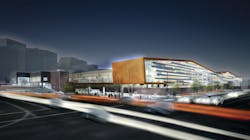
Architects find more transit facilities taking on sustainability aspects, big and small.
No one is mistaking the Wealthy Operations Center in Grand Rapids, Mich., with Frank Lloyd Wright’s Fallingwater home, or a new bus maintenance facility in Lorton, Va., with the revolutionarily green Hearst Tower in New York City.
But the tenets of sustainable architecture that are making their mark on the world of architecture as a whole are trickling through — with marked, certified success — to transit facilities across North America.
Public buildings for buses and train cars may be behind the curve of private office towers in terms of sustainability, which architectural leaders said is due to a smattering of economic and cultural reasons. But those same architects now see greener facilities hitting their stride in efficient function and tasteful form, both in world cities and Midwestern towns
Progressive AE Transit Practice Leader/Project Manager Seth Horton said it ultimately boils down to these buildings being “treated as any other public building” from the point of sustainability.
“It’s a building meant for the public, not unlike a mall, movie theater or library. It is a destination for people who come and go as necessary to meet their needs. Reducing energy costs and improving the user experience in all of these facilities are always at the top of the priority list,” Horton says.
The Talk before the Walk
Before the first exhaust heat recovery system is installed, officials at transit facilities need a realistic assessment of what isn’t — and, increasingly — what is possible within their budgets.
Ken J. Anderson, associate principal with RNL Design at the Washington, D.C. office, says his office engages with transit facility clients through a workshop or questionnaire to “see what they’re after.” Anderson says many are surprised how little their budgets change all the way up to Leadership in Energy and Environmental Design (LEED) Platinum, the highest level of green building and design and performance.
“They can’t all be LA Metros and MTAs, where they’ve got facility builds on their capital project budget on a regular basis, so to some of them, it’s a new thing to think of and they need to be able to get their arms around. Some of them, they may have not put up a new building in 15 or 20 years, before the LEED movement took hold,” Anderson said. “As you sit down with them, you understand what their operational philosophies are, how the facility is going to function to their needs, and the sustainability is part of the inherent functional needs.”
Catherine Calvert, director of Community Sustainability at Pacific Northwest-focused VIA Architecture, wrote in August that it’s a “misconception” that sustainability is an “add-on” in the design and execution of mass transit hubs.
“Good sustainable design is actually a form of radical common sense that can challenge some of the assumptions that accompany current transit design principles,” Calvert wrote in a blog on the architect’s site. “Using a combination of critical thinking and creativity, the integrated design process examines each component of a transit system to determine if each is necessary (rather than expected), and if each is able to serve more than one function.”
Basics to the Front
Increasingly, those talks are leading to design action. Amherst, N.Y.-based Wendel Companies has worked on designs for more than dozens of transit facilities, with eight of the last 20 targeting either LEED Silver or Gold certification. Initially taken on by the office construction community, there has been a “significant rise in the number of transit and publicly-funded facilities” aiming for LEED standards, says Wendel Associate Principal Philip Muse.
The normalization of sustainable thinking has brought along with it a slew of traditional green building elements that are now regularly packed into new projects: recycling construction materials, opening structures to natural light and leveraging capital expenditures on features that impact operational costs. But there are sustainability challenges that crop up specific to transit buildings.
Wendel Associate Principal Raymond Johnson noted that the amount of required ventilation at transportation facilities shifts around designs, and directly impacts consumption levels and plans. Hardly quiet buildings, there are considerations to cancel out some of the noise “pollution” from the vehicles coming and going, sometimes at odd hours in residential communities.
As facilities that need and use lots of water, many are addressing this with simple things like rain gardens that circle a property, and more involved options like water reclaim systems from their bus wash areas, Horton said.
Wendel’s Muse touched on heat recovery equipment synced with HVAC units as nice to have, but something that can nearly double the size and cost of a heating and cooling unit upfront.
On that far end of efficiency is the new maintenance and administration center for the South Bend Public Transportation Corp., a gray, white and beige site layered in windows and sloping roofs in northern Indiana. Certified LEED Platinum, the first multi-use transit facility in the United States to notch that level of efficiency, the building ran with the design team on green options, like rain water capturing and cooling systems that run without using ozone depleting chemicals, said architect Anderson.
Green Not Always Visible
As with design in other buildings, there is importance in what is not visible.
Johnson at Wendel said there are architectural obstacles in allocating space at these sites for things like the separation and burial of fuel tanks, and minimalizing long-term environmental disturbances.
Layout of some structures also considers future growth or sustainability efforts, said Anderson. Even at buildings registering high marks in green design, Anderson said there is an emphasis on more flexible walls, roofs and outside space “in a much greater way than we’ve seen before.” It’s both an acknowledgement that more can be done or could be coming down the pipeline, as well as the “economic pinch” many publicly funded transit operations run on.
Then there is there are sustainable elements that make vast improvements in-house, but may not go for the full recognition or certification. Horton said that plenty of facilities are taking on smaller revamps or initiatives in the name of sustainability.
“Owners recognize the value in sustainable building, such as energy savings, improved indoor air quality, and reduced waste, but sometimes LEED certification is an extra that doesn’t fit the budget or the client’s goals,” he said.
Green Power for the People
And what good are sustainability and design if you don’t consider the people who will use it?
Throughout its 300,000-square-feet, the Wealthy Operations Center in Michigan has a number of features that marry conscientious aesthetics with environmentally sound practices. Natural light pours into many corners of the center, and aspects like fast-acting overhead doors both preserve energy and shut off lousy weather from drivers and other workers. Horton, from Progressive AE, says that these types of features are just as critical as those in the sustainability specs.
“A bus storage and maintenance facility is often approached as just a space to house and maintain buses,” Horton says. “However, it is important for clients to expand their design view to recognize that people are still a priority. ‘People’ costs are one of the largest expenditures of any operation, so keeping employees healthy and happy can have a direct impact on the bottom line.”
Wendel architects Johnson and Muse pointed to efforts to “maximize occupant health and comfort” at the Cinder Bed Road Maintenance Facility in Lorton for the Washington Metropolitan Area Transit Authority, such as a sloped, operable roof that lends itself to ventilation and glazing on bay doors to capitalize on natural day light.
And the people-side of that sustainability goal even shows up in the form of handcrafted jewelry sold and recycled glass beads sold on rubber tire floors. The Santa Monica, Calif. Big Blue Bus system tacked on a retail store that is green to the hilt, a compliment that green public transit plans it established in 1992 that, most recently, included a new, 66,000-square-foot maintenance facility. Linda Gamberg, acting customer relations administrator for the city’s bus service, said the tokens and trinkets for sale help give users and transit enthusiast “a glimpse into our philosophy.”
About the Author

Justin Kern
Justin Kern is a writer and nonprofit marketing manager who lives in Milwaukee with his wife and cats.