Funding High-Speed Transportation in America with Public-Private-Partnerships
According to the American Society of Civil Engineers (ASCE), America has an infrastructure investment backlog of more than $2 trillion. Nowhere is this more apparent than in the area of transportation. But with federal and state governments running deficits far into the future, and a federal debt approaching $16 trillion, public sector finances are acutely stretched.
The private sector has the experience and capacity to undertake many of these critical projects but is wary to commit on its own for fear of being exposed to risks it will not be able to justify to its shareholders. But were both sides able to collaborate, the public sector could mitigate the risks and the private sector could use its resources to expedite infrastructure investment. Welcome to the potential of public-private-partnerships (P3’s).
High-Speed Rail and P3’s
It is useful to take a look at how public infrastructure has been traditionally financed and look at some recent examples of infrastructure funding, starting with the high-speed rail (HSR) program.
HSR got a jump start with $10 billion of stimulus funds from the American Recovery and Reinvestment Act of 2009 (ARRA), but the results have not matched the promise. Taxpayers were under the mistaken impression that for $10 billion they would get the 200 mph Japanese Shinkansen-like transportation.
Instead what emerged were projects like Ohio’s C3 Corridor from Cleveland to Cincinnati with a published timetable that unwisely translated into an average speed of just 39 mph. It was a classic marketing misstep: over-promising and under-delivering.
There have been numerous starts and stops with several governors turning back Federal Railroad Administration (FRA) money for HSR lines. In terms of potential for “true” high-speed rail – top speed of 200+ mph with average speed of 160+ mph, there are only two projects with any significant level of support at this time.
First is California High Speed Rail (CAHSR) which has a business plan, a much higher price tag, and several billion dollars of funding (though the current funding will not achieve true HSR speeds). Second is the Northeast Corridor (NEC). The NEC is making incremental improvements and has the advantage that it is already electrified and has equipment, the Amtrak Acela, capable of running at 165 mph.
Both of these projects have one thing in common, a very large price tag price tag, and no long-term commitment for the monies necessary to complete the projects. This is a perfect lead-in for the two historical approaches to fund public infrastructure: Plans A, the most common avenue, where the public sector bears full responsibility, and Plan B, also known as privatization, where the private sector goes it alone.
Plan A: Government Funding
Plan A is the “Government Provides all the Funding” approach. In recent years, it was anticipated that America would be able to make a significant dent in the infrastructure investment backlog. Taking a close look at ARRA, or the Stimulus Bill as it was often called, one sees that of the $831 billion actually appropriated, less than $50 billion was targeted at transportation infrastructure. Of that $50 billion, only $10 billion was for rail, primarily higher-, not high-speed rail. (higher-speed rail, HrSR, average speeds are in the 50- to 60-mph range. Several shorter routes are coming on line with a top speed of up to 110 mph).
Contrast this with the Chinese government which spent in the vicinity of $300 million on HSR. Estimates for America to get back in the HSR race are in the range of one-half to three-quarters of a trillion dollars for the 11 HSR corridors in the FRA plan. That translates into $25 to $30 billion a year for 20 to 25 years.
Plan A is most commonly promoted by liberals and progressives, as well as many rail advocacy and environmental organizations. But with the financial stress on general revenues in the federal budget, are such outlays feasible?
These groups will blame the “other side” and with some justification. But it is not that simple. Ask a Democratic legislator to put $25 to $30 billion a year, every year, toward HSR, or any type of rail, when constituents are camped out in their offices and jamming their phone lines worried about cuts to Medicare, Social Security, Medicaid, and Home Heating Assistance, which do you think will be one of the first items to fall off the plate? If you said rail, you would be correct.
Similarly, ask a Republican law maker who appreciates the benefits of rail about his priorities when sequestration (i.e. mandatory budget cuts) provisions from the debt ceiling deal of earlier this year will result in further significant cuts to Defense. What falls off the Republican’s plate? Correct again. Rail.
So despite the positive words from many rail advocates who parade up to Capitol Hill with “Pollyanna” funding requests and no recommendation as to how these expenditures can be funded, the prospect of the government funding these rail transportation infrastructure investments is remote at best.
Plan B: Private Sector Funding: Privatization
Then there is Plan B, or “private industry provides all the funding.” Looking at HSR again, Plan B makes the assumption that if “true” HSR is such a great idea with fantastic opportunities for financial success, then private industry should be willing to jump right in and assume all the risk for the certain reward
This approach has primarily been recommended by conservative think tanks and Congressional conservatives. In fact, there was an opportunity just recently for the private sector to invest in the upgrade of the NEC to “true” HSR capabilities. No takers.
How many projects of this scale have broken ground in America, to date, under Plan B? Zero.
Might we get a line or two operating this way? Perhaps. But will America get a network of 21st Century HSR infrastructure that will be competitive with and complement air travel? Unlikely.
So what is the private sectors aversion to provide funding public sector projects? Risk, specifically for lack of a better word, governmental risk. Developers, architects, engineering and construction firms et al clearly understand risk. One of the significant benefits they bring to the table is their expertise in quantifying risk and putting a box around it. It’s what gives them the confidence to develop a cost commitment for a project and agree to a schedule. Challenges like the type of steel, glass and cement to use (or invent); or how to deal with wind shear or water infiltration, or underpinning existing structures do not faze them. What does concern them are issues like the time to acquire all the properties needed to start a project.
Even more so are the painstaking processes of zoning the property and mitigating the impact of the new infrastructure on impacted parties, both real and imagined. But nothing concerns the private sector more than NEPA: National Environmental Protection Act regulations. It is nearly impossible to qualify and quantify that risk. In development, time is money. Few, if any, private sector firms can bear the risk of lawsuit after lawsuit, appeal after appeal, stopping a multi-billion dollar project dead in its tracks, year after year after year.
Plan P3: Public-Private-Partnerships
This leads to the third way of funding public infrastructure. That approach would be implementation of public-private-partnerships, PPP or P3’s as they are often called. The underlying assumption with P3’s is that (1) there is a role for both government and private industry in building out this infrastructure, (2) neither the government nor private industry has the financial wherewithal to do so on its own, and (3) by both parties doing what they do best, the construction can be expedited and results realized more quickly.
Many now believe that P3’s can be the answer to building HSR in America. The task at hand is divining a formula for P3’s that would work and be palatable to government, private corporations, unions and management, as well as citizen taxpayers, fare payers and toll payers.
Several actions are needed:
There needs to be enabling legislation to facilitate P3’s in areas like Joint Power Authorities for governance, and regulations that will expedite permitting, zoning and environmental regulations. House Transportation & Infrastructure Chair John Mica (R-Fla.) has already called for this to upgrade the NEC. Also, legislation is required to expedite land acquisition for HSR right of way and areas around HSR train stations for transit-oriented development (TOD). Another critical legislative initiative will be requisite to facilitate the value capture of project revenues from existing properties in the proposed HSR station areas.
Developers must be allowed to assume that when calculating the return on investment (ROI) for the HSR project that they could include not only revenues from HSR fares, but also from rent and lease payments flowing from commercial and residential properties at the TOD sites.
Government entities would procure the HSR right of way as well as the TOD-related properties. The government would be responsible for all zoning, permitting and environmental (NEPA) work, so as to minimize the red-tape risk to the private firms.
These TOD properties and ROW’s would be leased, at very favorable terms, to the private contractor or syndicate for 35 to 50 or more years. For existing properties, the private entity would be contractually obligated to return these properties to the governmental authority at the end of the lease in as good or better condition than when first received. For to-be-built properties, there would be a strict construction schedule, with severe penalties to the contractor for non-performance.
Lastly, importantly, and perhaps most controversially, is the requirement to prime the pump with a steady, predictable cash inflow of, on average, $10 billion per year and an initial government-backed bond offering of $100 billion. The bond offering would be secured by the yearly cash flow, thereby providing the financial liquidity that would enable the governmental entities to purchase and prepare the acquired land for development.
Public Sector Funding Mechanism
So just where would that $10 billion a year infusion come from? The answer: a proposed High Speed Passenger Transportation (HSPT) fund. This transportation fund would address needs in both air travel as well as high-speed rail. Air travel and HSR are linked together because these modes are both competitive and complementary, just as automobile travel and public transit are both competitive and complementary.
The gist of this proposal would be to put a user fee of 6 percent on airline tickets, charter flights, air freight revenues, Amtrak tickets, and future HSR tickets to fund a High Speed Passenger Transportation (HSPT) fund. Proceeds would be in the vicinity of $10 billion annually. The proposal would allocate 60 percent ($6 billion) to build high-speed rail, 20 percent ($2 billion) to the airline industry to deploy a state-of-the-art next-generation air traffic control (NextGen ATC) system, and 20 percent ($2 billion) to subsidize and improve the performance of existing intercity rail.
HSPT fund benefits
High Speed Rail (HSR) Construction: HSR construction is the key component of this bill. Lack of assured, predictable funding is holding back deployment. Assuming the $6 billion annual revenue stream for HSR, allocate $3 billion for bond interest payments (the $3 billion will float $100 billion bond offering at 3 percent coupon rate), and remaining $3 billion for ongoing government actions that will minimize the risk to private developers.
With the initial $100 billion capital infusion and the annual $3 billion from the HSPT fund, the HSR program can be jump started. The government can take the following actions: buying rights of way (ROW) for the rail lines, purchasing land around HSR stations for transit-oriented development, starting and completing all zoning and permitting, negotiating mitigation settlements, and most importantly, completing all NEPA studies and reviews, and securing the required NEPA approvals.
Government can also make progress payments to the private sector for long lead time items. One example would be to incent manufacturers to invest in factories that develop and manufacture American-built train-sets and other equipment for the HSR lines. Future HSR fare revenues will be used to pay off debt and fund more HSR lines.
NextGen ATC: The existing air traffic control system is 50 years old, obsolete and unable to handle current traffic in high volume markets such as greater New York City. Congestion in this market ripples in both directions, delaying flights from the west (Midwest, California) and the east (Europe). The cost for this new system has ballooned from $10 billion to $40 billion and future funding for this project is not assured.
Higher-speed rail (Amtrak and other intercity rail with an average speed of 60 to 70 mph or greater).HrSR is important as a feeder to HSR. At 70 mph, HrSR which still requires subsidization, would require less of a subsidy since it is far more competitive with both automobiles and buses. Many of these HrSR lines, also called emerging HSR, can become true HSR service in the future, as demand, conditions and financing warrant.
P3 Benefits
The HSPT fund is the key. With this fund, the government and private sector can work together in P3’s. The additional revenue streams from the commercial and residential TOD construction, along with the anticipated rail fares, will result in HSR operators turning a profit, covering not only operating and maintenance costs, but also capital costs. The added benefit is that the HSPT Fund is a user fee and will not require allocations from strained general federal tax revenues.
Neither the federal government nor private industry has the wherewithal to construct HSR alone. The total cost of development along the 11 key FRA corridors will be in the vicinity of $500 billion to three quarters of a trillion dollars, or $25 to $30 billion a year for 25-plus years. The benefits accruing from the HSPT Fund are numerous.
The country benefits because there is now another time-competitive, cost-effective way to transport the additional 100 million Americans that are projected to be here by 2050. The airlines benefit because they will have a new ATC system that will make their operations far more efficient.
Take-offs and landings will be more predictable and planes will not waste expensive jet fuel as they circle airports or queue on taxiways. Aircraft utilization will increase and the return on these expensive assets will be improved as the planes spend more time in the air on revenue service. Another benefit to the airlines is that this proposal will reimburse them for the cost of retrofitting their planes with the NextGen ATC hardware, a price tag estimated in the $20 billion range.
For convenience sake, many Americans will chose to travel by rail between key city pairs 200 to 600 miles apart, and airlines will be able to concentrate on more profitable, longer-haul flights. Americans benefit because they will have a viable, cost-effective, time-competitive alternative to airline travel. Say goodbye to long lines at airport security checkpoints and intrusive, annoying TSA searches. Even travelers who cannot use HSR benefit because a viable HSR system translates into less congestion at airports, and better on-time performance when they have to fly.
HSR Deployment
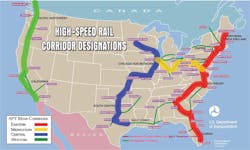
Another part of this proposal would impact the politics of HSR funding. Instead of the 11 HSR corridors proposed by the FRA, keep it simple. Picture four mega-corridors Eastern: Portland, Maine to Miami, Fla.; Central: Minneapolis, Minn., to Chicago, Ill., to Houston, Texas; Western: Vancouver, B.C. to San Diego, Calif.; Mid-American: Washington, D.C. to Chicago, Ill.
These 1,000- to 2,000-mile corridors will have multiple 200- to 600-mile corridor segments between key city pairs where HSR will be more than competitive with air travel. But, by having the long corridors, it will be feasible to take political advantage of the additional senators, congressmen and governors that will represent states included in an HSR corridor.
This is a strategy that Amtrak has used successfully for more than 40 years, and by having competition amongst the various states, the execution of the P3 can be even further expedited by more aggressive states pushing to complete their sections earlier. And by keeping key Amtrak routes in the picture as HSR feeders, that vocal political constituency’s concerns are addressed.
Issues and Concerns
Will there be complaints from the airline industry and perhaps from some members of congress for the user fee on the plane tickets? Yes. But consider this. One of the action items from the Simpson-Bowles deficit reduction committee, now being reconsidered by the senate, is a 3 percent fee on airline tickets.
Not one cent of this fee would go toward transportation; all proceeds would be earmarked for deficit reduction. There already are additional fees on the tickets for 9/11 fund, facility charges, TSA funds and other taxes. The airline industry, through a steady stream of mergers and acquisitions over the past several years, has become much more concentrated, is experiencing much less resistance to fare increases especially for higher fuel prices, as many travelers will attest.
Additionally, airlines are now bringing in billions of extra dollars in additional revenue for items passengers used to get for free. These “extras” include checked baggage fees, food on plane, ticket change fees, seat fees, etc. It is unlikely that the HSPT user fee will have a major impact on airline revenues, especially since airlines get a major benefit from NextGen.
Another issue that will need to be worked is the acceptance by affected parties of the benefit of P3’s. Some unions, frankly, do not trust them. Railroad unions, especially, are concerned that long-term benefits on labor security may be jeopardized. Construction unions are concerned that P3’s will adversely impact their ability to negotiate project labor agreements (PLA), which tie all labor costs on a construction project to the union scale.
Developers have a different set of concerns. Although popular in Europe and Asia, many American developers are not particularly comfortable building on land that they do not own. This will be a different model for American developers, and may necessitate longer lease terms to mitigate risk, but as long as the financials work, it should not be an insurmountable problem.
Rail advocates and the public in general are concerned about the diversion of public assets to private corporations. There is great resistance to seeing Amtrak privatized, which could potentially lead to the discontinuance of its heavily subsidized long-distance, overnight routes. Also, many in the public are leery of political leaders to selling valuable state assets to a private company, especially if the proceeds from the sale are not used in the long-term public interest. This proposal is careful to note that the state assets are not sold; they are leased. More importantly, at the end of the lease term, the private party must return the leased asset to the state in as good a condition or better than it received it for existing assets or in full operational conditions for newly developed assets.
But perhaps the thorniest issue relates to capturing value from existing property assets near new HSR train stations. General rule of thumb is that the land within a quarter mile of a train station is very attractive from a development standpoint. Some planners would go so far as a half-mile away. In some areas, this will not be a problem as the prime locations are in need of redevelopment, and the land can be acquired relatively easily and inexpensively by Eminent Domain. This would obviously not be the case with stations like Penn/Moynihan Station in New York City and Union Stations in Washington, D.C. and Chicago, Ill.
It may now be necessary to enter the world of Business Improvement Districts (BID) and Tax Incremental Financing (TIF) rather than seizing properties by Eminent Domain. The risk is that BID or TIF revenue alone may not be enough to make the financials work. There may need to be legislation that would treat the private buildings near HSR stations as property tax-free entities, like hospitals or universities, with the developer receiving the property tax income and making Payments in Lieu of Taxes (PILOT) to the city to compensate the local government for city services. Depending on the situation, a portion of the rent or lease payments may also need to be allocated to the HSR builder.
Why so much revenue back to the builder/developer? As indicated earlier, the best and cleanest way would be for the government to acquire all the land around the stations and lease it to the developer. This is necessary because, while HSR will cover its operating expenses, it cannot recover its capital expenses quickly enough to build out the entire rail network in a timely manner.
It requires the additional financial kicker it will get from TOD revenues. These revenues (both rail fares and TOD-related) will be needed to construct the thousands of miles of HSR lines, build the commercial and retail spaces around the stations, pay back the original $100 billion bond offering that was used to prime the pump, upgrade and modernize the existing HrSR speed rail lines, and continue to innovate on the HSR lines.
The cities that are home to HSR stations can be expected to have concerns about the diversion of property tax, but the increase in business activity around the stations and resultant sales taxes can help to mitigate that issue.
The Win-Win
Lawmakers at both the state and federal level will have to work hard to resolve these complicated issues. But reasonable parties will hopefully be able to reach consensus because the potential benefits are so great.
A preliminary estimate is that the $10 billion average infusion from the HSPT user fee for 25 years (total infusion of $250 billion) could yield up to $1 trillion in investment in HSR infrastructure and transit-oriented development.
The federal government will be able to leverage this growth and develop a 21st-century, state-of-the-art, high-speed passenger transportation infrastructure without tapping general tax revenues. Other ancillary benefits arise from the formation and related economic activity related to the tens of thousands of jobs created, not just in construction, but also in engineering, design, product support and domestic manufacturing.
Americans are by nature impatient, but patience will be required. Concerns have been opined that the airlines and their allies would never agree to the 6 percent user fee. It is a valid point, but it is important to put that argument into perspective. It is taken for granted that 20 percent of the Highway Trust Fund has always been dedicated to transit. When the current House committee tried to strip the transit support section out of the Highway bill , a bi-partisan group of representatives saw to it that an amendment was passed to restore transit funding.
But back in the 1972, the Commonwealth of Massachusetts under a Republican Governor Francis Sargent took a very bold decision to not build Interstate 95 into the city of Boston. He petitioned the U.S. Department of Transportation that the highway monies for the first time be flexed instead to the Orange Line subway. When Democrat Michael Dukakis followed in the governor’s chair he continued the request, which was again granted on an ad hoc basis. It was not until 1982 under a Republican president named Ronald Reagan that this transit allocation was formally codified into law for all the states.
The lesson for transportation advocates is that it will take some time to establish a formal mechanism for High Speed Passenger Transportation fund. It would be unrealistic to assume a yes answer right out of the box. Hopefully it will not require a protracted amount of time to make it operational in some form. But as an economic imperative, the time to start asking is now.
Richard J. Arena ([email protected]) is the president of the Association for Public Transportation (APT) and is on the advisory board of US High Speed Rail (USHSR). The views in this article are his own and do not necessarily reflect those of APT or USHSR.