Major Overhaul for Via Rail's "Corridor" Fleet
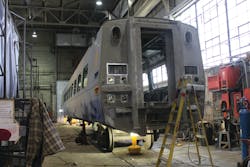
The backbone of VIA Rail Canada's so-called 'Corridor" fleet — which serves the highly populated Québec City to Windsor Ontario urban corridor — is being overhauled in one of the government-owned train company's largest projects.
The $98.9 million contract awarded by the government of Canada to Moncton, New Brunswick's Industrial Rail Services Inc. (IRSI) will see a variety of coach configurations gutted and re-built including the installation of new wiring, upgraded technology, all new interior trim and seating — effectively creating new rail cars.
The coaches are known in Canada's official bilingualism as LRCs — "Light, Rapid, Comfortable" in English and "Léger, Rapide, et Confortable" in French — manufactured and delivered to VIA by the manufacturer, Canadian-owned Bombardier Inc. between 1981 and 1984. There are no equivalent trains operating in the United States although the LRC was used as a basis for Amtrak's Acela Express, and a couple of actual LRC train sets were used in an Amtrak pilot in the early 1980s.
The VIA LRC fleet, which is 98 cars (two of the original 100 cars were permanently damaged and scrapped after involved in accidents), is being brought in stages for overhaul to the IRSI plant located in the former booming rail town of Moncton, which saw its local economy devastated with the closure of the former Canadian National Railway repair shops 30 years ago. The IRSI, owned by businessman Richard Carpenter, therefore represents something of a renaissance in rail maintenance for this eastern Canadian city.
The contract was announced in 2009 at the same time as a $5.8 million contract to IRS for smaller upgrades to improve physical accessibility to 21 cars of VIA's 106-car Renaissance fleet, which VIA acquired in 2000 from the United Kingdom and which has been operating also on corridor services and on VIA's overnight Montreal to Halifax route. The cars were originally built in the mid-1990s by Metropolitan-Cammell (later Althom) for the planned but later abandoned Nightstar Chunnel overnight service from England to the continent.
"For a long time, the feeling was that rail work was a day in the past history of Moncton and here we are back again," Moncton Mayor George Leblanc said at the May 2009 IRSI contract announcement.
IRSI in fact has been in business since 1999 operating from the former CN diesel shop located in the CN Classification yard on the railway's main line.
"When CN was trying to get rid of the property (Carpenter) saw it as a chance to buy a piece of real estate for next to nothing and then he was looking for what to do with this piece of real estate and finally realized that there might be a market for refurbishment of rail equipment," Daniel Nobert, senior manager for VIA's equipment program said.
For almost a decade IRSI obtained various small contracts such as rebuilding locomotives along with some passenger car work. Its clients have included a few American short lines as well as Canada's Rocky Mountaineer tourist train for the railway's single-level glass-domed cars.
But the VIA LRC and Renaissance contracts, as well as a smaller one for several VIA rail diesel cars (RDC), really lifted the company on to another level. It quickly launched a hiring spree to increase its workforce from 30 to 200.
The 125,000-sq.-ft. plant now has grown to have 18 service bays, overheard cranes, drop tables, metal fabrication and paint shops. It offers everything from repairs-in-kind to full remanufacture for locomotives and passenger cars. Meanwhile routine maintenance on VIA equipment is done at VIA's longstanding maintenance shops in Montreal, Toronto, Vancouver and Winnipeg.
The LRCs make up 80 percent of the VIA Corridor rolling stock and have been used heavily on runs between Montreal-Ottawa, Montreal-Toronto, Ottawa-Toronto, Toronto-Windsor and Toronto-Sarnia. The equipment was introduced soon after VIA was created as a Crown or government-owned corporation — similar to Amtrak — to take over passenger service from the Canadian National and Canadian Pacific railways in the late 1970s.
The Canadian-designed LRC cars have a more streamlined and unconventional look compared to traditional BUDD coaches built in the 1940s and 50s and which they replaced. They even look different from the more conventional Amtrak single-level Amfleet and Horizon cars. They are made mostly of aluminum, are wider, built two inches lower to the ground, and are one-third lighter than conventional equipment — all to cut down on wind resistance as part of the original goal to make for a faster train.
Originally intended to run 125 mph, the trains, ironically, when matching locomotives were attached, were found to be too heavy for existing tracks so speeds had to be reduced. Operating speeds these days often reach 90 mph and in certain route sections are permitted to be as high as 100 mph.
"The LRC is very, very comfortable equipment," says Jason Shron of the Toronto Railway Heritage Association. "It's spacious, it's about a foot-and-a-half wider than conventional passenger cars so it's a very spacious car and it feels that way when you're in it."
Shron says VIA made the "absolute right decision" to overhaul the LRC equipment for about $1 million a car versus purchasing new at $3 to 4 million per unit. "For $100 million they'll get 98 cars as good as new whereas $100 million is going to buy them 25 brand new cars."
The overhaul, however, will remove one of the LRC cars' most innovative features.
The cars' had banking systems built into the bogies to counter centrifugal forces on curves and create a better passenger experience. But the systems were fully deactivated a few years ago because of repeated problems of locking in cold weather. The overhaul will now see the systems "totally removed," according to VIA's Daniel Nobert, senior manager, equipment programs for capital projects.
This will also make the cars lighter and result in fuel savings.
Shron said it's unfortunate the banking systems failed to function. He suggested the deactivation might have been because of VIA's anemic repair budget.
"I wonder how much that has to do with the age of the equipment because banking was not unreliable in the 1980s and 90s," he said. "What I understand is that it was very expensive to maintain."
When the systems were working they resulted in a ride that was "much smoother" than, say, even Eurostar trains, he said.
Meanwhile all the original LRC matching locomotives were removed from the fleet by 2001 because there also were "plagued by electrical problems," Shron said.
"There were so many electrical problems that 45 percent of the time locomotives were not available. They were of a unique design so getting parts also became more and more difficult." The locomotives were replaced by P42 DCs followed by GE Genesis class locomotives.
Shron's group recently purchased an LRC locomotive as part of its "Save the LRC" campaign and hopes to eventually display it.
Shorn said that besides the LRC train's wonderful passenger experience, the LRC is really what has sustained VIA's important Corridor routes after significant funding cuts and then uncertain government financing during the 1990s.
"VIA really has been starved" by lack of funds, Shron said. Nevertheless, he said, the rail company had the ingenuity to create "innovative new services and increase ridership." This included acquiring U.S. railroads' heritage BUDD equipment and then gutting and refurbishing it. It also acquired the European Renaissance carriages, bought at the "ridiculously cheap" price of $1 million a car, he said.
Shron in fact remembers a meeting with a VIA executive shortly after the early 1990s cuts who told him "and her exact words were, 'Thank heaven for the LRC.'" This was after VIA was "forced to dispose of most of its fleet, and the LRC was basically what kept VIA alive in the Corridor because they're comfortable equipment; they're reliable equipment."
On March 3 of last year, LRC car number 3315 was the first overhauled unit to roll out of the IRSI shop and then sent on its way to the Montreal Maintenance Centre (MMC), hundreds of miles west. An additional 1,000 mile test run took place before the unit was returned to service.
Moncton is 547 miles east of Montreal. To move the equipment to IRSI the LRC cars are attached to VIA's name train The Ocean which runs almost daily between Montreal and Halifax on Canada's Atlantic coast.
"There's a 15-minute station stop in Moncton," Nobert says. "We just cut off the piece of equipment there and leave it on the station track. And CN comes with a switcher and picks it up because the shop is literally about six miles from the station."
The IRSI shop has room for 24 cars. It's designed with two through tracks and 16 stub tracks. Once brought to the shop the coaches are stripped to their shell, grit blasted and cleaned through high-pressure washing. A full visual inspection is done for cracks or other repairs.
After structural work is completed the cars are repainted and then interior rebuilding starts. This includes new wiring, reinstalling overhauled components, all new electrical cabinets, interior trim, carpeting and seats.
"From the passenger point of view there are some major improvements," Nobert said.
For example, new technology replacing the former solid-state electrical relays means the passenger experience will be much better. The cars will be better insulated and climate control sensors are designed to adjust depending on the temperature on either side of the coach.
"If you were sitting on one side of the car and the sun was shining on that side you'd be too hot whereas on the other side you might be too cold," he said. "Now they actually have sensors on each side of the car to control the heat and AC more to one side versus the other."
Restrooms have also been reconfigured. "They're better laid out," Nobert said. They remain the same size but give a greater feeling of space and have new vanities. "The colours are brighter, the lighting is better," he said.
New wheelchair accessible restrooms have been built into a new type of car that is being created as part of the overhaul. These are the "combi" or combination cars which will have 20 premium class seats and 38 coach seats with the all-new restroom. But the car will have just one restroom unlike the others which will continue to have two restrooms.
"This washroom will be much bigger than what is in there today – a 1500 millimetre turning radius for the wheelchairs," Nobert said.
Altogether the overhaul will result in a reconfigured fleet complement of 46 coaches, 26 club cars and 26 combi cars.
So far it is taking 10 to 12 months to refurbish each car. "The target is to get production down to about six months," Nobert said.
Have there been any challenges?
Nobert says it's the first time the 30-year-old cars have been rewired and upgraded to current technology.
"So with some of the new technology, there's software issues, there's interface issues," he said. "To get all of the kinks out, the interfaces between the different computers, and the different systems that have to talk to each other, that's been a challenge."
As far as aesthetics are concerned, the seats have been refurbished in new fabric that has also been developed and made by another of IRSI owner Carpenter's firms, Heritage Textiles. Both IRIS and Heritage operate under the umbrella of Heritage Associates Inc. The company operates in a 75,000-sq.-ft. site in what has been a 120-year-old textile mill.
Heritage Textiles is vertically integrated, including raw fibre processing, yarn making, dyeing, weaving and finishing, and specializes in materials for the transportation industry. It produces Trevira CS flame-retardant textiles.
The LRC interior color scheme was formerly green, including seats and trim. This has been changed to a brighter look with warmer hues of beige and brown, and multicolored seats interweaving gold and grey with alternate blue, gold and red headrests.
"So as you're looking down the car visually you'll see the various different colors being picked up out of the seat upholstery itself," VIA media relations officer Catherine Kaloutsky said. She calls the look "urban contemporary."
The fleet's physical overhaul will correspond to new passenger service classes.
With the combi cars a new service and pricing level eventually will be introduced — premium economy — which will be a level between business and economy classes. This category will have more spacious seating and upgraded service compared to the economy class.
"(The cars) are going to be placed between the business cars and the economy cars and they're going to contain both economy and premium economy sections," Kaloutsky said. This class will be for passengers "who want a little more comfort and privacy than the economy class but aren't prepared to spend the entire amount for Business class and meals."
The premium economy seats will actually be the former business class leather seats refurbished in new material and colors. Unlike business class, where passengers pay in their ticket price for choices of hot gourmet-style meals delivered to their seats, premium economy passengers will pay for lighter fare, similar to sandwiches and snacks currently sold by attendants from food trolleys in economy. Food currently ranges from pastries and coffee in the morning to sandwiches and snacks. There are no separate snack bars or dining cars on LRC trains.
Kaloutsky said the "specifics" of the premium economy service, including food, still have to be worked out, noting the combi cars will be the last to refurbished and not ready until 2014.
VIA operates 19 train routes across Canada but the overwhelming number of scheduled services are in the densely-populated Corridor — Canada's equivalent to the Washington–Boston east coast corridor. There it operates 22 sets of LRC trains and five sets of Renaissance equipment. Renaissance was originally put on the Montreal-Quebec City route and as of April 2010, hass been added to the Ottawa-Toronto and Toronto-Niagara Falls runs.
The Corridor, which represents 75 percent of Canada's population, also remains VIA's highest revenue-generating region, providing more than 80 per cent of the company's revenue.
Shron said the LRC cars' overhaul is the latest example of VIA improvising to sustain itself with a meagre budget and resources, though government funding has improved over the past decade. He said VIA traditionally has been hamstring by underfunding and having to make do with refurbished older cars or getting the best bang for its buck by buying mothballed cars and then refurbishing to Canadian standards.
VIA, he said, simply has not had the funds to buy new equipment. "So what ends up happening is they take older equipment and they keep it running and they do whatever they can to refurbish it, refresh it, and they do a wonderful job."
Despite "working on a shoestring" Shron says VIA has also found a way to increase service. Between 1990 and 2000 when funding was at a low ebb VIA "created innovative new services during that time and they increased ridership — it's very impressive."
Kaloutsky says the railway still plans to wring out more efficiencies from its current rolling stock. It has no immediate plans to acquire new equipment.
"What we're looking at doing is working with our time table and with our infrastructure to make more use of the current fleet that we have and the current timetables we have in order to better serve all our communities."
Ron Stang is a freelance writer in Windsor, Ontario.