Around the world cities and transit agencies are implementing bus rapid transit (BRT) systems to improve traffic flow and transit options along some of the most congested corridors. While BRT systems have gained popularity in cities across the United States, the approach taken here differs from that taken in other countries.
“Generally speaking BRT is implemented in a way that is different than the way the U.S. implements it. The general difference is that BRT outside the U.S. tends to be a more network based strategy, whereas BRT inside the United States seeks federal funding and sort of the way the traditions of development of rapid transit in general, not just BRT but other modes as well,” explains Cliff Henke, senior analyst with Parsons Brinckerhoff. “It’s done with a view in mind that for a total network, now that’s not to say when a BRT is planned in this country we don’t consider those aspect, it’s just that they are not emphasized as heavily as they are outside the United States.”
Janmarg BRT — Ahmedabad, India
Ahmedabad, India is a growing city that was facing congestion problems due to the large number of young professionals who are making longer commutes to work and are adding to the number of cars on the road, according to Clinton Bench, deputy executive director Massachusetts Department of Transportation Office of Transportation Planning, who traveled to Ahmedabad on a study mission with the International Transit Studies Program.
“In Ahmedabad it’s notable that it’s the first sort of ground up fully planned BRT system that’s operational there are sort of BRT elements are being used in Delhi and some of the other cities on routes but this is the first time where they really started from scratch and said ok here is a city that currently has no rapid transit system at all, the city in the case of Ahmedabad has about 6 million people, it’s very fast growing and automobile congestion is becoming a major concern,” Bench says.
He adds: “Ahmedabad is sort of bringing brought down to its knees because of the congestion and they’re a pretty progressive thinking city and also a pretty wealthy city for India.”
Janmarg BRT opened for operation in October 2009. When Bench and the others on the ITSP mission study visited the line in April 2011, the first corridor was open and covered 12 kilometers. The entire system that was approved for construction will cover 78 kilometers
The Ahmedabad Municipal Corp., the city government, contracted Center for Environmental Planning and Technology University (CEPT) t o oversee all the elements of planning, design and consecution of the BRT system. Today, CEPT is responsible for operating the system and monitoring the quality of service.
“That was very unusual the kind of concept of a partnership with an academic institution,” says Bench. “Also there what they are planning to do, this is something we started to see throughout India and China, is that there once they’ve sort of perfected the concept of instituting rapid transit in a place, in this case it’s bus rapid transit, they’re using the institutional model not only as something to replicate in cities throughout India or in other countries, but the institutional model in the original city is kind of becoming entrepreneurial itself.”
Bench says that one of the most interesting aspects of the Janmarg BRT layout and features was the incremental approach that was taken in implementing the system.
“They, and this seems like a no brainer but in a way I don’t think we always use the strategy to its fullest here, they wanted to be able to make the system feel both immediately accessible to the people who otherwise would be used to riding their motorbikes or getting in a rickshaw cab there. So they made sure to use a corridor that they knew could be easily built almost as a pilot project, as a demonstration of how BRT could be successful.”
All the features of BRT were not implemented right away, however. For example, all the buses were not initially air conditioned. “To make sure they kept it affordable, they kept it feeling like it wasn’t going to be a high-class service, they wanted it to be something that all people could use and feel comfortable with,” says Bench.
In addition, automated fare collection wasn’t included in the initial implementation as well because it wasn’t something the people in Ahmedabad were familiar with and they wanted to have that personal interaction to introduce the service. However, as the system grows that is starting to change and they have begun to put in fare collection machines.
“The incremental approach of making sure that it can gain acceptance through the first phase of its operation is very interesting,” says Bench.
The system uses dedicated lanes however the system does not include flyovers, so buses still stop at light controlled intersections. In addition to stop lights, military veterans are employed to direct traffic through intersections and ensure that bus lanes are being respected, explains Bench.
In addition to adding the dedicated BRT lanes to the corridor, the project also improved the automobile lanes, bike lanes and pedestrian sidewalks as well. What they did was add two dedicated lanes for bus rapid transit, one in each direction, plus two to three lanes for high way travel in each direction, plus a dedicated bicycle lane plus a clearly defined sidewalk
“What they did was go through and made one single corridor that would address the needs of bus rapid transit and of all the automobile drives and the bike users, all at the same time. I guess, in a way that’s another approach I think they were able to use to ensure that there would be adequate public support was to say not only just an effort to take right of way and convert it from regular car operators and convert it to public transportation, but also it’s an effort to make sure those who are choosing to drive and have a reason to drive are going to have a more pleasant experience and a more congestion-free experience along those corridors...so it was a way for everybody to win all at the same time.”
South East Busway Extension, Queensland Transport — Brisbane, Australia
Bus rapid transit came to Brisbane, Australia in the early 2000s; however it has experienced such growth that expansion has become necessary. The existing South East Busway between Brisbane and the suburb of Eight Mile Plains carries more than 150,000 passengers a day. As part of Queensland’s long-term public transport strategy, the busway will be extended 2.9 miles (4.6 kilometers) to Springwood to meet the needs of Brisbane’s growing south side communities.
“Brisbane is almost a victim of its own success. Many parts of it are over capacity. They’re looking at expanding the system. There’s also major stations where they’re now over whelmed because they are big transfer points where all the busway networks meet that they need to expand the infrastructure to allow a greater capacity,” explains Henke.
They system needs to be expanded both in its infrastructure and the area it covers. “Expand the performance of the existing infrastructure with things like queue jumps and other expansions to actually improve the performance of the existing infrastructure, but also expanding the network, expanding the busway beyond where it is now, considering additional tunneling or other improvements to expand capacity,” Henke says. “So it’s both from just the one southeastern busway but also the entire network of busways that Brisbane has built over the years. As well as expanding stations to allow for more vehicles to enter the system, etc.”
Parsons Brinckerhoff is working with Queensland Transport on the expansion and completed options assessment and preliminary engineering design for more than half the length of the proposed busway. A staging and implementation plan was completed for the full length of the extension. The study included capital cost estimating, environmental investigations, and traffic analysis and modeling. Parsons Brinckerhoff also performed preliminary design for a 2,300-foot (700-meter) viaduct, and elevated Springwood station that would serve as a transport hub to support and encourage the development of the nearby Springwood town center.
According to Parsons Brinckerhoff, “at the start of the busway, future corridor-based bus services will access the alignment through an innovative spiral ramp design to gain access to the elevated station platform. Careful planning and design was required to ensure that the busway station was integrated with the adjacent town center, local feeder buses, pedestrians, and cyclists.”
Passengers using the busway have the option to use a go card, which can also be used on train and ferry services as well and allows for seamless transfers between services. In addition, users can register their card to protect their travel balance if it is lost or stolen.
Cambridgeshire Guided Busway — Cambridgeshire, United Kingdom
Cambridgeshire in the United Kingdom is home to the world’s longest guided busway, which opened in August 2011 and is already seeing healthy ridership growth. The route runs from Cambridge to Huntingdon, a distance of around 15.5 miles (25 kilometers). There are 10 stops, allowing 11,500 trips per day.
Parsons Brinckerhoff, in joint venture, managed the design. A major structure on the scheme that Parsons Brinckerhoff designed is the 721-foot (220-meter) seven-span Great River Ouse Viaduct.
The project was designed for high-quality, high-speed ride quality. “The way they did that was the precast beams and pilings that were used in actually engineering the project were done in very low tolerances so that the quality of the castings were extremely accurate so that and there was actually a the casting mill if you will, the factory, all the casting of the beams were done on site and then they were put in place again with a high degree of quality control,” explains Henke, “and as a result the objective they were trying to reach was high speeds — 55 or 65 mph — of these buses traveling down the busway and passengers being able to drink a cup of coffee as the thing goes at 65 mph.”
In addition to the high speed service, the Cambridgshire Busway features platformed stops, advanced ticket purchase and real-time passenger information. It also provides links for the Northstowe housing project, which will see 9,500 houses built north of the city and effectively become a new town, according to Parsons Brinckerhoff. There will be new associated park-and-ride sites at St Ives and Longstanton, where the planned new town is to be built.
From an operational standpoint, instead of contracting out the service it is franchised out. “We [the United States] contract out BRT services in a variety of places, Las Vegas being one of them and Phoenix being another where private operators are actually operating the service. Here it’s a little different because it’s at risk under a franchise agreement,” Henke says.
Guangzhou BRT — Guangzhou, China
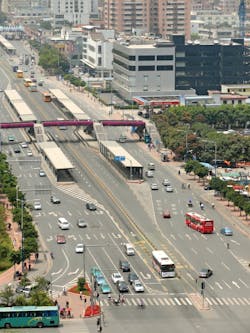
Guangzhou, China is a city about the size of New York and has three distinctive “downtown” areas. All of these downtowns are connected by one main six lane corridor that had become “hopelessly congested,” Bench says.
“A lot of the congestion oddly enough was being caused by buses at intersections because there is substantial demand for public transit in Guangzhou. They do have a rapid transit network but it’s still growing; it’s not as big as they’d like it quite yet,” Bench says. “What they ended up with was actually horrible congestion, but a lot of it at these intersections was caused by literally eight, 10, 15 buses all trying to stop at the same bus stop. So they’d be sort of effectively double, triple, quadruple parked and then kind of cutting off all of the vehicle flow of automobiles and other buses along the corridor. It was just getting to the point of gridlock.”
To solve the congestion issue, Guangzhou completely redesigned the whole corridor. “So it’s that same concept of going in and saying, OK we’re not just building a bus rapid transit line right now, but we’re figuring out how to turn this into a working corridor for all the different modal uses that are necessary along there: bikes, cars, buses,” Bench says.
The new corridor now features dedicated pedestrian sidewalk, bike lane, a couple lanes for case and two lanes for buses at each of the station locations, allowing for buses to pass each other. The demand in the corridor is so high, that Bench says the effective headway at peak periods is 10 seconds.
“It’s mindboggling. Every 10 seconds a bus is coming along,” he says.
The BRT line is 14 miles long and has six stations along the way. Each station consists of three platforms that can each accommodate three buses. So, a total of nine buses can be berthed at the station at the same time. Guangzhou uses a direct service model, meaning most of the service along the bus rapid transit line is being provided by local buses that come on and off the BRT line.
“What it ends up being able to accomplish is one you have very high frequencies anywhere along the rapid transit line because there are all these local buses feeding into it and going along for two or three stations or eight stations or 20 stations, but you’re also able to facilitate these fare-free transfers, these seamless transfers between local bus routes instead of having these buses go to a transfer center where they all pull up and dock and everybody gets off and goes and gets on another bus and you have to time the transfers,” Bench says.
Each station has fare gates, allowing for seamless transfers once a passenger is inside the fare prepaid area, Bench explains. “So you don’t have to pay again you just get on and off at whatever line you need to transfer to or if you are just transferring to go farther along the bus rapid transit line, no problem. So that’s how they end up with this very high frequency and also the seamless service and it’s just an amazing kind of symphony to watch all this occur,” he says.
“That was just awesome. I know that sounds very casual to say but I don’t know how else to describe that system. It was just phenomenal. All of us were standing in awe watching what was happening there,” Bench says.
About the Author