Do your riders link up to your system via another system in the area? After they get off your system is their journey done, or are they getting on another system? If your answer was yes to either of these questions, a regional fare card system might make sense for you and the other agencies in your region. However, it’s not something you can just jump right into. Careful planning and coordinating are a must.
Neil Poling, a senior project manager with CH2M Hill, advices that the first thing transit agencies need to do is decide on what technology they want to use. This is one of the tougher decisions, he warns.
“By that I mean everything from magnetic cards, smart cards; they want to consider if they want to go with some of the future technologies like AFC (Automatic Fare Collection) and open payment systems. The first thing is you need to decide on the technology,” he says. “It’s probably an important thing to point out in this article that the technology is always shifting.”
The other important decision that should be made early in the process is what sort of payment structure and fare policy will be used. “They have to decide what sort of payment structure, fare policy they want, whether they want to be a proof of payment system or if they want to be a gated system, if they want distance-based fares. They need to decide their fare policy up front because much of the design is based on fare policy. I think a lot of times transit agencies do that backwards,” Poling says.
Warns Poling: “Policy is a very political process that happens in boardrooms and if you’re not careful you’ll back yourself into the wrong corner with a technology or by the wrong technology based on your fare policy. I would say upfront decided your fare policy; then decide your technology.”
San Francisco Bay Area Clipper Card
The Clipper Card has been in use in the San Francisco Bay Area for about 18 months and serves seven agencies: San Francisco, which is the No. 1 operator in the area, Bay Area Rapid Transit (BART), AC Transit, Valley Transportation Authority (VTA), CalTrain, Golden Gate Transit and Ferry and SamTrans, which just became available in January 2012. There are a total of 28 transit agencies serving the nine-county region. However, the seven agencies on the Clipper system serve 95 percent of the transit riders in the region, according to John Goodwin, public information officer for the Metropolitan Transit Commission. He says the other 21 agencies are small suburban systems.
Prior to Clipper there was Translink, which started off as a six-month pilot serving six agencies. “In the pilot phase in the early 2000s, it was available for about 3,500 to 4000 customers, select routes, select stations, six of the biggest operators in the bay area,” explains Goodwin.
“It was enormously successful. The small number of people that participated really loved it in limited application and consequently the operators approved a region-wide rollout. OK, we’re going to do this thing. That’s where it became difficult.”
Following the great success of the pilot, Goodwin says there was a great deal of enthusiasm among all the operators to roll out the regional fare program across their entire fleets and eventually expanding to the smaller suburban operators. That decision was made in 2002, but then full roll out for the first two operators – Golden Gate Transit and AC Transit – didn’t happen until November 2006.
While the Clipper Card is working and has been a success, Goodwin says it wasn’t an easy. A big challenge was that the decision was made to incorporate all existing fare structures across all the systems.
“So we have 28 different operators, each with its own fare policy, its own eligibility requirements for discounts, some have a flat fare, some have a distance-based fare, some have a hybrid of the two, and the operators had asked MTC as the manger of the program that the system be developed in such a way that it incorporate all of their fare policies,” Goodwin says.
He says there are a seemingly limitless number of fare combinations a rider could have as he moves from one system to another. A business rule had to be written into the software to accommodate all these different possible combinations. This “proved to be an enormous challenge for bringing the system to where we are now, where it’s in place with the seven transit operators.”
Goodwin says if they had the opportunity to go back in time and change anything, it would be how they handled the fare policy.
“That was an opportunity to establish some regional fare policies and we failed to take advantage of that opportunity. Every last detail of the existing fare policies was accommodated rather than establishing some regional policies. It is still the same case today. Fare policy is made by the individual fare operators,” he explains.
Informing the Public
MTC along with the various agencies and the Clipper contractor, Cubic Transportation Systems Ltd., put together outreach teams that went out to different stations and stops to help educate their passengers about the new system.
“Wherever there areas with lots of transit riders we had teams whether that involved Cubic staff, MTC staff, transit agency staff, sometimes it’s all three working together to make sure you’re able to do outreach, particularly to the non-English speaking community.”
Goodwin says it was particularly important to include outreach in Chinese, Spanish and Vietnamese, as the area has large Chinese and Spanish speaking populations, and to a less degree Vietnamese too.
“I think the importance of outreach to all members of the community not just the commuters, the regular Monday through Friday go to one destination and then go back home in the evening. Outreach to all members of the community, making sure you have recourses where the riders are. Elderly Chinese folks, young Spanish speaking kids, high school students. Transit plays a real big role in the bay area as a transport for school. It is the school bus for thousands of kids and high school kids in particular all around the region. We worked really hard to cover the youth base, senior citizen base, non English speaking base and I think that those efforts have been born out in the tremendous acceptance that Clipper has had.”
Poling says that outreach is one area that many agencies under estimate how important it is. “You should probably begin at least a year ahead that something is coming. You’re going to be tearing up – in the case of a rail installation – you’re going to be tearing up those stations,” he says. “There’s going to be physical changes to a rail station. Customers will encounter new fare boxes on buses, a new way to pay. It doesn’t have to be an expensive marketing campaign, but if you start at least a year in advance that something is coming or maybe even use that to their advantage or spin it positively because you can tell folks things are getting better. Typically agencies wait too long to buy fare collection equipment and it’s falling apart, so even though you’re going to disrupt people you can tell them things are getting better.”
Southern Florida
In Florida, the EASY Card is helping transit riders transfer between Miami-Dade Transit’s Metrorail and Metrobus and South Florida RTA’s Tri-Rail. MDT introduced the EASY Card in October 2009, and in January 2011 SFRTA introduces it into their system. A monthly Regional Monthly Pass allows travelers to seamlessly travel between the two systems.
In Miami, the EASY Card was introduced in phases to help passengers with transition. “The EASY Card was implemented in phases to minimize disruption to passengers during the transition. Phase I consisted of brand design, development of a sales outlet network, employee training and a “Coming Soon” customer informational campaign. Phase II, the full-system implementation, consisted of the extensive marketing and outreach effort mentioned above. The phased-in implementation allowed for system testing addressing any potential glitches,” says Karla Damian, information officer, Miami-Dade Transit.
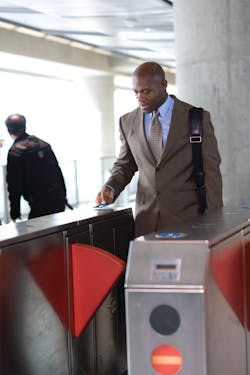
The EASY Card system consists of the EASY Card and the EASY Ticket. “The EASY Card is a durable, reloadable plastic card, which can be used for up to three years and has an initial cost of $2. Riders can also opt to us e a paper-based EASY Ticket (no initial charge for the ticket), which can be used up to 60 days but has less flexibility (fare-paying options) than the EASY Card. To ride on MDT buses and trains, passengers simply tap their loaded card or ticket on a bus fare box or Metrorail fare gate,” explains Damian.
It was SFRTA that reached out to MDT about creating a regional system, says Renee Matthews,
director of special projects for SFRTA. “We reached out to Miami-Dade following our research and procurement process to determine whether or not they’d be willing to cooperate in developing this regional system. They were and then we held a series of meetings and came to an agreement. We entered into an agreement between Tri-Rail and Miami-Dade Transportation, which we call the participation agreement which pretty much acknowledges the responsibilities Miami-Dade and SFRTA have between them.”
For in the back office system is administered by Miami-Dade and the two agencies have a shared customer service center, Matthews says.
Informing the Public
MDT launched an extensive marketing campaign to inform riders of how the new fare collection system worked. The campaign included radio and television promotion, a comprehensive print media campaign in three languages (English, Spanish and Creole), community outreach meetings and interior and exterior bus and rail advertising, explains Damian.
“The community outreach and passenger education campaign assigned 275 MDT employees from all divisions to distribute and provide instructional information at all 22 Metrorail stations, between June 2009 and August 2009. Miami-Dade Transit also partnered with the youth volunteer program City Year to distribute EASY Card brochures at all major Metrobus passenger transfer locations,” Damian says.
Matthews says community outreach turned out to be one of the hardest parts of the whole project
“The first thing we did on the very first day of the full system launch is we had a customer education campaign put together out on the station platforms. We actually staffed all of our stations with people who could support new passengers, or passengers using the new system and take the time to explain what an EASY Card is, you still get your paper ticket, walk them through how to use the machine,” Matthews says.
Converting the public to the new system wasn’t an easy task for SFRTA. “I would say initially there was certainly a reluctance to change. That would be fair. Very reluctant to take the time to learn how to use a new card. They were completely ok with the paper ticket, they understood the system,” Matthews says. “When we introduced a new card, the name of it is EASY Card, but our fare structure is fairly comprehensive. So it took awhile for the customers to get comfortable using the card. Even a year later we’re still kind of struggling with educating the public on how to use the card. There was definitely a reluctance to change from the customer.”
Thus far, Matthews says the regional fare between SFRTA and MDT is going well. However, the system does not yet work with Broward County Transit and Palm Trans Buses. “So that was a little bit of a stumbling block for us. We initiated a change to our machines whereas the machine you can use your Easy Card to have a bus transfer ticket issued,” Matthews says.
However, Matthews says there is currently a project underway being headed by the Florida Department of Transportation to study what it would resources and technology would be needed to equip their buses to also accept the EASY Card.
Agency Advice
Matthews offers this bit of advice for other agencies exploring regional fare cards: My advice would be to bring in your partners early. Don’t think of it as a one agency project unless of course you don’t have any connecting services what so ever. If you have any connecting services, I would say the first thing you need to do is partner up and come to some agreements on having a combined system early on.”
Damian says: “Miami-Dade Transit attributes much the success of its EASY Card system implementation to the fact that MDT had full control of the project, as well as direct contact with the contractor. Miami-Dade Transit’s recommendation to other agencies trying to implement their own automated-fare collection system is to form strong a partnership with their contractor, so that the agency and contractor can both work toward the common goal of achieving a fast and successful implementation.”
Goodwin advices regions with multiple transit operators to establish a streamlined regional fare policy that will limit the number of possible fare combinations. “It will make the whole system work so much more efficiently, so much easier and be much more customer friendly. That is the No. 1 lesson that we’ve learned.”
His other piece of advice is to make sure you reach out to all members of the community, not just your regular weekday commuters.
It’s also important to remember that this is not a project that is going to come together over night. A great deal of planning and coordination is necessary. Just how long it will take really depends on the size of the system, Poling says. However, “The very best an agency can plan for if they’re going to a smart card system or one of the new technologies, two years at the very best.”
About the Author
 Kim Kaiser