It takes a certain situation to make a design, build, operate and maintain (DBOM) public-private partnerships an option, and in the United States that can often be easier said than done.
Arthur Guzzetti, vice president of policy for the American Public Transportation Association (APTA) says that while DBOM public-private partnerships are good, they are not necessarily always good in all cases. “First, there is complexity and second they’re not always the right answer. So we can’t assume these are always the right way to do things; that’s not the case. Three you need the right legal framework, and many cases the procurement laws and not that they are for good reasons or bad reasons but sometimes the laws just need to catch up to the times,” he says.
According to the Federal Transit Administration, A Public-Private Partnership Pilot Program was authorized in the 2005 Highway and Transit bill (SAFETEA-LU) to demonstrate the advantages and disadvantages of P3's in public transportation. Three pilot projects were selected—Oakland Airport Connector, Houston Metro Light Rail, and the Denver RTD Eagle P3 project.
Guzzetti explains that one reason that these projects are perhaps less common in the United States than they are in say Europe is because sometimes procurement laws don’t allow them for public contracts.
“It’s lumping all these things together into one contract, that’s a mega deal, right? That’s a mega deal and some people might say, ‘why don’t we break this up a little bit into this stage and that stage?’ ” he says.
On the other hand Guzzetti says others look at a public-private partnership deal and say, “let’s just get government out of the way.” That, he says, is wrong and wrong for many reasons. There are two main reasons government can’t be completely eliminated from the equation. If the project is dealing with a public policy objective, like transportation, government needs to be part of it for policy oversight and to ensure the intent of the project is being achieved, Guzzetti explains.
“So the government has to be part of it. I think sometimes people say let’s get government out of the way and it’s rhetoric, ideological,” he says.
The second reason is the government needs to be part of the revenue stream. “This isn’t benevolence that’s brining the private sector into the equation. They see an opportunity,” Guzzetti says. “But, you need a revenue stream. You can’t, the private sector isn’t going to just come in and do it and pay for it.”
While the private sector isn’t going to just take on a public project and pay for the whole thing, it will bring its expertise to the table and can share in the risk.
Says Guzzetti: “The government is at risk for the price tag, but we’re going to put our neck on the line too and we’re going to be taking risks and we’re going to be accountable for the results. So if they want to share that risk, there will be a reward at the end if it’s done right, but there will be a risk if not everything goes right. So they can help share the risk, they can help bring management expertise to the table and, but then in return for that they get a revenue stream.”
Finding the Right Fit
Then what makes the ideal situation for a DBOM public-private partnership project to work for a transit agency? First, Guzzetti says you have to be willing to and understand that you will have to put up some sort of revenue stream to support the project. The revenue stream is what piques the private sector’s interest. “It absolutely won’t work without that, he says.
However, Guzzetti warns that fare box revenue alone won’t be able to support a project in most cases.
The project also will have to be segmented from the rest of the transit system.
“If you have a line that just blends into your system that is going to be very hard. You want to separate the accounting of this new line that the private sector is going to take on and the private sector is going to take the risks on, you can’t just have it mixed in with everything else,” Guzzetti explains. “It has to be separated and distinct. You’ve got to be able to distinguish what’s this project vs. what’s the rest of the system. So that’s another condition.”
Finally, there has to be a condition of the project that the private sector is doing something that the public sector can’t do as well on its own. That could be managerial expertise or previous project experience.
What makes DBOM public-private partnerships – and all public-private partnerships for that matter - a bit trickier in the United States is having to navigate through not only federal laws but state laws as well.
Guzzetti says: “In addition to these federal laws, there are state laws on contracts, how you can procurement laws and how you can do that. And rightfully, government…there are a lot of procurement scandals across the country so you do need to have procurement laws that protect the public interest and provide procedural process for the private sector to seek government contracts. You need that. But then, different states have different laws, so maybe there are some states that are more open to these creative procurement uses, and some states are more restrictive on it.”
Currently APTA is working on a project looking at all the states and their procurement laws to determine where public-private partnerships are plausible and where they are not. “The question came up, how we can promote it on the federal level if the state doesn’t allow it, don’t we have a problem there?” he says.
The FTA has no formal assistance program to help transit agencies with public-private partnerships, but has held a number of workshops on the topic.
According to the FTA, the Denver RTD Eagle P3 project is a great example of successful public private partnerships because of recent spirals in the economy this project sustained itself. Transit agencies should use this example of an innovative finance project that uses a P3 procurement, private activity bonds, and a TIFIA loan for financing.
The Eagle P3 Partnership
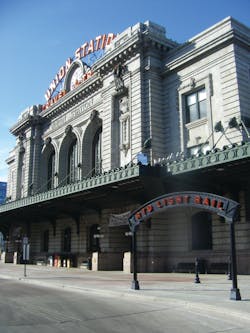
The biggest project on the Denver's Regional Transportation District (RTD) FasTracks expansion is the Eagle P3 project; the east corridor into Denver International Airport (DIA), the Gold Line to Wheat Ridgeland Arvada, and segment 1 of the Northwest Rail Line. Bill Van Meter, FasTracks Team assistant general manager Planning Department says, “This was, as far as our research could tell, the first transit public-private partnership in the country.”
The project is being delivered and operated under a concession agreement. The concessionaire selected through a bid process is Denver Transit Partners (DTP), which includes Fluor Enterprises, Uberior Investments and Laing Investments. Other firms involved include Ames Construction, Balfour Beatty Rail, Hyundai-Rotem USA, Alternative Concepts Inc., Fluor/HDR Global Design Consultants, PBS&J, Parsons Brinckerhoff, Interfleet Technology, Systra and Wabtec.
DTP will design-build-finance-operate-maintain (DBFOM) these lines over a 34-year period, the total contract length. “That’s very unique and very successful to date,” Van Meter says. “The bid came in well under our budget.
“I think because these concessionaires to bid on the job, they really have skin in the game.” He states, “If they don’t meet defined metrics on operating performance, they can be penalized by up to 25 percent of the availability payments, so it’s in their interest to build this line and operate it to a very high level.”
WHY PPP?
The public-private partnership route was a financial strategy to get projects underway. But at this point, Van Meter says, “The more we got into it, we just felt it was a good procurement process and we get a lot of innovation and risk-sharing with the private sector.” He adds, “We’re pretty pleased with how it’s turning out."
Phil Washington, RTD general manager, stresses, “You’re moving the project forward sooner than you would be able to without this private sector financial involvement.”
He calls it the three-legged financing stool and says he thinks it’s the process that’s going to be used in this country for megaprojects.
“This three-legged financing stool is the private sector with that one leg of that stool, the private stool, the private sector funding – in our case to the tune of about $486 million,” Washington says. “Then you add the local investment, ie sales tax to the tune of about $500 million and then you add the federal involvement of the 1.03 billion full funding grant agreement.
“It takes all three to do these multi-billion dollar projects of infrastructure, whether it’s rebuilding or building it out, you’re going to need all three.”
And to people that say there shouldn’t be any federal involvement? “No, there has to be,” Washington says. “There’s always been federal involvement, whether you’re talking about the building of the Trans-Continental Railroad, the Erie Canal, the Interstate Highway System; there’s always been these public-private partnerships out there.
“So we preach that we’ve got this three-legged stool and we needed all three to get it done.”
LESSONS LEARNED
It didn’t come without its share of challenges. RTD recently published a “lessons learned” report for the procurement. “A lot of those challenges are defined in there,” Van Meter says.
One of the lessons learned was to have very high-level support before you get into it because of the tough decisions along the way.
“Our board of directors had to make some tough decisions and they stood up for it,” says Van Meter. “These companies, they’re risking a lot of their company and a lot of their money based on this, so they want to make sure there are good financial guarantees from the agency to go through with it, that we’re not going to pull the plug at some later time. Those all involve some major decisions that we had to get our board to buy into.
Washington says it’s important with a PPP, to understand the allocation of risk between the public agency and the concessionaire. “Understand how to put together the risk allocation matrix,” he explains. “Who takes on what risk; who takes on the risk of the ridership; who takes on the fare risk? Put these risks in some type of matrix and decide who does what and how you cross those things out.
“That was a big one for us in terms of this procurement,” he stresses.
Another piece of advice he offers is the need for confidentiality when going through these procurements. “I’m still amazed that we can have 120 that was on the evaluation team for our Eagle P3 and still maintained this code of silence or military silence I call it,” Washington says. “That’s still amazing to me.”
A Detailed Process
FasTracks Team Senior Manager, TOD and Planning Coordination Bill Sirois says that after the award was made, both teams complimented them on the process because of the fact that RTD set a schedule and most importantly, stuck to it. “We were able to take a little bit more time at the front end and then kind of got our ducks in a row.” He also said that allowed them to make some big decisions from a scheduling standpoint. “I think that was a real important piece of why we were successful.”
And with such a huge project – at $2.1 billion – there are a lot of eyes on RTD. And there were a lot of people that didn’t think they were going to pull it off, especially during this tough economy. “They thought these funding partners will never stay in the mix and what have you, and you know what? We pulled it off,” says Pauletta Tonilas, RTD FasTracks public information officer. “There have been people amazed over this thing.
“With FasTracks and now again with this Eagle P3 Project, we have really been trailblazers, really set the foundation for what others are learning.” She adds, “We’re pretty proud of this particular effort.”
It was a 4-year process and some 3,500 documents to get to this partnership accomplished. And during that time it is important to keep the board of directors informed, engaged in making decisions to keep the process going forward. One of the key ones that they had was a misalignment with the timing of our procurement for the whole project, keeping those concessionaires on schedule versus the timeline for the full-funding grant agreement.
It was apparent as they were moving through the procurement they were not going to get the full-funding grant agreement until potentially a year or more after the end of the procumrent process. They recognized they risked losing the competition of the concessionaire teams that were bidding on the project if they didn't have a way to move something forward in advance of the full-funding grant agreement.
The board of directors approved construction with the local match funds along the East Corridor, which essentially put the Gold Line and the Northwest Corridors at risk until they got that full-funding grant agreement.
At the same time, they had to convince the Federal Transit Administration (FTA) that they would be able to use the funds that they were using on the East Corridor in advance of the full-funding grant agreement as a match to their federal grant. They were able to pull all of that off and to move forward and get the grant, which allowed them to proceed to have a groundbreaking on August 31 of last year.
Also key to the program and to moving the cash flow forward was a TIFIA loan for $218 million on December 2, 2011. They got two loans for the project, one for Denver Union Station and one for this Eagle P3 Project. The terms, the financing rates, TIFIA really helped the cash flow and to give them insurance that they will be on schedule and on budget with the finances.
Getting Projects Going
With the bids for the Eagle P3 Project coming in $300 million below the estimate, Van Meter says they’ve decided to use that money available primarily to fund construction on the FasTracks program. “It’s pretty exciting because we’re getting some corridors started that were previously totally underfunded and now we’re getting some work going.”
The three biggest projects it’s going toward are the US 36, the North Metro corridor and the I-225 project.
For the US36 project, they are partners with the Colorado Department of Transportation (CDOT) on a managed lane project, which is the main highway between Denver and Boulder. “They’re doing this managed lane project where we’re financial participants,” Van Meter says. “We’re given $90 million on top of the $30 million we were already given and they have a procurement out for a public-private partnership to build and operate these managed lanes and, obviously, our buses. We will be able to use those managed lanes with a lot of time savings.”
About the Author
 Kim Kaiser