RTD: A Willing Partner
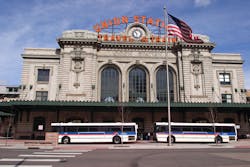
When I went out to visit the Denver Regional Transportation District (RTD), it was a quick-and-easy 22.8-mile commuter rail ride into Union Station, right down the street from RTD … oh wait, no, not yet. While on this trip I actually took SkyRide, a commuter bus service RTD provides to and from Denver International Airport, in a few years, the East Rail Line will connect people from the airport to downtown Denver.
The East Rail Line is just one part of the RTD FasTracks project. FasTracks is a multi-billion dollar expansion plan that includes 122 miles of commuter rail and light rail and 18 miles of BRT; a plan with a 0.4 percent voter-approved sales tax increase, passed in 2004.
RTD General Manager Phil Washington says finding partners and the employees’ innovation and willingness to step out of the box and do things that are not common in the industry are really how they’ve been able to push everything forward.
“We have gone out and really cobbled together some interesting financial funding tools to build our program,” he says. Working with more than just the usual suspects for partnerships is what’s helping RTD get infrastructure built in the region.
Getting FasTracks on Track
When it comes to partnering, the regional cooperation it took to get FasTracks where it is today was no small task. Pauletta Tonilas, RTD FasTracks public information officer, says, “Folks in a lot of cities can’t imagine their mayors all ending up on the same page and we had unanimous support from all the mayors in the metro area.” She continues, “They were all out there vigorously supporting and campaigning for FasTracks back in 2004 and that’s kind of an unprecedented thing.”
That level of support, however, was rooted in the failure of the 1997 “Guide the Ride” initiative. Guide the Ride was taken to the voters for a similar plan, 0.4 percent, and it failed. “Miserably,” Bill Van Meter, FasTracks Team assistant general manager Planning Department, states.
“As a result of that, we went back to each corridor and did planning studies, major investment studies where we much better defined our plans and commitments for each of the corridors.” He continues, “We worked with the citizens and the elected officials, defining those plans, getting reliable cost estimates and really getting a better understanding of what our commitment was in each of these corridors so when we came back in 2004, the mayors and their staffs and the citizens have been a part of the process of figuring out what the improvements were going to be in their corridor now.”
In 2004, the 0.4 percent sales tax increase passed 58 to 42, the exact opposite of what RTD lost by in the Guide the Ride.
There are about 48 miles of rail that’s currently in construction and committed to start construction. All of the environmental impact statements and environmental analysis required for all of the corridors are completed, both those that are currently funded and those that are not committed to or are unfunded at this point. Committed and completed projects are more than $4 billion and there is a $2.6 billion gap.
The board will soon decide whether or not to move to an election to ask for a 0.4 percent sales tax increase next year to fund the entire program by 2020. Van Meter says, “If not, it still will be completed, we still have the revenues, but it will be 2042.”
PENTA P and Eagle P3
The biggest project of FasTracks is the Eagle P3 project; the east corridor into Denver International Airport (DIA), the Gold Line to Wheat Ridgeland Arvada, and segment 1 of the Northwest Rail Line. Van Meter says, “This was, as far as our research could tell, the first transit public-private partnership in the country.”
The project is being delivered and operated under a concession agreement. The concessionaire selected through a bid process is Denver Transit Partners (DTP), which includes Fluor Enterprises, Uberior Investments and Laing Investments. Other firms involved include Ames Construction, Balfour Beatty Rail, Hyundai-Rotem USA, Alternative Concepts Inc., Fluor/HDR Global Design Consultants, PBS&J, Parsons Brinckerhoff, Interfleet Technology, Systra and Wabtec.
DTP will design-build-finance-operate-maintain (DBFOM) these lines over a 34-year period, the total contract length. “That’s very unique and very successful to date,” Van Meter says. “The bid came in well under our budget. I think because these concessionaires to bid on the job, they really have skin in the game.”
The public-private partnership route was a financial strategy to get projects underway. But at this point, Van Meter says, “The more we got into it, we just felt it was a good procurement process and we get a lot of innovation and risk-sharing with the private sector.” He adds, “We’re pretty pleased with how it’s turning out.
Washington stresses, “You’re moving the project forward sooner than you would be able to without this private sector financial involvement.”
He calls it the three-legged financing stool and says he thinks it’s the process that’s going to be used in this country for megaprojects.
“This three-legged financing stool is the private sector with that one leg of that stool, the private stool, the private sector funding – in our case to the tune of about $486 million,” Washington says. “Then you add the local investment, ie sales tax to the tune of about $500 million and then you add the federal involvement of the 1.03 billion full funding grant agreement.
“It takes all three to do these multi-billion dollar projects of infrastructure, whether it’s rebuilding or building it out, you’re going to need all three.”
And to people that say there shouldn’t be any federal involvement? “No, there has to be,” Washington says. “There’s always been federal involvement, whether you’re talking about the building of the Trans-Continental Railroad, the Erie Canal, the Interstate Highway System; there’s always been these public private partnerships out there.
“So we preach that we’ve got this three-legged stool and we needed all three to get it done.”
One thing Washington says is important with a PPP, to understand the allocation of risk between the public agency and the concessionaire. “Understand how to put together the risk allocation matrix,” he explains. “Who takes on what risk; who takes on the risk of the ridership; who takes on the fare risk? Put these risks in some type of matrix and decide who does what and how you cross those things out.
“That was a big one for us in terms of this procurement,” he stresses.
With many more lessons learned, there will be an article focused on public-private partnerships and the Eagle P3 Project in the Mass Transit March issue.
Transit Means Jobs
I talked to a lot of RTD and FasTracks employees about the massive infrastructure projects underway and they, in turn, talked about all of the other jobs that are being created in the region. FasTracks West Corridor Construction Project public information officer with Denver Transit Construction Group (DTCG), Kathy Berumen stresses, “We have had a significant economic impact; we spend 250 million in local subcontractors. It’s been substantial.”
Washington says RTD has always had a pretty strong minority-owned, woman-owned, veteran-owned business program. “I think that our team took it to a new level,” he says.
“We know small businesses in this country hire the most people and so we advocate very aggressive goals on projects, that we have a very strong compliance piece that says to a prime, ‘Hey look, when you bring a small business on to a project, we’re going to bring your feet to the fire to give them meaningful work and do what you say you’re going to do. You’re not going to be putting small businesses on a project just to get the bid and then six months later you kick them off, you have to come to us.’”
And to do this, it also means training your project managers, Washington says. Project managers are trained in the DBE, small-business area and they are encouraged to unbundle packages. There is also a goal on everybody’s performance appraisal, a small business goal. When these goals are tied to money, like being tied to an employee’s performance appraisal, Washington says, “You’ll be surprised how folks start looking at the program differently.”
Berumen, with DTCG, a Herzog Contracting Corp. – Stacy and Witbeck Inc. Joint Venture, says they have a trucking consortium so any guy that owns a truck can join, whether they own one or 10. “It’s a lottery so you could get as much work as a big company.”
Once the company has certification through RTD, it can join the consortium and Berumen says, it’s been a huge boost for people to grow their company and capacity to do future work.
“One of the local TV stations did a story on one of the truckers that started out with one truck when he started in the consortium and now he has three trucks and he’s working on the Eagle Project,” she says. “It’s so exciting. He would have never been able to do that if someone didn’t help him and teach him. It just changed his life and he appreciates it.”
DTCG set a goal of 18 percent for small businesses, Berumen says, and that translates to close to $79 million in work. “And we will be over.” She continues, “That’s the first corridor that’s being built and that gets them ready to be a part of the rest.”
Building the Workforce
“My thought is, the economy of our country is being restructured; we go through this every now and then,” Washington says, explaining his perspective on our evolving economy. “In the 50s we had the Interstate Highway System; we built that … and it made jobs. In the 60s it was space exploration. We had to get on the moon; it created jobs. The economy restructured itself to chase that.
“In the 70s, 80s it was probably home ownership; we were going to build a whole bunch of homes, everybody’s got to own a home. And, that’s probably why we’re in some of the problems we’re in now. Then we had the big dot com thing. We’ve got to chase that.”
He continues, “I don’t know if people agree with me, but I believe we are in another phase of restructuring our economy and it’s called rebuilding or building our infrastructure.
“We’ve got bridges falling down, we’ve got highways messed up, our transit agencies, especially the ones back East, aging unbelievably with the equipment and all of that. And, at the same time, we have high unemployment.” He stresses, “There’s an intersection between the need to rebuild our infrastructure and need to create jobs.”
What they’ve done at RTD is to trumpet that intersection and to say that everything that goes out the door at RTD with regard to its projects and the pursuit of federal funding, has Workforce Initiative (WIN) program language in it. They’re building infrastructure and at the same time, training folks to get good jobs.
When Washington talks about partnerships, one of the areas they’ve looked at is the training partners in the community, community colleges in Denver. “We will ask our training partners in the community to train some of these people in the work skills that we need,” Washington says. “We have made a conscious effort to link that jobs piece to our infrastructure build-out and as a result of that, we were successful in getting almost half a million dollars for our workforce program from the Federal Transit Administration late last year.”
Washington says they wanted to build a partner program with the community colleges of Denver, 34 training providers that are mostly small businesses or not-for-profits, RTD and the Denver Transit Partners, who are building the Eagle P3 Project.
“This program is open to anybody, but we are really focusing on the communities that are located along the alignment that we are building which are the most impoverished zip codes in this area,” Washington says. “What we’re saying is look, we’re building an infrastructure project through your community, we want you to be a part of this.
“If you come to the table and you don’t have a high school diploma, then one of our partners, in this case, community colleges of Denver, will get you your GED; you’ve got to go there first.”
After that, they will assess their skills and what they like to do and send them to training, including the soft skills, such as interviewing.
“Then the contractor that’s building the project, they have committed to a certain percentage of the jobs for the project and they’re going to put you to work,” says Washington.
It’s a new initiative and they’ve already got some people through the training and on the job, the first having started in December.
RTD has done some baselining of various factors in the zip codes identified in the corridor, including the crime rate, the foreclosure rate, the unemployment rate and the education level. “As we lay this program down in those areas, we want to see what impact this program has in those factors,” Washington explains. “That allows us to go to the police department here in Denver or the justice department saying, ‘You know what? The crime rate has gone down in this area as a result, we believe, in this program we have. We need some grant money.’”
He adds, “Every FasTracks Project has language in the package, this commitment requiring of the contractors that get this work, we’re asking them to commit a certain percentage of the jobs they will have to this program.” He says, “We just did a Union Station deal so folks are coming to the table and they’re saying, OK, we know you want this, you’re making it a requirement, so we’re going to have to do it.”
At the FTA funding signing they held on August 31, he says, “I turned to the DOT Secretary Ray LaHood and said we want this in very federal project document so in other words, if you’re chasing federal money, there should be some type of program like this that is a requirement at the federal level.”
MAX: Staff Training
While helping train people in the community to get jobs, RTD is working with a couple of other transit agencies to better train their own team. Washington says MAX (multi-agency exchange) started as a conversation at a conference.
Log Angeles County Metropolitan Transportation Authority (Metro) Chief Executive Officer Art Leahy, Dallas Area Rapid Transit (DART) President/Executive Director Gary Thomas and Washington were thinking about having agencies that were having similar capital expansion programs to have 8 or 9 people from each agency, visit with the other agencies for a training-type program.
Each agency assigned the point people from their respective agency and then each of the three agencies went through a nomination process and some interviews to pick the individuals.
“We said that we would make the trips three times during the year and I volunteered to host the first one,” Washington says. “We put together a curriculum of what we wanted to cover, the areas we wanted to cover, the idea being Transit Economics 101: looking at project management, bus operations, security, labor relations, all of these things.”
The groups from Metro and DART came out to RTD for about a week in August and Washington says it was a great success and the next scheduled visit is LA in February.
After a year of the program they agreed to evaluate the program, with the idea being to look at if they continue the program and if they add another agency to the program.
Challenges for RTD
When Washington talks about the challenges facing the RTD, it’s a lot of what we’ve been hearing across the country: funding, training the next generation and aging equipment.
With all the technology out there, how do you manage it and how do you use it? Washington says, “My IT guys get ticked off at me all the time because they come and they say, hey look, we need this, we need that … a lot of times it turns out to be more ornaments on the tree.
“I always say wait a minute, tell me how much of the current system’s capability you’re actually using. I give the example of the TV remote,” he says. “The TV remote, you probably use maybe 2 or 3 features on that frickin’ thing: channels, volume, on-off switch, but there’s probably a hundred different features on that remote. That’s technology.
“That’s the same thing we’re dealing with,” he says. “Wait a minute, we just got a big new system, tell me what is the percentage of the capability of that system we’re using? Are we at 20 percent? Forty percent? That’s a tough question.”
All About Partnering
Throughout his interview, Washington stresses the willingness to partner as key to the successes RTD has seen. “There could be a resistance in some areas to partner with the private sector,” Washington says. “I’ve heard people say, well you know we’re a public agency and we’re not going to do this.” And to that he says, “You know, you partner with who you can partner with to invest in the infrastructure, building or rebuilding of this valuable infrastructure.
“We’ve partnered with so many folks,” he says. “Not just on the Eagle P3 side, but when you talk about transit-oriented communities, transit-oriented development, we’re partnering with developers. In our workforce development program we’re partnering with our community colleges of Denver, the Denver Urban League, the various training providers to train people to do work in the transportation industry.
“Don’t be afraid to partner with – and I don’t mean this in a bad way – unusual suspects.”