Emergency Preparedness Training
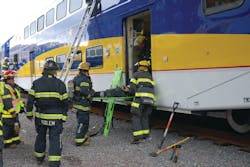
Disasters and emergencies can happen anywhere, at any time. Over the past two years alone, more than 130 presidential disaster declarations have been issued covering 45 states and territories. No public or private entity is immune to disasters, and no single segment of society can meet the complex needs of a major emergency or disaster on its own. When disaster strikes, the community is clearly divided into only two entities: those who need help and those who can provide help.
In early 2007 the National Transit Institute (NTI), with funding provided by the Federal Transit Administration (FTA) and the Department of Homeland Security (DHS), began offering a two-day emergency preparedness workshop called “Connecting Communities.” Since that time, the workshop has been delivered in more than 30 cities nationwide, including Washington, D.C., Boston, Providence, R.I., Newark, Richmond, Va., Atlanta, Raleigh, N.C., Orlando, Tampa, Fla., Columbus, Ohio, Cleveland, Chicago, Dallas, Houston, Phoenix, Las Vegas, Minneapolis, Milwaukee, St. Louis, Seattle, Portland, San Francisco, Los Angeles and San Diego.
The workshop features a unique blend of participants and facilitators. The participants include representatives of local law enforcement, fire service, local emergency management, emergency medical services and public and private transit agencies. In many instances, private entities such as Walt Disney World participate as well. The facilitators possess professional backgrounds in law enforcement, fire service and public transportation. Class sizes usually range from 30 to 40 participants.
The primary goal of the workshop is to illustrate how professionals in the emergency services of police, fire, emergency management and public transportation can partner, collaborate and share resources and operational plans to minimize the loss of life and damage to property and ultimately to stabilize the incident.
The workshop focuses on teaching emergency services and public transit each other’s respective capabilities, expertise and contributions during emergency incidents. Also key are the types of resources and services each agency can bring to the table, resulting in an effective multi-discipline response. Connecting the communities of emergency services and public transit is the key concept of the workshop; each agency contributes in its unique way. Emergency situations requiring a multi-agency response have happened before and will happen again. We must recognize the reality that such events happen and how a coordinated multi-agency response can mean the difference between success and failure.
Emergency Management
Participants in the workshop are introduced to the fundamental principles of emergency management. Emergency management is a comprehensive, integrated program of preparedness, response, recovery and mitigation for emergencies and disasters of any kind. Emergency management establishes order and supplies resources to incidents exceeding the capability of single jurisdictions. No matter the scale of the incident, the local incident commander or unified command is in charge of the emergency impacting its area. Local responding agencies may request additional resources through the next layer of government. This could involve, for example, a county office of emergency management, should the need exceed the supply of local resources. Similarly, the county may request assistance from the state office of emergency management, and it in turn can request the assistance of the federal government.
Preparedness: In the preparedness phase of emergency management rings the old saying, “Hope for the best and prepare for the worst.” Preparation employs comprehensive planning to identify high-risk emergency situations in order to institute a response system and team to deal with the incident. During this phase a strong regional partnership must be established. Evaluation of available resources needs to take place in order to disseminate these resources effectively. The preparedness phase is where training, readiness exercises and drills are coordinated to educate responders so that they can practice working together. One of the key elements in preparedness for public transit agencies is designing evacuation plans. Public transit can play a vital role in emergency evacuation.
Response: Response includes mobilization of needed emergency services and first responders. Incident commanders on the scene assess the situation and call for the development of an incident action plan that identifies needed resources. This plan could incorporate a role for public transportation providers in meeting evacuation needs.
Recovery: Recovery includes helping those in immediate need of food, housing and medication. During this phase the clean-up process begins along with the rebuilding effort in order to return the affected areas as back to normal as possible.
Mitigation: Mitigation efforts attempt to prevent hazards from developing into disasters. Mitigation identifies likely hazards and their impact with the idea of moving community residents away from the hazardous area. This can be done through the use of building codes, or property zoning regulations away from flood plains as well as, at times, property acquisitions.
NIMS and ICS
The National Incident Management System (NIMS) was first conceived by the California Division of Forestry when responding to wildfires in southern California in the 1970s. It was initially created to establish consistent, standard terminology and to efficiently manage the expansion of wildfire incidents. Over the years, fire service agencies throughout the country have adopted the use of the incident command system and have used it and trained with it.
More recently, the first secretary of Homeland Security, Tom Ridge, defined NIMS this way: “… a consistent nationwide approach for federal, state, tribal and local governments to work effectively and efficiently together, to prepare for, prevent, respond to, and recover from domestic incidents, regardless of cause, size or complexity.” In 2003 Homeland Security Presidential Directive (HSPD-5) mandated the use of NIMS by all responding agencies. HSPD-5 also required the development of a National Response Plan (now called National Response Framework).
Participants in the “Connecting Communities” workshop review the fundamental principles of NIMS and the Incident Command System (ICS). These principles show that direct, effective command and control are essential at every type of incident. The key to success is to have a coordinated incident command structure in which all of the players integrate their resources to address the problem in a safe and effective manner. In simple terms — you need an ICS structure.
NIMS is a core set of doctrine, principles, terminology and organizational process that ensures effective, efficient and collaborative incident management at all levels. NIMS also provides a framework for interoperability and compatibility while striking a balance between flexibility and standardization. While most of the law enforcement, fire service and emergency participants in the workshop regularly use and are certified in NIMS, most public transportation providers are not familiar with the use of ICS or NIMS.
Public transit professionals are certainly encouraged to go to the FEMA website where they can become certified in ICS 100, 200, 700 and 800. Participants will come away from the workshop with a practical understanding of command structures, including unified command, command and general staff positions, as well as their duties and functions. Most importantly, public transportation providers — who could be a critical element and integral part of the incident response and recovery — will understand where they fit into command structure as well as to whom they report in the overall command of the incident.
Los Angeles 1992 Civil Disturbance
In April of 1992 riots broke out in Los Angeles following the Rodney King verdict. Watching Abrams tanks and armored personnel carriers patrol the streets near my office is a sight I will not forget. During the riots there was looting, assault, arson and murder. Tragically, 53 people lost their lives with thousands injured and billions of dollars in property damage.
The Southern California Rapid Transit District (SCRTD, now called LA Metro) was an integral part of the response to this incident. In those days SCRTD regularly participated in what was then called “disaster drills,” what we now call full-scale exercises. The disaster drill usually dealt with an earthquake hitting the Los Angeles area. The working relationships established during those disaster drills between police, fire, local emergency management and SCRTD personnel laid the groundwork for the efficient use of SCRTD resources during the riot.
SCRTD provided a significant number of resources to the incident. SCRTD relocated 150 buses from its Division 5 operating facility in South Central Los Angeles to other divisions in the system. Division 5 then became the LAPD’s command post and refuge for 4,500 responders. Also, SCRTD maintenance personnel fueled and repaired hundreds of response vehicles, including police cars, fire apparatus, National Guard trucks and Humvees, as well as many other assorted response vehicles. One hundred forty SCRTD buses transported responders to and from the riot areas, including county sheriff deputies, National Guardsmen and U.S. Marines. Clearly SCRTD had a major role in providing facility resources, fuel and skilled personnel to support the tactical response to the riot. Transit agencies across the country have continued to provide similar support during times of emergency, thus demonstrating their commitment to their respective communities
Tabletop Exercise
Tabletop exercises are invaluable tools for preparing responders and testing emergency plans, policies and procedures. Tabletop exercises expose weaknesses in planning and resource needs. Moreover, tabletop exercises train responders in their roles and responsibilities, improve responder coordination and communication, and develop effective teamwork.
The second day of the “Connecting Communities” workshop is largely devoted to a tabletop exercise. Workshop participants are divided up into four or five groups, each led by a facilitator/instructor. Each group is then given a different disaster scenario. The scenarios can include hurricane, tornado, terrorism, blackout, flooding, civil disturbance and hazardous materials release. The exercise is designed to test the theoretical ability of the group to respond to an incident.
Each group is asked to set up an incident command system for the response and recovery phases of their scenario. The facilitator/instructor assist the group in selecting someone to act as incident commander, public information officer, operations chief, transit agency coordinator and other relevant unified command staff, depending on the scenario involved. As the exercise proceeds at intervals of 15 to 20 minutes, scenario updates are given to the group that can expand or complicate the scenario, forcing modifications to the tactical response and unified command structure. At the end of the exercise each group presents an after-action report on how it established a command structure, its incident response priorities, and what hindrances occurred during the exercise and how they were overcome.
Following the after-action report, each group then manages the recovery phase of the scenario. The groups are dealt with the questions: Do the tactical objectives change? Is there a transfer of incident command? What resources are needed in the recovery phase? These and other questions are central to the recovery phase of the scenario.
The exercise demonstrates that no single agency can effectively manage a major emergency alone. A major incident is going to require the resources and expertise from many organizations and agencies. All responding organizations bring their own agendas to the emergency scene. Each of these agendas represents real, valid and significant concerns. Problems are often created, however, when there is no communication prior to the emergency and each organization feels that its specific agenda or interest is most important. Ultimately, the ability to mount a safe and effective response builds on what is accomplished during planning and preparedness activities. The real issue is not just communicating command — it is also coordination and cooperation.
Conclusions
From an emergency response perspective, there are two kinds of transit agencies: those that have lived through a crisis and those that will.
The “Connecting Communities” workshop provides an opportunity for agencies and stakeholders to become acquainted with one another, their interrelated roles and their respective responsibilities. We always begin the workshop by telling participants that one of the best things that can happen in the next two days is the exchange of business cards among them. Transit systems have a place at the emergency management planning table; transit systems can offer tremendous resources in times of emergency. Aside from just moving people, they can offer large facilities, large fuel storage, skilled repair personnel, evacuation planners and communications equipment.
Transit agencies must become full partners in local emergency planning efforts; this will ensure that transit becomes part of a designated emergency command structure. Furthermore, transit agencies are uniquely qualified to efficiently provide emergency service to people who lack mobility options.
Transit agencies may apply directly to FTA to sponsor this workshop at their agency. Also, Transit Security Grant Program (TGSP) funding or Urban Security Initiative (UASI) funding can be used to bring this workshop to your agency. If you would like more information about how to bring this Workshop to your transit system, contact the National Transit Institute.
Vince Pellegrin is the chief operating officer at Metro Transit in Minneapolis/St. Paul, Minn. and a senior instructor with the National Transit Institute, Rutgers University.