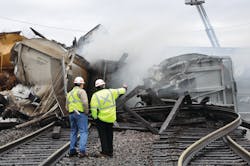
The scene was chaotic at 5:30 a.m. on November 3. A long CN freight train had derailed, right where the CN tracks cross the Metra Milwaukee West Line tracks near Bartlett, Ill. Freight rail cars were upended, flipped over and crunched, and some were on fire. Rails from several different sets of tracks were ripped up and twisted amid the derailed cars. The intersection was completely blocked by a smoking mass of debris, and service on the Milwaukee West was crippled, with seven of nine train sets caught on the wrong side of the accident in Metra's yard in Elgin.
And yet, less than 24 hours later, Metra trains were rolling out of the yard and through the intersection to begin serving the line's 12,000 passengers again.
To make that happen, a lot of hands pitched in – from Metra and from a variety of other agencies. Police and fire departments from Bartlett, Elgin and nearby communities quickly and effectively contained the scene and enabled the cleanup to proceed rapidly. Metra worked closely with CN to get the debris untangled and removed from the Metra right-of-way. Other state and federal agencies assisted.
But the accident presented some unique challenges for Metra, and it had to scramble to overcome them. First, Metra had to address the disruption of service and run whatever trains and buses it could. Metra had to plan for the resumption of at least partial service and keep its riders as informed as possible. And it had to decide the best way to restore at least one track through or past the accident scene – and since time was of the essence – begin preparations to do that before the debris was cleared.
The work began right after the derailment. Don Orseno, Metra's chief transportation officer, said he knew Metra had a major problem on its hands as soon as he heard the derailment happened at what is known as the Spaulding Crossing. That crossing is between the Milwaukee West's overnight storage yard in Elgin to the west and most of the rest of the line to the east. With that intersection blocked, Orseno knew that Metra would be unable to run most trains on the line.
In the early morning hours following the accident, key executive and media relations personnel put together a communications plan to try and provide all customers with Metra E-Alerts and Twitter information that would save them a trip to their station and allow them to immediately determine an alternate way to get to work that day.
Soon thereafter, Metra's top executives convened in its GPS conference room downtown, which serves as its emergency operations center. That group eventually included Alex Clifford, Metra CEO; George Hardwidge, deputy executive director; Orseno; Joe Lorenzini, chief engineering officer; Marty Ryan, chief mechanical officer; Sharon Austin, senior division director, Customer Affairs; James Sanford, Metra police chief; members of Metra's Web, media relations and customer communications teams and others.
The first priority for Metra was to do what it could do to serve riders of the Milwaukee West, and the main responsibility for determining that fell to Pete Zwolfer, the senior director who oversees the lines out of Union Station, and Rich Oppenheim, the trainmaster for the district. Metra did have two trains that made it through the intersection before the accident and it borrowed another train from another line. For Thursday morning's rush, Metra used those trains to operate very limited service between Bartlett and Chicago. It also set up buses to get riders from the last three stops of line in Elgin to Bartlett.
Metra used its E-Alerts and Twitter to inform riders about the accident and about the limited service it was able to offer. Metra also suggested that, if possible, they should use the UP Northwest or UP West lines and, if they lived from River Grove to Chicago, the North Central Service. All information also was posted on its website, which was updated frequently. Chicago's media outlets were told about the plans so they could help inform the riders.
The next step was to put together a plan for the evening rush, since it was clear the intersection would not be open by then. Using four sets of equipment, we arranged a limited schedule to Bartlett, with buses beyond to the three Elgin stops. Again, Metra did everything it could to alert riders. In all we sent more than 180 tweets and more than 90 E-Alerts in about a 24-hour period.
While officials downtown were planning for service and informing the passengers, other Metra workers were at the scene to determine the extent of the damage to its tracks and begin planning repairs.
Two of them were General Roadmaster Al Bobby and Milwaukee West Director of Engineering Larry Powell. Bobby and Powell quickly decided the best way to reestablish service was to install a straight track through the accident scene. Unfortunately, the pile of debris – and the still-burning fire – were centered over the two main tracks of the Milwaukee West line. However, there is a parallel track just to the south that is usually used by freight trains. It was also damaged and also had upended freight cars blocking it, but Bobby and Powell believed it would be faster to clear that track than either of the two main tracks. When Clifford and Hardwidge arrived a few hours later, the plan to concentrate efforts on the parallel track was worked out with CN and finalized.
Metra had to coordinate with CN to make sure debris was removed from the parallel track first, and it had to wait for fire department officials to extinguish some stubbornly burning rolls of paper from one of the cars. In the meantime, Metra crews immediately began assembling 40-foot panels of track off-site that would be used to rebuild that track. To repair the parallel track and both mainline tracks, about 260 feet of panels were ordered.
The parallel track was cleared of debris at about 7:30 p.m. But the fire wasn't out until about three hours later, and that's when the track repairs began in earnest. Because the panels were already assembled, it was simply a matter of laying them down and connecting them to each other and to the parallel track. Four hours later, the new track was ready for trains – which meant the Milwaukee West fleet was no longer trapped. Bobby and Powell, who did not sleep for more than 24 hours, then moved on to repairs to the mainline tracks.
In anticipation of getting the track open overnight, Transportation Department officials made plans to operate Friday's morning rush. Unblocking the intersection freed the fleet to serve the line's riders, but Metra knew the bottleneck created by the single-track operation would delay trains. That's why, starting Thursday night and into early Friday morning, Metra informed riders through its website, E-Alerts and through the media that trains would run but could be delayed by as much as 30 minutes.
From those who repaired the track to those who planned, communicated and operated the trains, workers from every department of Metra contributed to the successful resumption of service Friday. At 4:17 a.m. that day, train No. 2200 rolled out of Elgin on the line's first run of the morning. Sleepy riders were no doubt glad to board the train, even if they weren't aware of the huge effort put in by Metra to deliver it to their station.
Alerts Kept Riders Up To Date
The disruption of Milwaukee West Line service caused by the derailment of a CN train demonstrated why it's so important that its riders sign up to receive e-mail alerts.
In the 24-hour period after the accident, Metra sent about 90 separate alerts to Milwaukee West riders, notifying them about the disruption of service and updating them about our plans for resuming service at every point along the way. The information also was updated frequently on our website, www.metrarail.com.