Transforming the BART PD
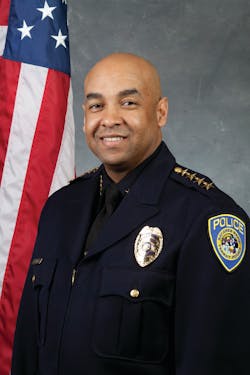
Using public transportation, growing up on the south side of Chicago, Bay Area Rapid Transit District's Chief of Police Kenton Rainey's family didn't own a car so they got around through mass transit. "I understand it and I believe in it," Chief Rainey says.
"I definitely sought this job out; it was something I wanted to do," he says.
Rainey's been with BART since June of 2010. When he came on board, it was around the time that the trial process was starting for Johannes Mehserle, former BART officer that shot Oscar Grant in a controversial case on January 1, 2009. He says, "Tensions were kind of high, a lot of media attention, public scrutiny, it opened up an old wound ... so now everybody has to relive this.
"I thought this was a huge challenge, and thought I had the necessary skills to lead the organization back and forward as far as what the board was looking for, for a change and to bring accountability into this organization." He adds, "Those are the types of things I've been known for throughout my career."
After the Oscar Grant incident, the district hired the National Organization of Black Law Enforcement Executives (NOBLE) to come in and give an organizational assessment of the police department. They issued several hundred recommendations as far as what they felt the department needed to implement in order to move forward in the right direction.
"I've been part of teams that have gone in and made recommendations to organizations and you don't expect them to obtain them all," says Rainey. "You cannot because some of them, economically, are not feasible.
"You ask a cop to do a bottom-line inspection and if this is your department and the sky's the limit; what would you do to make it a premier law enforcement organization and you get this list," he explains. "As you go through it, it will usually take you two to five years to really start to transform the organization because you're trying to change organizational culture."
One of Rainey's mentors told him organizational culture is like personality; no one likes to be told there's something wrong with your personality. They're going to naturally resist so you have to really prepare the organization for change to the policy and procedures manual, put in that foundational training.
"Using that report as my guide, some of the things that I've initiated is we've changed the policy and procedure manual, totally revamped it working with a corporation called Lexipol," Rainey says. "The policies and procedures are grounded in the latest case law, law enforcement best practices ... it's a great foundation for any organization. It's very important that we had that as our foundation."
Advancing Training
In the wake of the Oscar Grant incident, the district has appropriated enough money to have its officers receive 40 hours of training every year, while the state of California requires only 24 hours of Continuing Professional Training every two years. BART is taking it very seriously and appropriating the necessary funding.
With 40 hours, there are a variety of courses they can focus on: communication, defensive tactics, weaponless defense, Tasers, first aid, etc. Rainey says, "You can bring people in and out depending on what the emerging issue is."
The training committee takes a look in advance at what they want next year's 40 hours to be and they put together the curriculum.
Rainey says, "As far as training, we are really focused on three areas and that's leadership, continued professional training of our line level officers and our crisis intervention training.
"From a leadership standpoint, I wanted to make sure all my supervisors and managers were exposed to managerial law enforcement leadership, management, supervisory training."
He says throughout the state and the country, they've been successful in graduating in a couple people from California POST Command College, a year-long program where the manager goes with other managers from other law enforcement organizations from around the state and they meet monthly for a weekend. It's very intensive coursework with a futurist perspective on what direction law enforcement is going toward.
Rainey adds, "The person actually has to almost write a Master's thesis to graduate; it's a very intensive program."
Rainey's had several of his command staff members attend the role of Police Chief Course. "It's very important from my standpoint," he says, "that they understand when they're sitting in for me and making decisions; decisions are not being made in a vacuum. They have to understand what's coming from the top, what's coming from outside the organization, that they really have a good global perspective."
Impact of Mental Illness
Crisis Intervention Training is how a law enforcement officer deals with subjects that are mentally ill — a very volatile situation. "We have so many people out there that are homeless, possibly suffering from some type of mental illness because they're not being properly treated, not getting their medications so they have a tendency to slip into a crisis episode where they become a danger to themselves or others," Rainey explains.
"Law enforcement gets the call and before you know it, you can have a violent confrontation because maybe the individual is armed, not necessarily armed to protect themselves from law enforcement, but they're living out on the street and they're getting preyed upon by other homeless individuals or other predators out there."
He says they trained all of their field officers in crisis intervention, 24 individuals, and now are expanding it to include regular line officers so they would have an additional 20 officers trained.
"A lot of people don't understand; it's not like a traditional class where you have one instructor come in," explains Rainey. "You're trying to coordinate schedules of mental health professionals, people who are affiliated with the National Alliance of the Mentally Ill — NAMI —, doctors, other practitioners, they get people who have suffered from mental illness but are on medications to try to explain what it's like — this is what I experience when I'm not on my meds and when I am on my meds — very intensive coursework to really give an officer a better perspective when they go into these situations."
The way he came across the idea, Rainey says, was while he was working in Southern California, about 10-1/2 years ago, and he was dealing with this type of situation. There were homeless individuals that the Flood Control District required to be evacuated from the river bottom and the other officers were explaining to Rainey that it's not just a simple rounding them up and getting them out. "A lot of these individuals are veterans. They're definitely trained and they can protect themselves," he states. "They have booby traps down there, dogs and stuff; it's dangerous going down there.
"As we researched this, we came across the CIT program, often known as the Memphis Model." He elaborates, "As we looked more and more into this, just within our county, we looked 10 years back and found out all the law enforcement officers that had been killed in the last 10 years had been killed by somebody suffering from a mental illness. Very profound; really opened our eyes to how big this problem was.
"Seventy percent of our officer-involved shootings through-out the county involve somebody with a mental illness." Rainey says, "It really put the spotlight on us that it's not just mental illness; it's an officer safety issue. So the more tools we can put in our personnel's tool kit when they go out there, the individual we're trying to get help for, the better off for personnel."
Budget Cut Impacts
"It's this whole period of austerity or budget cutting, whichever your political leanings want to call it. We have prison realignment going on where everyone's looking for a way to cut back every level of government, cutting back and more or less, putting the burden on smaller levels of government," Rainey says.
"Starts off at state, state to counties, counties to the cities, and the smaller you are ... you really become impacted." He says, "We've seen cities, their law enforcement agencies, they do away with them and they contract with a service department. Part of the barebones minimum number of people that they can get away with and putting out on the street."
The social services safety net that used to be out there that would catch a lot of those individuals are gone, Rainey says. "They had these programs in place that we could take them to or call them out to help us. Now a lot of those programs are gone because there's no money. There's literally no money."
He says with the money lacking for proper re-entry programs, you've destined it for failure if you don't appropriate the necessary funding because you are putting these people out on the street in the worst economy since the depression. "They're not just going to curl up in a corner and die. They're going to do what they need to do to survive," he says. "There are a lot of people with a college education that can't get a job."
As BART/Capitol Corridor Public Information Officer Luna Salaver says, transit properties are a magnet for these types of individuals for a number of reasons. "One, in the wintertime we provide shelter and in the summertime we provide air conditioning, so if you're homeless, you're going to be attracted. "
She also says, "You have the situation where if you're looking for crimes of opportunity, you are attracted to places where there is a lot of people and BART serves 380,000 people per weekday, so if you want to break in to somebody's car or do a robbery, you're going to go where there is a lot of people congregated."
Building Relationships
The biggest challenge, Rainey says, is to manage expectations. With the hundreds of recommendations they received and the public safety hearing, people putting the BART police down and being critical that they're not moving fast enough, why isn't everyone trained yet?
"Every law enforcement organization in the state of California, we all have the same needs." Rainey says, "None of my peers want their officers to encounter a mentally ill person, have a critical incident and then that person isn't in CIT training, knows the media is going to get them; they're going to get criticized." He continues, "So when a class pops up, everybody's trying to get their personnel in that class. So you're lucky to get maybe one or two slots at a time." He adds, "Whenever we see a class, no matter where it is in the state, we send at least a couple people."
Reaching out and talking with organizations and individuals that are critical of his law enforcement is important to Rainey. Not that he's going to change their mind, but he wants to hear what they have to say and give them a voice to what they're saying, including the ACLU, local minority ministers and the Oscar Grant Foundation. "I maintain a relationship with those individuals, and I accept their constructive criticism; and it's almost a renewal process for me that I need to go and work harder and challenge my personnel to do the same thing."
He also says he has a very good working relationship with his partner law enforcement agencies of the four counties, 26 cities, the federal and state because, as he says, "Good, bad or indifferent, BART is one of those high-value targets for terrorists.
"You look at mass transit around the world, 22 other countries, mass transit systems have been hit and they have definitely tried to target, not necessarily BART, but our mass transit systems in our country.
Taking Care of Personnel
Police officers are the first point of contact for people's government, Rainey explains. "You call and they come.
"And usually when people call us, they call us when people are at their worst. In emergencies, we're expected to come and make sense out of chaos. You constantly have your folks going in and out of these types of situations and sometimes they don't get a break; it's non-stop." He stresses, "You definitely worry about your personnel's mental health."
They've created a Trauma Response Team within the organization since he's been there and that team works with clinical psychologists and individuals who have witnessed or experienced some type of trauma: individuals who've witnessed a suicide, somebody accidentally killed or somebody that was shot and killed in a law enforcement situation.
"They can talk them through the post-traumatic stress, guilt feelings and those types of things," Rainey says. "We lose a lot of personnel, a lot of law enforcement in general, off of these types of situations.
"People think that these guys are just heartless, cold, wake up in the morning, 'Who can I victimize today?'
"Nothing could be further from the truth.
Moving Forward
"People joke with me about it, but I knew what I was signing up for," Rainey says of coming to BART. "I knew it was a big job but I've been here, I've met a lot of the people inside this department and outside this department." He stresses, "It's not something we can't do. We've got some great people and the district is committed.
"With the Oscar Grant situation, it's going to be our turn for a long time; we're going to be in the spotlight for a long time, just like Rodney King and the LAPD 20 years ago; they're still reliving it," Rainey says.
"Rightfully or wrongfully so, somebody's dead." He says, "Somebody's dead at the hands of our officer. There's no legal, moral, ethical justification for what occurred on that platform on January 1st, 2009 and it's incumbent upon everybody in BART to make sure nothing like that happens ever, ever again."
Rainey says, "My guys are human. I would hope that everybody would understand these are the folks that live next door to you, and there is no malice intended and our No. 1 priority is giving good service to our riders."