Looking at Propane Autogas for Transit Fleets
As the government continues to develop new standards for vehicle emissions, fleet managers are looking to incorporate vehicles that meet sustainability requirements while maintaining organizational cost and performance goals. These government directives, coupled with rising fuel prices, are leading fleet managers to look into alternatively fueled fleet vehicles.
One option growing in popularity is incorporating buses, shuttles and vans fueled by propane autogas into fleets. New models feature the latest in propane autogas technology, and successfully meet cost, performance and sustainability expectations, while offering a viable alternative to conventionally fueled vehicles.
Many fleets across the country are already realizing the advantages of these vehicles. Mammoth Cave National Park uses buses fueled by propane autogas to transport more than 200,000 visitors annually. Because of the success the park has already seen, it recently bought four new Blue Bird Propane-Powered Vision school buses to replace aging buses in its fleet through a grant from the Energy Department and facilitated by the Kentucky Clean Fuels Coalition.
Sustainable, high-performing solution to transport hundreds each day
The cost, performance and sustainability attributes are a few of the reasons that Mammoth Cave National Park converted its entire fleet of six buses from gasoline to propane autogas more than a decade ago.
Mammoth Cave's buses join more than 270,000 on-road vehicles today in the United States, according to the Energy Department, running on propane autogas, the nation's third-most-common vehicle fuel after gasoline and diesel.
The park's concessionaire, Forever Resorts, owns, operates and maintains the buses, which make continuous routes from visitor parking lots to four cave entrances across the park. The buses travel up to 10 hours a day for a combined 475 miles during the park's busy season.
Mammoth Cave chose propane autogas as it provided a sustainable fuel option for its buses. With government directives, such as the National Clean Fleets Partnership, many fleet managers have incorporated propane-autogas-fueled vehicles, as they reduce emissions, resulting in cleaner air for passengers to breathe.
"Fueling our buses with propane autogas matches Mammoth Cave's mission to be an environmental leader and employ sustainable practices," says Mammoth Cave National Park Superintendent Pat Reed. "The buses allow us to transport visitors while reducing our carbon footprint."
Fueling vehicles with propane autogas results in emitting fewer greenhouse gas emissions and smog-producing hydrocarbons when compared with gasoline-fueled light-duty vehicles and diesel-fueled heavy-duty vehicles. Propane-autogas-fueled vehicles emit 12 percent less carbon dioxide, about 20 percent less nitrogen oxide, and up to 60 percent less carbon monoxide than gasoline-fueled vehicles, ultimately reducing greenhouse gas emissions by up to 25 percent.
The California Air Resources Board (CARB) has granted certification approval for many buses, vans and shuttles fueled by propane autogas, meaning these alternative fuel vehicles meet California emissions standards and can be sold and operated in all 50 states. The U.S. EPA also has certified these vehicles.
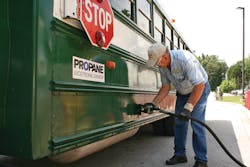
Signage on Mammoth Cave's buses notes that they are fueled by propane autogas, which has resulted in awareness and positive feedback from visitors.
"They've noticed the signage, and we've gotten a lot of comments from visitors about how they are pleased that we're using an environmentally friendly fuel," says Greg Davis, general manager of Forever Resorts.
High performance with reduced maintenance
Along with sustainability comes high performance. Operators of buses, shuttles and vans fueled by propane autogas experience the same horsepower and torque as gasoline- and diesel-fueled engines. Mammoth Cave's buses are able to climb the park's hills without trouble, and drivers and passengers have not noticed a power difference.
"The performance is exactly the same as a gasoline- or diesel-fueled bus; there is immediate acceleration and lots of power," Davis says. "If you drive a bus, you would never know it didn't run on gasoline."
Mammoth Cave services the buses through certified mechanics who have been trained to perform maintenance on the buses. Vehicle manufacturers frequently provide training to mechanics and dealers to learn how to maintain the fuel system.
"Our engines are getting more years of service with propane autogas," Davis says. "We haven't had any problems as far as maintenance is concerned."
Propane autogas also burns cleaner in engines than gasoline and diesel, which traditionally results in reduced maintenance costs throughout the life of a vehicle, and extended engine life. While vehicles fueled by propane autogas may have a purchase price that can be up to $4,000 to $12,000 more than that of traditional gasoline- and diesel-fueled vehicles, these costs can be offset by the reduced maintenance costs and less expensive propane autogas fuel.
As a practice, the park continues to change the buses' oil approximately every 3,500 miles, but technicians have noted that the cleaner-burning fuel does not require oil changes as frequently as conventional fuels.
Implementation that can curb costs
The good news for fleets that are attracted to sustainability and operating cost advantages of vehicles fueled by propane autogas is that they can be cost-effective for fleets to implement. Federal and state incentives support adoption of buses, shuttles and vans fueled by propane autogas and create new opportunities in the market.
Incentives vary and are often available for the cost of fuel and refueling infrastructure. The federal government and many states offer programs encouraging the use of alternative fuels, with most states offering at least one incentive. This includes a propane autogas fuel tax credit of 50 cents per gallon through December 31, 2011, as part of the Tax Relief, Unemployment Insurance Reauthorization, and Job Creation Act of 2010.
Federal tax credits also are available for up to 30 percent of the cost of installing alternative fueling equipment. This amount cannot exceed $30,000 and must be in service before December 31, 2011. Fleet managers should consult with their tax adviser regarding claims for credits or refunds, and the Internal Revenue Service website for appropriate dates and forms.
The cost of propane autogas also helps reduce payback periods. On average, the cost of propane autogas has been 30 percent less than the cost of gasoline for the last 30 years. Fleet managers can work directly with propane providers to lock in rates.
Convenient, straightforward refueling
Transit fleets are constantly on the go, making fuel availability and refueling, either on- or off-site, an important consideration. Approximately 56,000 miles of pipeline and more than 6,000 retail dealer locations make propane autogas increasingly available throughout the United States. In addition, using vehicles fueled by propane autogas can play a key role in lowering the national dependence on foreign oil, as 90 percent of propane autogas used in the U.S. today comes from domestic production sources.
Ease of refueling has accelerated the use of vehicles fueled by propane autogas among fleets of various sizes. Many fleet managers are realizing the advantages of installing on-site dispensing, which includes a large tank and a no-spill dispenser. The cost of installing a propane autogas refueling station is comparable to the cost of installing a gasoline or diesel refueling station. Propane autogas providers can help fleet managers select the best on-site refueling option and coordinate ongoing delivery of propane autogas.
For example, Mammoth Cave owns a 1,000-gallon, on-site refueling dispenser, while Forever Resorts negotiates an annual fuel contract and manages weekly fuel delivery with a local propane provider. During the busy summer months, the buses use around 80 gallons of fuel daily. All drivers have been trained on proper refueling procedures. Safety and training classes can be taught by local propane providers on-site.
Fleets also can refuel off-site at thousands of refueling stations across the United States; propane autogas is the only alternative fuel with fueling stations in every state. In fact, there are more propane autogas refueling stations in the country than for any other alternative fuel. Fleet managers and drivers can locate stations via the Energy Department's Alternative Fuels and Advanced Vehicle Data Center.1
Getting started
The North American market for vehicles fueled by propane autogas is gaining momentum. The combination of advanced propane autogas engine technology and availability of vehicle and refueling options means that fleet managers can begin to integrate vehicles fueled by propane autogas into their existing operations immediately.
Fleet managers have incorporated buses, shuttles and vans fueled by propane autogas into many aspects of their operations, as many vehicle models are currently available. The Propane Education & Research Council (PERC) supports the research and development of engines and liquid propane autogas injection systems for vehicle platforms. In the past two years, more than a dozen new platforms fueled by propane autogas have been developed with funding from PERC.
Fleet managers can choose from buses fueled by propane autogas from companies such as Blue Bird Corp., Collins Bus Corp., and soon from Thomas Built Buses. These manufacturers have collaborated with well-known automotive companies to provide liquid propane autogas injection engines for their respective bus offerings.
Other applications include shuttle bus and van applications from Roush CleanTech through a partnership with Ford Motor Co., and CleanFuel USA through a partnership with General Motors, each of which has new platforms in development. These include Ford E-series vans and GM 6.0L G4500 Cut-Van Chassis and GM 6.0L G3500 Cut-Van Chassis.
Fleet managers also are able to convert their existing gasoline-fueled vehicles to run on propane autogas. Aftermarket conversion kits are available from manufacturers such as Alliance AutoGas, Landi Renzo, RGR Alternative Fuels, IMPCO, ICOM North America and others.
Using propane-autogas-fueled vehicles has fit so well into Mammoth Cave's operations that officials are not ruling out adding more buses after the delivery of the new Blue Bird Vision Propane-Powered buses.
"We want to continue to provide examples of how to interact in a sustainable way with our environment," Mammoth Cave's Reed says.
The Propane Education & Research Council was authorized by the U.S. Congress with the passage of Public Law 104-284, the Propane Education and Research Act (PERA), signed into law on October 11, 1996. The mission of the Propane Education & Research Council is to promote the safe, efficient use of odorized propane gas as a preferred energy source through research and development, training, and safety initiatives.
Steve Wayne is chief commercial officer for the Propane Education & Research Council.
1 Energy Department's Alternative Fuels and Advanced Vehicles Data Center
http://www.afdc.energy.gov/afdc/locator/stations/