Open payment systems based on agreed standards that connect transit providers are expected to be the norm in a few years. But getting there may be trickier than figuring out an out-of-town bus line map.
Open payment is already in place in Utah and three separate transit authorities in the New York City region are evaluating a bi-state collaborative system. Conferences are peppered with breakout sessions on the topic, and a growing pool of standards has been established by the International Organization for Standardization and, in the U.K., the ITSO. And the U.S. Department of Transportation Research and Innovative Technology Administration noted in January that “virtually all current Requests for Proposals for fare payment systems are requiring open payment solutions or at least requesting an open payment solution as an option to consider.”
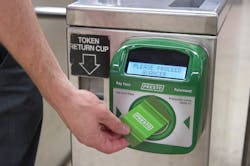
“Micro payments through the retail, banking and mobile payment systems are a reality today and will need to be accommodated in the transit world,” said Ernie Wallace, executive director of Canadian payment system, PRESTO. “Open payment will become a client option of choice on most major systems in Canada in the next two-to-three years, and it is already a fact in much of the world outside North America.”
Taking it for a Ride
On Jan. 2, 2009, the Utah Transit Authority (UTA) became the first major municipal transit provider to launch an open payment network across its system. UTA carries riders on about 140,000 trips each weekday and has about 200,000 active electronic passes its system, tallying on average 6,000 transactions per month. About one-quarter of those total trips are made using electronic cards or passes, though that is steadily increasing as UTA rolls out more card types to the point where UTA is prepping for all transactions to be covered by electronic pass or payment card, said Gerald Carpenter, UTA spokesman.
While the system has grown to be quite large, its successful start came from a small fleet: UTA ski buses that served resorts in neighboring canyons. Carpenter said this test run provided tweaking and a real-life reflection for authority executives and systems integrators for the bus and rail lines, which span one of the largest geographical areas of any U.S. transit system.
“This approach allowed us to test the processes and payment methods in a moving environment on a fixed number of buses running the same routes daily. It also tapped into the tourist market, which was more likely to pay a fare using a contactless credit or debit card, which were more readily available outside the Utah market at the time of the pilot,” Carpenter said.
Open standards that were developing at this same time were sewn into the UTA’s roadmap, leading to acceptance for NFC products using ISO 14443 contactless technology that enables partnerships with outside institutions for sales and products – and, ultimately Carpenter said, new flexibility.
“For example, several schools and employers have worked with UTA to add a transit benefit to their compatible school or employee IDs,” Carpenter said, adding, “This eliminates the need for a separate ‘transit pass.’ [They] simply tap their ID to a bus or transit reader, validating it just like any other transit pass.”
On the other end of implementation is the Southeastern Pennsylvania Transit Authority (SEPTA), the rail and bus lines for a five-county region in the systems bidding stage of an open payment system. Jerry Kane, SEPTA program manager for new payment technologies, said an open system provides freedom and connections to other providers – the nearby PATCO transit system is moving away from its disparate instruments to open systems this month, for instance – and capabilities for mobile interactivity development.
As SEPTA is set to announce its contractor for open services – one that would replace archaic legacy systems – the prime battle has been a debate over the payoff for instituting the open system, Kane said.
“[It’s been] convincing the supplier industry and systems integrators that open payment is feasible in transit,” he said.
The learning curve in the road
Cubic Transportation Systems Inc. is a provider of open payment integration and development, a field that company VP and regional director Steve Brunner admits is “still in its infancy.” As part of the developing know-how on open systems, Cubic is introducing cards at the PATCO system in the Delaware River region. That system will go live in late September, with PATCO-branded Visa contactless reloadable cards available to customers for six months, then moving to full acceptance of many major bank card brands. In addition, the system will continue to offer card options for under- or un-banked customers.
The big question mark in the room isn’t on getting the correct systems or even bringing PATCO in the modern age of open payment; it’s with customer acceptance, something not entirely known until a system is underway, Brunner said.
“Today, in a closed loop system, when an agency-issued smart card or magnetic ticket is presented at a transit payment device the customer obtains an immediate indication of the fare charged along with the remaining balance on their fare media. With an open-payment card the fare charge will appear on the customer’s statement after it is processed,” Brunner said. “This is a big change in how customers have traditionally interacted with a transit payment device and as a part of the PATCO implementation we will evaluate and refine our solution to improve the perception and acceptance of open payments.”
Wallace’s PRESTO system has already been introduced with open standards in Southern Ontario, including Canada’s largest city, Toronto, and will expand to Ottawa’s users by spring 2012, according to its user site. With all of that in place, PRESTO plans to introduce new functionality completely unavailable to token machines or traditional fare cards such as payment via mobile or smartphone, and account management through Facebook. Even with all of that in the hopper, Wallace said it is vital to keep one aspect in mind for both the provider and the user: the bottom line.
“The largest obstacle is the total cost of the ownership and the operation of these systems in the direct and indirect cost to the transit retailer and their customers,” Wallace said. “The issue of consumer and household debt is a serious public policy issue and the use of public transit cannot be seen to aggravate that issue.”
About the Author
 Justin Kern
Justin Kern
Justin Kern is a writer and nonprofit marketing manager who lives in Milwaukee with his wife and cats.