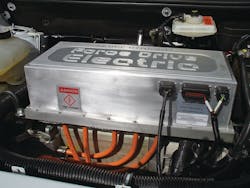
Hybrid electric/gas buses are used in many locations, but an all-electric bus is not common. Locations such as San Francisco offer electric buses, but most are connected to an electric system and unable to stray from the set route.
"Electric drive in transit has been around some time, but it's always been tethered," says Michael Elwood of Azure Dynamics, which offers smaller electric vehicles as well as hybrid vehicles. "Now, transit agencies are looking for primarily pure electric drive for mass transit that isn't tethered. A lot of transit systems are using hybrid, diesel-electric vehicles that are designed to work in parallel with an electric motor so you get the best of both worlds."
It's the all-electric bus that does not have to run on a connected line that transit systems are seeking. Foothill is one of the first transit agencies to use an all-electric bus, but the demand is there and growing.
The Foothill Transit system has received little to no complaints on its electric bus service.
Foothill put three fully electric buses into service a year ago. There hasn't been an overwhelming response by riders of the route on which all three are deployed, but that's just how Foothill representatives want it.
"The biggest thing they say is there isn't a difference, which is what we're looking for," says Felicia Friesema, communications manager for Foothill. "It is so much quieter, and the loudest thing on the bus is the air conditioning.
"As long as the bus is able to provide seamless service, that's all riders care about. They don't want something that's a new technology if it doesn't do what it's supposed to do."
The technology is doing what is expected of it, and it's evolving.
"People say, 'You'll never make a battery-powered bus last 17 hours a day on one charge,'" says Dale Hill, founder of Proterra Inc., which made the three Ecoliner buses Foothill uses. "It may be a long time, but we came out of the box and asked ourselves what an urban transit bus does. It repeats the same route every hour or so, comes back to a common point and has a five-minute layover to be on time for the next route. We said if we could build a bus that has enough energy to run three or four hours and be charged every hour, that bus will fit into an urban bus environment."
Proterra's rapid-charge technology is rather new and allows transit systems to keep a bus in service longer than in the past.
"Up until now, electric bus technology required an overnight charge. You could run a 30-mile stretch and had to charge overnight," Friesema said. "We cannot operate a service with a vehicle out of service after one trip.
"Fast-charge technology enables us to keep the bus going."
"We do have a request out to purchase nine more buses via a grant," Friesema said. "We received largest the TIGER grant from the United States ($10.2 million) and we'll use that to purchase those buses.
"It's a demonstration project where we're trying to test and work the technology so it fits with service we provide. It's a new technology, so there have been some things for us to work around. But they have been very minor things."
Proterra's business has been picking up as of late thanks to the TIGER II grant program through the United States Department of Transportation. Hill said there will be three buses going to San Antonio in the future, and there will be others sent to Tallahassee, Fla., early next year.
"We have a number of other transit agencies through the grant program that have either submitted something or will submit something in the next few weeks," Hill said. "There are probably another 15 agencies soliciting funding."
Shorter Routes Prove Ideal
Washington's King County is working with ECOtality on installing charging stations for its metro van pool. The county is looking into possibly making its paratransit routes for disabled riders all-electric.
"What we'd really like and like some of the vehicle manufacturers to deliver is a seven-passenger vehicle," says Ron Posthuma, assistant director for King County DOT. "We've got 1,200, and almost all of them can fit within the areas needed for electric charging. A five-passenger vehicle is at the bottom edge of what we want in a van pool. Battery technology is still moving, but it's not quite there for a vehicle that size."
What many agencies are realizing is that full-size electric buses are good for shorter routes, such as the 291 line that Foothill runs its three Ecoliners on. Foothill, a joint agency of 22 cities and Los Angeles County that runs 33 lines, is hoping to use those nine buses to make its 291 line an all-electric line.
"It's a heavy local line," Friesema said. "It hits some schools, a couple public libraries, shopping centers, the Pomona Transit Center, which is a transfer point for many lines. We got a lot of on-off traffic, a lot of wheelchair traffic.
"It was the perfect opportunity to put this technology through its paces."
"Some of the leading transit agencies said they only put buses out three hours in the morning and three in the evening," Hill said. "They said they don't need fast charging, but they want a bus with a longer range. We have a system that allows a bus to run 75 to 80 miles without a charge, but it can't fast charge.
"We can use a less-expensive battery technology where they charge the bus at night and then charge in the middle of the day when it's not peak hours."
Chattanooga runs an electric bus in the morning on one route, brings it in for a charge and redeploys it during peak times in the late afternoon and early morning.
"Once they're done with rush hour, they can charge the batteries or swap them out," Elwood said. "Then they repeat the same thing at the end of the day."
But finding an all-electric bus that will run from sun up to sun down is not possible at the moment.
"It eventually will be there," Elwood said. "A number of electric buses are being built. It does exist, it's a matter of really developing the technology within energy storage and constraints and working within those restraints to put a bus on a designated route."
Offering Charging Stations
King County Metro in the Seattle area has offered electric trolleys for a number of years, and they are expanding to offer public and private charging stations for owners of electric vehicles. King County is installing charging stations for electric vehicles at park-and-ride lots as well as county-operated parking garages. The county is also working with local companies such as Microsoft and Children's Hospital to install charging stations for those companies' employees.
"Everyone will have home-charging capacity, but you can't just go to the gas station with an electric car," Posthuma said. "What are you going to do when you're driving around and notice you're running out of juice? We're trying to offer a publicly available charging station in our network."
King County will benefit from the charging stations, being able to charge for parking in electric-charging parking spots. A $4 charge per charging session will be levied, which is also beneficial to the driver.
"A lot of the garages we're talking about, there's already a premium for parking space," Posthuma said. "A lot of park and rides are oversubscribed, so the value of the parking stall is getting the addition of the juice."
Expanding Technology
Electric technology is expanding throughout the country, and those that have it already in service are looking to expand upon it.
"We've been looking at other lines to see where the technology would be usable," Friesema said. "We want to see if we can find a place somewhere along that line's route to install an infrastructure for a fast charge."
Electric vehicles are an ever-growing entity, and companies aren't going to stop adapting to new needs. As demands grow for not only the number of vehicles but what each vehicle offers, companies know they need to adapt to stay relevant and improve the technology.
"We stay abreast of all the battery technology," Hill said. "I feel certain the battery we're using today will not be the battery we're using five years from now because technology is advancing so rapidly."