Regen Temps Challenge Vehicle Exhaust System Users
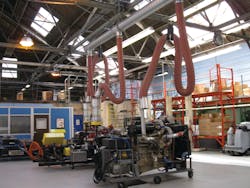
Managing the temperature demands of a catalytic converter regeneration (Regen) event is a growing concern for mass transit engine service operators. Extremely high temperatures associated with regen events can pose dangers for vehicle exhaust (VE) systems and their users. Everything from fan capacity to the velocity of air in the flexible hoses that duct extremely high temperature exhaust fumes away from diesel engine maintenance bays needs to be able to mitigate temperatures that can exceed 1,600ºF and cause safety problems.
"We were concerned that if the engine exhaust system went into the Regen mode when the vehicle was in the garage, the existing exhaust hoses would not be able to withstand the high temperature and may cause a fire," says Dave Varner, director of Bus Maintenance at the Maryland Transit Administration (MTA). So, what did Maryland do? "We changed all exhaust hoses to high-temperature," Varner says. A complete facility-wide upgrade of MTA's engine exhaust systems came at a time when the transit system was able to replace all flexible exhaust hoses and upgrade VE systems with those capable of ducting the 1,500ºF and higher temperatures, and MTA did so.
CEOs of transit agencies are directing their safety managers and facility architects to look into how best to accommodate changes created by new, higher-temperature engines and to meet the requirements of new regulations. Private bus garage operators, too, are looking for technical answers to the extremely high heat, safety, and ventilation issues that arise from catalytic converter regeneration that occurs during planned maintenance operations.
OEMs that offer full vehicle exhaust systems and design services to bus and transit authorities are quick to point out that hoses capable of handling extremely high temperatures are just a part of the solution for managing new, high-performance engine exhausts. "Often, vehicle exhaust systems are not designed by a person in our industry," says Fred Imming, president of Car-Mon. "Unfortunately, service managers want to use what they already have, as much as possible," Imming says.
"They really need to look beyond components to systems," he suggests. "Vehicle exhaust systems require a systems professional , not just a consulting engineer with HVAC experience. The difference is that we are dealing with contaminated air versus standard air for venting."
Sizes, Fans and Pressures
System sizes, the number of drops, venting diameters, the right fans, maintaining correct flow rates – they all have to be considered, Imming says. "The best counsel that I can suggest is, you really need to contact a person familiar with the requirements and materials available, and actually determine which system fits your individual needs.
"You need to evaluate system performance in general. We're systems guys, not component guys," Imming says of Car-Mon and other OEMs like his company.
Systems OEMs Share Views on Extreme Temps
Kyle Jefferson, VP of Sales and Engineering at Ventaire, echoes the need to have exhaust fans properly sized to ensure that VE systems are not compromised by extreme temperatures, and he goes a step beyond. "For existing systems, a portion of all of the flexible hose may need to be upgraded to one that carries a higher temperature rating." Are there ways to economize?
"Yes," says Jefferson. "The first 10 feet of flexible hose takes the brunt of the heat since the exhaust gases cool quickly after they enter the exhaust capture system. Hoses with different temperature ratings can be spliced together with the section near the inlet carrying the highest temperature rating," he explains. "We supplied a system for a bus manufacturer that utilized 10 feet of hose rated to 2010?F coupled to 25 feet of hose rated to 1200?F," Jefferson says to further illustrate the example.
"Another way to keep the cost of engine exhaust removal systems down is to increase the volume of air moved by the fan," Jefferson continues. "The fan can be oversized to draw room temperature air into the system, which mixes with the hot exhaust gases to keep the overall temperature to a level where cost effective components can be used," he suggests.
Adding to the discussion, Monoxivent National Sales Manager Erik Swanson endorses the idea of adding more ambient air into the system in order to keep it cool, while suggesting other VE system changes, as well. "We may also add high temperature accessories to the exhaust fan such as heat slingers, high temperature paint and other suggestions," Swanson explains.
"In an extreme case, where the vehicles may go into regeneration mode while attached to the vehicle exhaust system, we could possibly recommend utilizing a 2000-degree F flex hose," he adds.
Toward a Safer Work Environment
Monoxivent's Swanson looks to overall safety as part of the VE system improvements that can enhance the working environment. "We can put heat resistant handles on our tailpipe adaptors to help prevent the mechanics from getting burned," he suggests. "Mechanics have to keep in mind that today's engines are running hotter, which creates more heat in the vehicle exhaust system. They must exercise care when removing the VE system from the vehicle, because it may be hot, especially right after the vehicle is shut down," Swanson adds. He even suggests that vehicles be pulled outdoors to conduct certain engine tests that will definitely create high exhaust gas temperatures, and that the vehicle be disconnected from the VE system to do so.
Combining Old Engines with New Engine Maintenance Ops
"For the time being, service managers could designate one or two work bays of their facility for the service of new vehicles," Swanson suggests. "These bays could be outfitted or retrofitted with higher temperature, higher air volume exhaust extraction equipment and leave the rest of the facility as is," he reasons. "As more of the higher temp engines are introduced into the fleet, more bays can be retrofitted with high temperature exhaust hoses and equipment," Swanson concludes.
VE System Design Refinements Sense Load Capacity
Shawn Smith, vice president of Operations at Plymovent, Cranbury, N.J., urges a thorough understanding of usage capacity for the VE system, including considering the percentage of drops that will be in use at a given time. "Service managers need to get a clear snapshot of all types of vehicles that move through the service area," he recommends. "Planning should include a temperature monitor at each of the extraction points to ensure that no vehicle in maintenance reaches or exceeds an approved temperature level," Smith says.
Outsourcing Regeneration Servicing
Car-Mon's president, Fred Imming, points to an industry trend that is influencing maintenance of higher-temperature bus engines: outsourcing maintenance services to engine manufacturers. The Chicago Transit Authority (CTA) designates two bays in at least one of its bus barns for regeneration and subcontracts the maintenance work out to engine companies, he says. "Normally, they have two people from Cummins designated to come out and evaluate the catalytic convertor maintenance," Imming says. "You have to plug regeneration by laptop link to a computer program," for scheduled maintenance, he explains. Otherwise, catalytic converter regeneration can occur on the road, he adds.
All the more reason to have VE systems checked for extremely high temperature performance ability in those bus bays where regeneration maintenance is scheduled, Imming suggests. In a world where technical improvements in engines are taking place, engine service managers need to review the basics and ante up for vehicle exhaust systems that will match the on-coming requirements while providing improved safety and security in their operations.
Management of exhaust is one of the key components to any service function. New VE systems solve a practical problem. They are affordable and available, and you can procure them today.