Cloud Computing in Transportation: Increasing Efficiency by Connecting Devices to the Cloud
The cloud is no longer the future of IT — it's now the present state. We have already seen the cloud having a transformational effect on both businesses and individuals all over the world. So what exactly is cloud computing, and how can it benefit the transportation industry today?
Gartner Inc. defines cloud computing as "a style of computing where massively scalable IT-related capabilities are provided 'as a service' using Internet technologies to multiple external customers." Instead of storing software and data on a local PC hard drive or on data servers as businesses have for many years, cloud computing uses the power of the Internet to store and distribute data online.
Some businesses more loosely name other data storage and communication infrastructure as a "cloud." An Intranet, for instance, is simply an internal network housed behind the firewall. Developing an Intranet, no matter how complex, is not cloud computing. Other businesses might take advantage of a group of servers or load balanced servers for backup and redundancy. Again, those data storage options utilize traditional computing strategies, not cloud computing.
Public IT cloud services are Internet browser-based and are available to any person or entity. Cloud services are off-site from a customer standpoint and do not require any dedicated, application-specific, or proprietary client-side hardware or software to support access. Since cloud services are stored offsite, they provide a level of backup and redundancy that is beneficial to any industry, but they can also improve efficiency significantly in the transportation market.
A February 2011 report by International Data Corp states that the services and distribution sector — which includes vertical markets such as retail, professional services and transportation — contributes the largest share of U.S. public IT cloud services revenue. Currently a $3 billion market, IDC estimates the services and distribution sector's public IT cloud market will more than double to $8.5 billion by 2014.
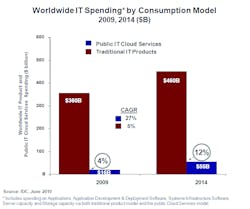
Worldwide revenue from public IT cloud services exceeded $16 billion in 2009 and is forecast to reach $55.5 billion in 2014. This rapid growth rate is more than five times the projected rate of growth for traditional IT products (Figure 1).
Early adopters in the transportation industry are using cloud computing today, and the data shows the market is poised for fast growth. In 2008, total transit ridership reached an estimated 10.5 billion unlinked trips, the greatest number of trips taken on transit since 1956. Although cloud computing does not make sense for every transportation application, its key value lies in bringing various measurements together into one useful dashboard.
By connecting devices in transportation directly to the cloud, agencies can bring multiple pieces of data together from square one for a more accurate and dynamic picture. At the same time, operational efficiencies are gained by eliminating the need for 10 different employees to analyze 10 different dashboards with data such as ridership, delays or vehicle safety. Through the cloud, the data also becomes available much more quickly, in near real time, allowing managers to make quick adjustments for better service. Let's take a closer look at the benefits of connecting transportation devices to the cloud.
The Device Cloud
Traditional transportation IT departments are set up with an IT director and staff, a network infrastructure, and local data centers. For many years, the transportation industry has been exchanging information, such as passenger counts and vehicle diagnostics, through a local network. Using cloud services to store fleet data may be where Web-based capabilities can have the largest effect in the transportation industry.
Many vendors provide online hosting or software-as-a-service (SaaS) models to transportation organizations. SaaS essentially allows the customer to rent the software and access it online for a monthly fee. While these tools can benefit the business side of the transportation industry, the real value comes when the cloud intersects directly with fleet management devices. Bypassing SaaS and simply passing data directly from the device to the cloud saves time and also money.
It typically takes months, or even years to plan, procure and deploy IT infrastructure to connect embedded transportation devices to the network and capture valuable data (Figure 2). Transportation agencies use GPS devices, passenger counters, fare collectors and other devices to capture key data. Traditionally, these devices are plugged into a hard-wired Internet connection, and the data is downloaded onto a local PC connected to a network. The data is downloaded at specified intervals, such as each night, or once per week. Many times the data is either never used, or analyzed once per month or even once per year to make service changes.
The device cloud is a term coined by Eurotech (Figure 3) to describe how organizations can bring data from device to business application with an integrated solution to turn bits of data into valuable and actionable information. By storing device data in the cloud, both public and private transportation agencies can access data in near real-time.
The device cloud is also scalable, secure and many times more cost-effective than traditional infrastructure for transportation IT departments. As cloud computing becomes more mainstream, transportation agencies are evaluating whether a cloud solution can be an efficient alternative to traditional computing networks.
Simplifying the Dashboard with More Useful Fleet Data
Storing transportation data in a central online location can be more efficient for transportation agencies. Currently, agencies collect various measurements ranging from travel time to fare collection (Figure 4). Then, multiple departments and employees manage each of those measurements and create reports for managers to compare and contrast data.
When all of these measures are stored in the cloud, transportation executives can access the data anytime and anywhere through a secure online portal. They can create a custom dashboard that pulls only the data they need, and they can look at the fleet over the past week, or ever since they began storing data in the cloud. This concept goes beyond simply gathering the various databases into one location — a device cloud solution instead pulls the data directly from the devices (fare collection, GPS, etc.) and into one central cloud database.
Connecting transportation devices to the cloud proves invaluable in analyzing data. For example, consider a standard bus with the following systems — a camera, fare collection, passenger counting, WiFi and GPS. Suppose the transportation agency holds a board meeting and wants to justify the free Wi-Fi they are offering to customers. Next, the general manager asks his employees for a few reports on fare collection and passenger counts to justify the free Wi-Fi.
Under the old technology, each of these data points is provided by different software and different vendors. Multiple employees collect the data and deliver it to the general manager, who then analyzes it and delivers the results to the board. Each report is slightly different since they are not integrated, and the general manager then spends his or her time comparing the reports to determine if the number of users and the fares collected justifies the free Wi-Fi.
With a cloud computing infrastructure, the cloud service can pull information from all of the databases together into one simple and secure dashboard. At any given moment, the general manager can generate a report containing both fare collection and passenger counting with a single click.
There are operational efficiencies to be gained from cloud computing to eliminate the hours and hours of recurring time used to generate the same reports month after month, year after year.
Making Quick Decisions with Faster Data Through the Cloud
In addition to increasing efficiency with a simple dashboard, cloud computing can also provide the benefit of much more immediate, near real-time data. Since data is sent to the cloud almost continuously (depending on how the cloud is set up and the communication infrastructure), managers can see realistic snapshots at any given moment.
For example, suppose a major snowstorm hits New York City. The transportation agency wants to know not only where all of the buses are, but how many people are on each bus. Instead of relying solely on GPS data to find the bus locations, the agency can also get accurate data on how many passengers are on each bus. If one bus were to go missing, they would quickly know exactly how many passengers to look for and be better prepared to handle any emergency situation.
Another timely example involves the high prices of gas. Gas prices are already high, but suppose a natural disaster caused them to skyrocket in one night. The transportation agency needs data fast in order to shorten routes and save fuel. Instead of having to wait weeks or even months to adjust routes, the agency can see an accurate snapshot of routes and usage and make quick changes.
Conclusion
Public transportation agencies typically have access to the resources they need — IT departments and equipment such as servers and communication infrastructure. However, they can still simplify their dashboards and benefit from private or public IT clouds. However, cloud computing may be of even more benefit to smaller, private transportation agencies without those resources. With the cloud, these smaller agencies are utilizing advanced computing without the long-term investment.
With more timely and relevant data, the entire transportation industry sees marked improvement in fleet management and customer service. The cloud is the key to meaningful information, placed more easily in the hands of transportation professionals. The results can mean better business decisions, better diagnosis of fleet service issues based on trend data, and a faster response to catastrophic events.
Cloud computing is in the early adoption state in the transportation industry, and proven solutions are available and ready to be deployed. By implementing cloud technologies on a case-by-case basis, the transportation industry can begin to embrace this trend so prevalent in the business world.
Bart Robison is product manager with Eurotech Inc.