Digging out of Debt: The MBTA
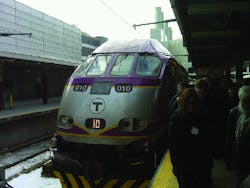
Catching fare evaders and being Tweeted about are just two of the new experiences for Massachusetts Bay Transportation Authority (MBTA, the T) General Manager and MassDOT Rail and Transit Administrator Richard A. Davey faces as he strives to improve communication for the T riders.
It was about a week before I went out to see the system that Davey gave up his car for good, donating the Nissan Altima to the Home for Little Wanderers.
“People appreciate it,” he says of he and his wife relying on the T. He says to get to work it’s only a few stops, but he and his wife use it frequently, almost exclusively.
He says it’s a largely positive experience and while he was riding with Lydia Rivera, MBTA deputy director of communications, they caught a fare evader. “I’m quite sure he didn’t know who I was.”
Some people recognize him and will come up to him with questions or comments but also that he has a Twitter account and will read from time to time that someone has spotted him out on the system. One recent comment was a Tweet from someone that said to the masses, “Saw MBTA GM at Tico. I was going to go up to him but I’m going to let him chillax.”
It may sound like just fun and amusement, but as Davey says, it gives him a chance to see the customer experience and better connect with them. “It’s fundamental to listen to people, to hear what they have to say.”
From MBCR to MBTA
Davey started in transportation in 2003 when he was asked to fill a position at the Massachusetts Bay Commuter Railroad (MBCR), the company which operates and maintains the MBTA’s commuter rail service. He was working with them on a temporary basis as a lawyer helping negotiate contracts, collective bargaining. “I saw the business model and argued that I thought that they should have a general counsel,” he says.
“Then they formed it, they agreed. And then I argued that they should hire me to do it and they agreed and that was my start.” Davey served as counsel to help the MBCR transition team that assumed MBTA commuter rail operations from Amtrak in July 2003.
While at MBCR, he focused on programs to improve operations, safety and customer service; on-time performance rates improved and customer complaints dropped.
In 2006-2007 he became deputy general manager, general counsel and then became general manager of the commuter rail in fall of 2008. “I ran that for about 18 months, closing in on two years, when this opportunity came up at the T,” Davey states.
Transportation Reform
Transformation reform in Massachusetts has brought a lot of change in the organization. In 2009 Governor Deval Patrick announced his vision for a comprehensive reform to simplify the system while addressing the financial challenges.
Some of the actions from that reform include a consolidated Office of Transportation, a gas tax increase, moving all transportation employees, including the T, to the same health insurance plan as other public employees and aligning the T’s pension system with that of the state.
Davey says the T and other transit properties often have a top-down approach, “there’s a real command and control.
“That’s good in a crisis, but the goal is not to be in a crisis,” he says. “So the goal, then , is not to be managing that way. The goal is to push as much decision-making down as possible and to give our employees the principles to do that.”
Davey continues, “If they’re focused on safety, if they’re focused on customer service, if they’re focused on saving the authority and the tax payer money and if they’ve done those three things when they make a decision, then the decision 99 percent of the time is going to be right; so I don’t need to make it. Nor does my senior staff need to make it.”
Another change in culture has been to focus on not telling the boss what one thinks the boss wants to hear. “I can’t solve problems unless I know about them,” he says. “I think there’s been a tendency here to tell the boss what you think they want to hear.
“People can’t just come in my office and say here boss, here are a few problems; I also demand solutions.
“What are your thoughts? How do we fix these? What are your ideas to improve them? We’ve been very much focused on that,” he says.
Once a month there is an employee roundtable where any employee, anyone in the DOT can come in to an open meeting with MassDOT Secretary and CEO Jeffrey Mullan and Davey.
Going out to the shops and barns has also been beneficial in increasing employee communication. “I can’t tell you how many times I’ve heard you’re the first GM I’ve met in 10 years or 15 years or ever,” Davey says. “I’m spending a lot of time focusing on the employees, getting their input, getting their feedback.”
Along those lines, they have also initiated a safety hotline where employees can anonymously report issues if anything arises.
Davey says, “General managers come and go but the trains and buses always run.” He continues, “there will be many more people that sit in this chair that I’m sitting in right now. It’s the 6,00o men and women that work here that make it happen, so it’s my job to give them the tools, the training, the equipment, to get their jobs done.”
He stresses that there’s been a huge push for himself, Secretary Mullan and their colleagues to get out of their offices and to go and listen to help the employees do their job.
Davey says they recently came to an historic agreement with three unions on the wages and benefits program. “That is a four-year contract with net healthcare contributions of a 5 percent rate increase over four years. That’s the lowest in 35 years.
“My point is that our labor unions get it. They know what our fiscal challenges are. They’ve been very good about stepping up and trying to find creative ways for us to save money and then save their jobs.”
The pension program was a 23-years and out, so employees could retire at 23 years of service, regardless of their age. That has changed, with current employees grandfathered in.
When talking about succession planning, Davey says there have been a number of senior management retirements since he’s been in his position and he’s only been there a year.
“I’m trying to dig a little deeper in the organization, folks who have maybe 15, 18 years experience, to tap on the shoulder and put them in senior management positions.”
He says they’re also finding ways to collaborate with high schools and colleges in the area. A current project with the local Madison Park High School has a shop and they’re looking at giving them a T bus to work on. “Let the students learn working on that automotive piece and my hope is that they would suddenly dream about working at the T one day,” Davey says.
Customer Communication
Aside from being out on the system, there are a number of things Davey says, that have helped in making the T a little more transparent for the riders. One of those was the GM for a day contest. “We said to the customer, write us a short essay, why would you want to be the GM for a day,” he explains. “We got 150/200 responses; we picked a gentleman who spent the day with me and kind of shadowed me.
“At the end of the day he had a great experience, he had a greater appreciation of the complexity of the system that we run.” He continues, “But we had this idea that there were a number of folks who were disappointed we didn’t pick them, so we picked 10 of those individuals, those customers, to come in and spend an hour in our control center and then come have lunch with me to get some feedback.” Davey stresses, “It was great.
“It was so good that we decided that I’m going to do this once a month, a focus group or a roundtable of eight to 10 customers. We’ll just randomly select folks to have lunch with me, my senior brass, and just say what do you see? What needs to be done?”
Another way to increase that communication with the riders is an immediate work order process that they are currently working on. There will soon be an application that will allow customers to provide feedback on the physical state of the MBTA. “Is the light bulb out of the station? Does the trash need to be picked up somewhere? Is a poster out of date? Is there graffiti somewhere?” Davey asks. “Just take a picture, email it to us, an immediate work order is generated and our crews go out and fix it.”
It’s an idea he says they “stole” from the city of Boston that already does this. He is excited that this is another way that they are leveraging technology to improve the customer’s experience on the T.
Opening the T’s data is also something they are very excited about at the agency. About 18 months ago, they released the data of five buses to the public. “We turned to the public to help us and they did. Huge,” Davey says. “All we did is release data we had.”
He said there was some initial reluctance to share data, “but it has been nothing but a home run. A grand slam.”
They started with the five buses and now it’s open to all 184 bus routes. He says, “We immediately released information for our red, blue and orange lines, our heavy rail lines; that is out there now to.”
About the apps, Davey says, “It’s been, particularly for our customers that use the bus, really a seminal moment in how they interact with us, how they’re able to get information in real time to know, is the bus two minutes away or is the bus 20 minutes away?
“We’re giving them back 18 minutes of their life.”
Bringing an Agency Up to Date
The second day I was at the T was the board meeting with the budget vote. Davey says once they get through fiscal 12, they have to really start thinking about fiscal 13. “Over the next few years, how do we continue to service, continue to support the expansions that the state’s paying for and then think about ridership growth, too.” He adds, “Those are some of the things we’re focused on.”
He explains, “Over the next few years, though, as debt continues to grow, our debt payments continue to grow, will continue to grow until about 2016-2017 and then it will begin to decline.
“The T has, per capita, the largest debt in the U.S. in terms of transit agencies.” He adds, “That’s what’s gone on in the past but we’re really paying for that now.”
Trying to find a way to pay for all of the necessary and good projects out there is a primary concern. Davey quickly adds that any project that has any safety issue what so ever, is funded. He stresses, “We do not run anything that’s unsafe.”
The budget passed without raising fares or cutting service. Because of coming out of recession, they felt it was important as a policy matter that they’re seeing job growth, particularly in the Boston area, that this is not the time to be asking for additional fares or to be cutting service.
There was in increase in ridership in 2010 and there area a number of strategies to close the gap with some new, one-time revenue sources, such as selling some non-core assets, being more creative in their advertising program, and not filling budget vacancies. “We’re really doing anything we can,” Davey says. “No stone is unturned.”
Lack of finances is also impacting the aging fleet. “The T has not purchased a new locomotive since 1988,” Davey says. Last July the T authorized a purchase for 20 new locomotives, about a $120M contract. They expect to receive the new locomotives in 2013. In the meantime, they can not wait he says.
“We needed to find other means to get us locomotives. 50 percent of all of the delays in commuter rail are because of locomotives. Fifty percent.” He stresses, “If we solve that problem, that’s a huge reliability improvement for our customers.”
The T scoured the country to find passenger locomotives that were available. They purchased two locomotives from Utah. They’re opening a commuter rail line in 2014 and had bought locomotives ahead of time so the T bought two of them.
“We’re currently negotiating to lease a handful more that we would give back to them before they open their line in 2014,” Davey explains. “And the other piece that we did very recently is lease locomotives from Maryland, MARC.
“Those were rebuilt in 1995 and they’re not new but we like to cal them new-er, relative to our fleet.” He says, “We have three, we expect to get maybe two more and we’ll put those in the fleet as well, so that’s huge.
“With the number of delays caused by the locomotives, if we can give the contractor four, five, six, 10, 14 either new or new-er locomotives that gives them more time to work on the old locomotives in the shop, which is key, and puts more reliable locomotives on the rail.”
Commuter rail has been in the news a lot lately, both fairly and unfairly Davey says. “It certainly was a tough winter, but other agencies did have as well.
“Metro North, all the sister agencies struggled in a variety of ways, as did we, but we ran service.” He continues, “I think overall we did reasonably well or about as well as we could have, with some exceptions.”
He says there are definitely some improvements that MBCR could have made and that there are some customer communication improvements that they have made. After a complete review of their winter performance, they will look at how they position themselves for next year so they are in a better place.
He says, however, that commuter rail carries 10 percent of their ridership, so while that’s important, they’ve got other issues, too. The Orange Line on the heavy rail system has cars that are 31 years old. “Every single one of them,” Davey states. “We have Red Line cars that were built and are in service, they were built in 1969.”
For the commuter side, there are 75 new coaches coming, there’s an investment coming in the next couple years. “We need to shift our attention back to our heavy rail side which does not have that kind of investment coming in the next couple years.” He says, “We have to figure out a way to make investment in the current vehicles and then figure out a way to buy new vehicles in the future.”
The Customer Experience
While Davey is excited about the many projects underway, he says he loves the day-to-day “tinkering.” With so many little things going on, there are a lot of ways they look to make the customer experience easier and better, including rewriting the cleaning contracts, improving the fare media so the Charlie card can be used to park at key stations, and quiet cars. “Those don’t cost very much money or save money, for example, but that can improve our customers’ experience with the MBTA.”