Adding Hybrid Buses to Your Fleet
Hybrid transit buses have become a valuable and proven choice for fleet operators looking to reduce maintenance costs, increase fuel economy and lower emissions. The marketplace has responded to the benefits of these high-tech vehicles with a very strong vote of approval.
Nearly one-third of all new transit bus orders have a hybrid drivetrain specified, and as of 2010 almost every major city bus OEM has a hybrid offering in its city bus lineup.
With hybrid technology now having gone mainstream in the public transit industry, one of the questions forward-looking fleet operators are asking is if there are substantial improvements yet remaining ahead from the current production models.
We see, in fact, that the hybrid transit bus still has considerable continued evolution and improvement ahead which will result in even more dramatic operating cost reductions, fuel efficiency improvements and continued emissions and noise reductions. This evolution is being driven by improvements in what has always been the weakest link in hybrid drive technology: the energy storage system (or in normal-person speak, “the batteries”).
Engine Dominant Hybrids vs. Battery Dominant Hybrids
To understand how improvements in battery technology can enable even lower operating costs, increased fuel efficiency and quieter hybrid vehicles, it’s necessary to first understand the difference between engine-dominant hybrid and battery-dominant hybrid bus architectures.
The majority of production hybrid transit bus vehicles that have been fielded to date have engine-dominant hybrid drivetrains. An engine-dominant system utilizes the smallest possible battery system for storage of energy in the drivetrain and is typically equipped with the same size, or only a slightly smaller engine than a non-hybrid vehicle.
Engine-dominant hybrid systems have been the lowest first cost and technologically the most conservative approach toward introducing hybrid drive-train technology onto transit bus platforms. Engine-dominant hybrid designs have also provided a vehicle that was more “familiar” to fleet maintenance personnel, with engines that had the same maintenance requirements and replacement parts as pre-existing fleets.
The engine-dominant approach was the most appropriate design architecture for the OEM’s who first introduced heavy-duty hybrid drivetrain technologies more than 10 years ago, since historically batteries were by far the weakest portion of the technology available at the time. The original Orion hybrid buses had lead-acid batteries, creating significant weight restrictions for moving to all but the smallest energy capacity battery possible (back then advanced batteries such as lithium-ion were not even an option). Allison Transmission, with its first production hybrid debut in 2003, went the path of nickel metal hybrid batteries, which were a proven advanced battery of the time.
Lithium-Ion Batteries — Changing the Rules in Drivetrain Design
In the nearly 10 years since these original hybrid buses demonstrated their basic value to the marketplace, significant progress has been made in commercializing more advanced batteries suitable for heavy-duty transportation application, such as lithium-ion. Lithium-ion batteries have long been viewed as a breakthrough technology for vehicle electrification. BAE Systems was one of the first major drivetrain providers in the heavy-duty hybrid industry to embrace the benefits of lithium-ion and switched over to lithium-ion batteries for its production hybrid drive trains in 2008. This new lithium pack was based on aggregating many thousands of small flashlight-sized lithium batteries into a single battery pack, while still keeping with the overall engine-dominant architecture of the drivetrain.
Today, lithium-ion battery technology is more beneficial for transit bus application and continues to surface in the marketplace. Lithium-ion batteries are available at lower costs than ever before and changing all the rules behind what is possible with hybrid bus drivetrain design. Newer, “large-format” lithium batteries have cell sizes much larger than previously available, resulting in much lower battery pack integration costs, higher reliability and higher energy densities. Using a common engineering rule of thumb, it’s a much better design and more reliable approach to utilize hundreds of batteries vs. thousands when possible. The resulting pack generally will have more energy for the weight and be more compact.
It is these new large format lithium-ion batteries that are finally providing the necessary building blocks to transit vehicle OEMs to construct viable battery-dominant approaches to the hybrid bus drivetrain.
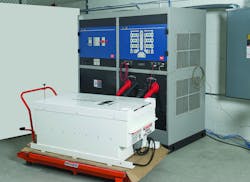
In the battery-dominant hybrid systems, the engine size is reduced much more dramatically vs. a non-hybrid vehicle. While highway speeds are always a must, with some flexibility on the fleet operator’s continuous highway speed requirements (i.e., 30 minutes to 1 hour continuous highway speed vs. sustained), the transit bus engine size can be reduced even more dramatically by a factor of up to four times. In compensation, the sizing of the battery in a battery-dominant system will be two to four times larger than that found in today’s engine dominant-hybrid drivetrains. A 60 kilowatt hour lithium-ion battery pack based on large format lithium cells and considered large enough for a 40-foot battery-dominant hybrid transit bus can weigh approximately 1,800 pounds. It is batteries of this size, where very high energy density is a requirement, that make large-format lithium-ion the battery of choice, whereas other more traditional advanced batteries — such as nickel metal hydride — could weigh up to 3,500 pounds for the same amount of energy.
Plug-in Hybrid Approach
So now that we know the differences between an engine-dominant and battery-dominant hybrid bus, what are the benefits of going with the more advanced drivetrain?
Running a smaller engine supplemented by a much deeper reservoir of battery power on the battery-dominant drivetrain will provide even further fuel economy and emissions benefits than possible with the engine-dominant approach. Likewise, the much larger battery will allow a measurably larger percentage of regenerative breaking to be absorbed and then discharged than the smaller battery on the engine-dominant drivetrain. This is because batteries operate more efficiently when the ratio of power being pushed in and out of them vs. their total energy capacity is lower, allowing the hybrid to be even more “hybrid.”
However, one of the even bigger drivers behind increasing fuel economy and lowering tailpipe emissions in favor of the battery-dominant hybrid is the ability of these buses to run in pure electric mode for very significant periods of time. Because the battery has a much greater reserve capacity to drive the bus in pure electric mode with the engine off, a “plug-in” hybrid approach can be utilized by fleet operators as an option. This plug-in hybrid approach would involve charging the vehicle battery at night or in between stops with “plug-in” power from the electric utility grid. Today’s lithium-ion batteries can be fully recharged in as little as two hours, with a significant amount of charge possible in as little as one hour.
This plug-in hybrid approach enables a portion of the hybrid transit bus’s “fuel” to be derived from grid charging vs. the diesel fuel tank. It has been well documented that increasing the mix of vehicle energy derived from grid electricity vs. an onboard fueled engine leads to dramatically higher fuel efficiencies, lower fuel costs and reduced tailpipe emissions and CO2 generation.
If this “plug-in” hybrid approach sounds resoundingly familiar, it should — think of the Chevy Volt. Just as the battery-dominant Chevy Volt has recently been released by Detroit as one of the most evolved of the various hybrid automobile platforms, so too is the battery-dominant approach to hybrid city buses now becoming available to fleet operators as the most evolved of the heavy-duty hybrid drivetrain architectures.
Other benefits can be specific to the fleet operator. For example, the ability to shut down the vehicle engine for significant periods of time enables fleet operators to tailor the noise performance of the buses when traveling through pedestrian districts.
Finally, reduced maintenance costs on a battery-dominant hybrid vs. an engine-dominant hybrid are a very real prospect. Both types of hybrid systems will give ample reductions to traditional high-dollar maintenance items, such as brakes, and have operating modes which are much easier on diesel engines. One of the big maintenance differences will be the lifetime of the hybrid battery. While the top two integrators of heavy-duty hybrid drives have done an admirable job with their products currently in the marketplaces, the design life of the lithium battery in the BAE System’s drivetrain has been advertised at six years, as has the nickel metal hydride battery of the Allison system.
While the math on lifetime maintenance costs is absolutely in favor of the engine-dominant hybrid bus vs. traditional diesel bus, these hybrid batteries are still quite expensive to replace. In fact, the basic calendar life of both these battery chemistries is greater than 10 years. The shorter lifetime of these batteries is actually a casualty of the basic engine-dominant approach to hybrid design. It was mentioned earlier that batteries are more efficient when the ratio of power being moved in and out of the battery vs. the total battery capacity is low. This is called C-rate. Running a battery at the high end of its C-rate capability will shorten the life of the battery, while running a battery at low C-rates is much more benign. By nature of its fundamental design, an engine-dominant hybrid system wants to have the smallest possible battery capacity, and push the highest amount of power in and out of the battery, resulting in high C-rates which stress the batteries and cause them to reach end of life earlier.
In a battery-dominant approach, because the battery is two to four times bigger, the C-rates on power being pushed in and out of the battery are much lower, resulting in dramatically lower stress on the battery. Today’s available lithium chemistries are in fact bringing the prospect of a battery-dominant hybrid bus having a single battery, which could conceivably last the 12-year life of the vehicle.
The downside to the battery-dominant approach is of course a much higher first-cost vehicle. However, in the United States’ subsidized transit market, fleet operators are motivated to pull operating costs forward into the first cost of the vehicle. In this regard, lifetime operating costs become the primary budgetary concern of the operators and battery-dominant vehicles will most certainly have strong appeal.
Buy American
One potential difficulty with the battery-dominant approach for OEM’s and public fleet operators alike is the Buy-America provisions in the Federal Transit Administration subsidies. If Buy American is important to your agency, it is important to understand that while many of the battery packs for transit use are “assembled” here in the United States, the cells these packs are built from are actually manufactured overseas, in most cases Asia.
With the smaller battery packs on the current engine-dominant hybrids, the foreign manufacturing content has not bumped up against Buy-American limitations. However, transitioning to much larger battery packs on battery-dominant hybrid city buses, or even pure electric buses, could begin to alter the content equation, as very few providers are yet assembling lithium battery packs with cells that are also made here in the United States.
Mark Armalli the transportation commercial manager for International Battery.