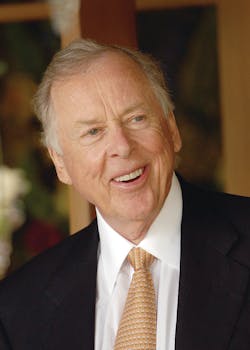
Walking into the BP Capital offices with a stylish Georgian ambience, there were items covering every surface: photographs, paintings and posters on the walls; statues and books on tables and shelves; and personalized notes on countless numbers of these items. The warm tones created a welcoming atmosphere, which almost made the substantial glass doors with security locks down every hall unnoticeable.
The formality of the interior was a stark contrast to the ease and familiarity of sitting down and talking to Pickens and Jay Rosser, the VP of public affairs for T. Boone Pickens and BP Capital, especially with their occasional jocose banter.
Talking to Mass Transit magazine about his plan for America’s energy, BP Capital founder and chairman T. Boone Pickens said OPEC is the enemy and Americans are just paying for both sides of the war with our dependence on foreign oil.
“I want to get off of OPEC oil,” was Pickens’ primary message.
“Seventy percent of all the oil we import goes to transportation. That’s five million barrels a day.”
The Department of Energy states that oil supplies more than 40 percent of our total energy demands. U.S. Secretary of Energy Steven Chu has said that nearly 70 percent of our oil use is for transportation, with more than 65 percent of that being for personal vehicles and he also stresses energy independence means changing from foreign oil to domestic fuels.
The Natural Gas Alternative
In 1996 Clean Energy was founded by Pickens and Andrew Littlefair, Clean Energy’s president and CEO. Clean Energy is a provider of natural gas in North America and designs, builds, operates and maintains natural gas fueling stations providing CNG and LNG fuel.
A combustible mixture of hydrocarbon gases, natural gas is clean burning and emits lower levels of byproducts than other fossil fuels and the United States is No. 1 in natural gas reserves. Ninety-eight percent of the natural gas is produced in North America and estimates are that there is more than a 100-year supply.
“It’s kind of interesting; it’s so much cheaper,” Pickens says of natural gas. Fuel costs are at least 15 percent less using natural gas rather than gasoline or diesel and an equivalent gallon of CNG provides the same miles per gallon as a gallon of gasoline.
“They do the same work; it’s unreal,” he says with a laugh.
“You’re getting ready to talk domestic compared to foreign and domestic is cleaner. It’s cheaper. If you get foreign, it’s dirty and expensive.”
Hydraulic fracturing, or fracking, is a drilling technique that extracts the gas from shale and has caused some controversy over natural gas. It involves sending vast amounts of water, chemicals and sand into the ground to release natural gas from shale formations thousands of feet underground.
Opponents of fracking say the process could be contaminating drinking water; the chemicals used in fracking might affect groundwater.
Some environmentalists support fracking and the extraction of natural gas because the gas emits a fraction of the carbon of oil or coal.
The industry says no conclusive evidence has been produced that show chemicals have migrated from a well bore thousands of feet underground and into aquifers closer to the surface.
Pickens agrees, saying, “We’ve been fracking in Texas in the largest aquifer in North America. It goes from Midland, Texas, to the South Dakota border and that goes across eight states.
“That whole area is a big part of it, is where oil and gas has been produced for years and the fracking has never been an issue.” And he adds that he’s fracked more than a thousand wells with the aquifer.
Change From the Top
The Pickens Plan is an extensive approach to America’s energy needs with an integral part of that being to utilize America’s natural gas to replace the imported oil as a transportation fuel. And the legislation proposed would expand the use of natural gas among heavy-duty vehicles with tax breaks for natural gas-powered vehicles and fueling stations.
The legislation is scheduled for a Senate hearing and Pickens is determined on moving it along and eventually getting it passed. He adds that there are more than 1,700,000 people signed on.
Commenting on people supporting clean alternatives and domestic fuel, Rosser says, “You know, it’s more than that. It’s companies like AT&T stepping to the plate to convert their fleets over to natural gas.” Operating nearly 76,000 vehicles nationwide, AT&T had committed to purchasing natural gas vehicles over a few years to replace gasoline and diesel vehicles to run a cleaner, more efficient fleet. With more fleets making that kind of commitment, the transportation infrastructure will need to keep pace.
“If I get 8 million 18-wheelers on natural gas, that will cut OPEC in half. That’s 2 ½ million barrels a day,” Pickens stresses about capturing the high-volume vehicles.
He has been asked why the taxpayers should pay it and Pickens says, “You’ve got to get it started, you have to help a little bit to get it started.” And Rosser points out the extension of the argument are some say the free market should dictate it. To Pickens he asks, “Your answer is?”
“Well do you think OPEC’s a free market? Of course not. Energy today is not necessarily a free market,” Pickens states.
He emphasizes, “But we can go in there and undercut the Hell out of it with natural gas.
“Anything American is what I’m for. And it makes my argument pretty simple; I’m not trying to sell natural gas, I’m trying to sell America.
“And if I fail, then get foreign oil, so the argument is tilted in my favor.”
Rosser adds that Pickens also spent 70 million dollars of his own money on this plan, to which Pickens retorts, “I think significantly more than that, but what ever you say.” To which Rosser counters, “Well it’s your money; I’m not going to argue with it.”
Fueling the War
“I feel that OPEC is the enemy; we’re paying for both sides of the war in the Mideast,” Pickens asserts.
“I want to get off of oil from the Mideast. And with that I think that we’re going to be able to bring people home,” Pickens says. “I do not like wars. I don’t understand what I see in the Mideast.
“We don’t need to secure the oil over there. If you go, if you put down how much money you’re spending to be sure we have oil in America, the numbers are huge,” he stresses.
Rosser adds, “That, by the way, the tax payers are paying for.”
“Remember, if you’re buying foreign oil, that goes out of the country — gone, to never be seen again,” Pickens states. “If you’re using domestic fuel, you create jobs, people make a profit, taxes are paid and the economy is helped.”
A large part of the problem Pickens says is that Americans do not understand energy. “It’s just too easy to pull into the gasoline pump and fill up and go. They don’t know where it comes from.
“I always ask the question, would you like to get off of OPEC oil? This is how you can help,” says Pickens. “And if somebody really starts to jerk you around a bit, what I say is if you’re for foreign oil, then you’re un-American.
“That usually sets them off,” he laughs. “But it’s true.”
He says that people question him on opting for other energy sources. “People say, ‘No, I want to go to battery.’ Good. Go to battery. Be sure you don’t swap Saudi oil for a Chinese battery, though. Let’s have a domestic battery.”
Moving America Forward
“What I want the president to do is to follow up on what he told us he was going to do, which was in his nominating speech,” Pickens says. “He said in 10 years we will not import any oil from the Mideast.
Pickens was referring to the statement by President Barack Obama: “And for the sake of our economy, our security, and the future of our planet, I will set a clear goal as president: In 10 years, we will finally end our dependence on oil from the Middle East.”
“Two and a half years has past and he’s done nothing,” Pickens says. “Now what I would like for him to do, to announce by executive order, all vehicles purchased by the federal government will be on domestic fuel.
“I don’t care if it’s a battery, plug-in, natural gas, I don’t care. Just so it’s American.
“Then, three months later, he announces to the American people to accomplish what he said, that we’ll have no oil from the Mideast in 10 years.”
When asked what’s next, Pickens says right now it’s just, “an oar in the water.
“You have to promote the results of it as you progress because the results will be very good,” he says of natural gas. “Once people go to it, they never go back.”