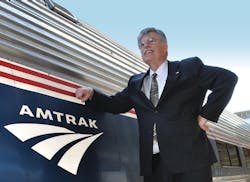
As soon as I met him, I could tell Joe Boardman was a rail guy. It probably was the story about trying to buy a short line railroad near his hometown of Rome, NY, when he was in his 20s.
Boardman got his start in transit driving bus for Cornell University in Ithaca, NY. Much like other leaders in the transit industry, he moved on and up from a college career, first running his hometown transit system in Rome, then on to running the system in Utica, and finally to Binghamton before moving to the private sector for a time.
Boardman would reenter the public sector as deputy commissioner of transportation for NY state, eventually becoming the commissioner. From there it was on to Washington, D.C.
From FRA to Amtrak
“After leaving New York state Department of Transportation (DOT), I came down as the federal railroad administrator for the Bush Administration,” Boardman says, “And that was really more about freight than it was about passenger, even though there was a link to passenger through having been secretary on the Amtrak board.”
Boardman’s time as administrator for the Federal Railroad Administration (FRA) wasn’t exactly as he had hoped, saying that the Bush administration had, “their own way that they were going,” which wasn’t necessarily where he wanted to go.
“I spent my time paying attention to rail freight safety issues and not so much toward passenger because they had somebody else doing that thinking and that thinking wasn’t where my thinking was.
“When Mary Peters came in, though, as the [Secretary of Transportation], I had known Mary for a long time, and I was allowed a little bit more freedom in terms of how to think about passenger rail,” Boardman says.
After his time with the FRA, he moved to the Amtrak board and eventually into the CEO position. And it’s from this position that he looks on an industry changing around him.
Backbone of an Industry
Boardman’s position on the transit industry is plain and simple, “Rail needs to be and is the backbone of moving freight in this country. It needs to be the backbone of moving people in this country.”
Boardman says that since he got seriously involved in the transit industry nearly 40 years ago, he understood the dangers of rising energy costs, the benefits of taking care of the environment, and the balance that needs to be struck between the two and in transit in general.
“Let me say at the start, all the modes of transportation have to be in balance, for as long as we can possibly keep that balance,” Boardman says.
“If you don’t have the balance you’re not really doing what the country needs.
“And if there is not an intercity rail passenger transportation system, then you have failed your country. Period.”
(((CALL OUT)))
If there is not an intercity passenger rail transportation system, then you have failed your country. Period.
(((END CALL OUT)))
Boardman says that an intercity passenger rail system is needed in the United States as much as its needed in France, Switzerland or anywhere else where there is a “rail culture,” although he doesn’t see that culture here, yet.
“We don’t have a rail culture here. There may be pockets of it because of New York and the Northeast. And there are some pockets of it on the West Coast and in the Midwest,” Boardman says.
“There’s a group of people that want to have a rail culture. They want the ability to have the freedom to ride the railroad both at a reasonable time and with a good connectivity. And that’s important, the frequency; the connectivity; the timing of the service.
“So I believe that we are a major player for the future in the United States.”
Committing to Change
Is Amtrak making the changes needed to become that backbone? Boardman says it already is, pointing the hiring of Al Engel as its new vice president for high-speed rail. Boardman says Engel’s responsibilities will be, “to look at both greenfield high speed rail like California and Florida, and how we take our own incremental high speed rail like is being thought of in the Midwest, in New York and some other places.”
One other thing Engel will be doing is looking at the Northeast Corridor and improving it in a way that emphasizes what Amtrak is, which according to Boardman, “what Amtrak is, is we operate railroads.”
“Our strength, our key competitive advantages are our men and women and our national interconnectivity. Coast-to-coast, border-to-border,” Boardman says.
“Those are our two critical key competitive advantages. And you will see every competitor that comes in here to go into the rail business, almost every, goes and hires Amtrak people cause Amtrak knows how to run a railroad.”
This brought up a question I had asked Boardman whether the future of rail transit in America was away from a passenger railroad to part of a passenger rail network. Boardman’s answer was to the point, “My answer to that is no, Hell no, and it better not happen.”
Boardman said not having a national passenger railroad would be like, “pulling up to somebody’s house in Iowa and saying even though there was a policy decision made back in the 30s [by the Rural Electrification Administration] to hook your house up to the power grid, it’s just no longer worth it for us to be able to do that. You’re not important because it is just one person out here, and in fact all you raise is chickens anymore you’re not even a real farmer any more.
“When I hear the idea is that we could have a little piece of a railroad here and a little piece of a railroad there, and maybe a bigger piece here and there, and not connect our nation together … this is the United States and we’re Amtrak.
“Amtrak was American Track. This is Amtrak America. This is our way to get across this country if you didn’t have a car, or if you don’t want to use your car and you don’t want to fly. How the heck else do you do it?”
Boardman says that it isn’t about Amtrak making money, and yet, it is about revenue.
“In comparison to any of the commuter rails, this company covers more of its own cost than any of the rest of them probably because it’s been required, but it’s something that, I think it’s critical for the transportation and mobility of the people of this nation to have a coast-to-coast border-to-border rail transportation network.”
Being On-Time and Profitable
On-time performance has always been a knock against Amtrak, and Boardman says this is a challenge for any part of the transit industry.
Boardman says one of the jokes about Amtrak is, “Well, the Zephyr was into San Francisco on time this morning. It was exactly the right time. A day late.”
“You can get hung up in the middle of the country if you have a major snowstorm, you have other kinds of derailments with freight or some other kind of problem.
“We understand those things. There is a different sense of on time for a 3,000-mile-trip than there is for a 225-mile-trip between NY and Washington.
“We will never lose the problem of keeping trains on time just like a bus system or commuter rail or anybody else. We’ve got to fight that battle every day all the time to keep our trains on time.
Boardman gives an example of Japan where its systems have taken the stations off the main line. This allows the fast trains to come through on the main line while other trains are stopped at the station, but safely out of the way.
Even on the Northeast Corridor, the only real high-speed corridor in the United States, Boardman says they don’t have this, which he says points to a thinking for the present instead of the future.
“There’s been this constant battle over the 40 years that Amtrak has been around of whether there is even a sufficiency in investment in infrastructure to maintain what they have let alone make improvements for the future.
“So there is a failure by this nation to really make the investment that was necessary to have high speed rail.”
With 40 million people within 40 miles of the Northeast Corridor, Boardman says that’s sufficient enough density to operate a high-speed rail service similar to other parts of the world. As for other parts of the United States, he says that, too, can work, but it must be kept in perspective.
“Remember it’s not about the speed, it’s about the time, it’s about the service, frequency, connectivity. A lot of that gets lost when we get into this big battle for who can go fastest across the country or on an alignment.”
Defining “High Speed”
One limiting factor for high-speed rail in the United States is the need to switch from diesel to electric power. In the Northeast Amtrak’s lines are all electric and Boardman says the majority of its equipment are electric and half its ridership everyday rides on electric-powered vehicles.
That isn’t to say that Amtrak is all electric. With a little more than 200 diesel locomotives, Amtrak still has a sizeable diesel fleet, which it uses across the country. But it’s the only electric railroad in the United States, which is good for several reasons.
“One its green,” Boardman says, “but also, and a lot of people don’t get this, one of the reasons you’re not going to go faster than 110 mph out beyond the Northeast Corridor is that you need to electrify if you’re going to go faster.”
Another reason for 110 mph to be a limit for many lines is the FRA requirement to remove all rail crossings — be completely grade separated — to operate above that speed, which incurs a huge cost. And when you look at the size of the United States, huge takes on a different connotation.
“A lot of people don’t [understand the scale] until they get on a train and ride across the country. The Europeans don’t understand the scale of this country,” Boardman says.
Boardman says that for the most part outside of the Northeast Corridor Amtrak operates at 79 mph on 21,000 miles of track because in part the freight lines don’t need any more than that.
But what about high speed rail? Boardman pulled out “general definitions” of high-speed rail from the Union of International Railroads (UIC) and read to me verbatim:
“We’ve deliberately used the word definition in the plural because there is no single standard definition of high speed rail or parenthetically nor even a standard usage of the term. Sometimes it’s called high speed and sometimes very high speed. The definitions vary according to the criteria used since high speed rail corresponds to a complex reality. We on the UIC high speed rail task force wanted to reflect this diversity by considering high speed from all the standpoints: infrastructure, rolling stock and operating practice.”
Boardman points out that America has become enamored with the idea of implementin high speed or very high speed trains like in Europe, which isn’t exactly what the public expects it to be.
“Europe doesn’t have high speed rail like the Americans think they have,” Boardman says.
In Europe many lines are green field areas with a straight line with one stop in the middle, which may not even be in the downtown area. Another factor is what is called “high speed traffic,” which is essentially going high speed outside of towns and reducing speed as the train enters a town only to go back to high speed once it exits again.
“There has to be an understanding and a common sense applied to what we need to do for the future,” Boardman says.
“The Northeast Corridor is high speed. It already is high speed, but to spend the dollars to take incremental minutes off from that speed is astronomical.”
Boardman points out a common sense statement that he head from someone from the Midwest: “One of the keys to go faster is not to go slower.”
“Let’s go from 20 to 40 — we just doubled our speed. Let’s fix it from 25 to 50. You know those kinds of fixes really improve railroading,” Boardman says.
“We’re not doubling our speed when we’re going from 90 to 110. We have to go from 90 to 180 to double our speed. [There are] huge costs there in comparison to all the long hanging fruit that is out there that we could fix today and for the future.”
True High Speed
So what will it take to have true “high speed” trains in the United States? To get there it will take a change in understanding according to Boardman.
“There’s a need out there for people to understand high-speed rail is going to pass you by when it’s doing 186 miles an hour. [You] can’t stop at all those little stations and still be high speed.
“Let’s go back to the Japanese example again for a minute. What we need then is a high-speed rail going down the center [track,] so you have an express line that goes all the way [to your destination] or that it’s a skip stop service or that it only stops at certain stops.
“Get those stations off the main line so that you can go very high speed to Philadelphia and stop, but somebody else wants to go to very high speed to Metro Park and stop and then the next stop for them would be Wilmington, Del., or something else. You would have to figure that out from the data that you had and the demand that you had from the public.”
Boardman says that high-speed rail will work, but it needs the density to make money for the railroad and makes sense for the riders.
Profitability
As we discussed high-speed rail, the topic of being profitable came up again, this time in comparison to other modes of transportation. Boardman was quick to point out a few things about Amtrak, especially in comparison to the aviation industry, which he says isn’t held to the same standard as any other mode of transportation.
Boardman points out that of the US DOT employees — about 60,000 people — 80 percent of them work for the FAA.
“50,000 of the 60,000 work for the FAA,” Boardman says, “Is that a subsidy to the airline?”
Boardman says the interstate highway system is similar because while there may be little more than 3,000 federal employees, each state has its own workers employed to care of the interstate highways.
“The state highway department in New York was almost 12,000 people. And they all get paid for by some level of government or government assistance,” Boardman says.
And Amtrak? It has about 19,000 employees.
“But to be fair and that number for Amtrak you have to add the maintenance of way workers for the freight railroads. So it’s higher than the 19 when you look at the total number. And [freight companies] have to pay the cost to maintain that Class 4 track, that signal system, everything across this country and they’re not subsidized,” Boardman says.
“Now interstate highways I think [has to] continue, and aviation [has to continue,] but it has to be balanced differently for the future.
“I want to say this carefully because if today aviation decided to no longer fly between New York and Washington, we could not handle the crowd. Sixty-five percent of the crowd that moves between aviation and rail is on rail. And we hear from time to time, and we hearing it again now, that aviation is going to go after that market because they want it back again.
“Is that in the national interest? For aviation and rail to really compete on this corridor? For them to spend the dollars to get the customers when aviation shouldn’t be in the 225 mile business?”
Boardman says that in the end what Amtrak wants is to be the connector for America it was designed to be.
“We’re saying Amtrak is America’s railroad. We should be operating the intercity operations, and were going to be aggressive and compete for commuter operations if somebody goes out for bid for them and were going to connect them.
And if Amtrak doesn’t get to run the system, then Boardman believes its people provide a valuable asset that can be of service.
“We’re thinking about what are the bundled services we should supply to others. Like the reservation systems and the training and the security and all the things that it really takes to run a railroad and to be a railroad. And those things we could market those as well.”
Getting a Rail Line
That rail line that Boardman wanted to buy when he was in his 20s? At that time it had to be first offered to the state, then the county, and finally to the city before an individual could put in a bid on it. He didn’t have the patience for that. Since then he has learned to have patience when it comes to adding new rail lines, especially when it comes to working with the states, which we know all too well here in Wisconsin.
“We want to run a railroad. You are our partners if you want to be our partners,” Boardman says.
“But a partner if [the states] want to say what that price should be for their local person, if we don’t collect enough revenue with that, somebody has to make that difference up. And what congress has said is that the state where that is happening has to make that up. In the Northeast Corridor we cover about 120 percent of our costs above the rail without capital even on the train — the operating costs.
“We just started for Virginia a Lynchburg service where we’re covering [our costs] so they don’t have to contribute. Because of the ridership were covering what our incremental cost is to supply the service. That might happen with Madison and it might not. We as a private company are obligated to maximize the revenue we receive from passengers or whoever is contributing.
“We don’t have to maximize the revenue if the state decided the fair price is going to be $22. But we shouldn’t have to cover the short fall if it takes 220 passengers a day paying $22 to cover that cost and we get 219 passengers a day.
“Who should accept that risk, Amtrak or the state? And the [Federal government] in the [Passenger Rail Improvement and Investment Act (PRIA)] passed in 2008 have said the state.
“If it’s a corridor service, if it’s a long distance train where you’re interconnecting across the nation — and [the Federal government] defined it as over 750 miles — it’s the feds.
“It’s the [Federal government] saying in effect we’re responsible for the interstate highway, but the local roads belong to the state and even though we might give you the aid you will have to figure out how you are going to distribute that aid.
“And I think it makes sense.”