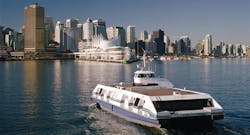
I had the opportunity to sit down with TransLink’s Ian Jarvis at this year’s APTA Rail Conference in Vancouver. The agency was on its latest effort at playing host, having earlier this year hosted the world for the 2010 Winter Olympics.
Vancouver, like its hometown system TransLink, is a great host. It’s laid back with lots going on — also like its local transit system. And Jarvis is very similar. I felt more like I was in an episode of Mad Men than in an interview with the leader of one of transit’s most noteworthy agencies — Jarvis is disarming and it was easy to just sit and chat about transit.
Growing
Jarvis has been with TransLink since, well, before there was a TransLink. The “numbers guy” for the Greater Vancouver Regional District (GVRD), Jarvis says the driver for TransLink’s creation was growth.
“The lower mainland had a growth strategy, a land use plan,” Jarvis says. “And in order to be successful on that land use plan you need to encourage transit and transportation development that supports it.
“So there was a drive by the local municipalities through the federation called the GVRD to take kind of more influence over transit — decisions in particular.
“So, I was with the GVRD as the finance person, somewhat working in the background in the creation for the first two years. TransLink was created, came into being in 1999 and for the first two years I was the CFO for the GVRD and TransLink.
“After two years of experience it was a little bit much, so fortunately I had the opportunity to make a choice and I chose to come to TransLink because transportation gets in your blood,” Jarvis emphasizes with a laugh.
And Growing
I asked Jarvis what had changed the most since TransLink’s inception and he said its growth and with that growth the confidence of its ability to deliver quality service.
“The Millennium Line, the Canada Line, two rapid transit links, close to 35 percent increase in our bus fleet and service hours. We built a tremendous amount of road infrastructure. Golden Ears Bridge, which is the region’s first toll bridge facility,” Jarvis ticks off all TransLink’s accomplishments.
“So expansion and, I guess, addressing the issue of concern would we be able to deliver,” Jarvis says.
“I think we’ve proven that we deliver, and again another off shoot of that is — very near and dear to my heart with a finance background — is being the first agency out of the shoot with respect to taking advantage of senior government funding.
“The federal, we refer to it as the gas tax transfer money. We were the first province, British Columbia was the first province, to sign. And we were the first region, metropolitan region to take advantage of it.”
Jarvis says this comes back to the organization having a plan in place and establishing a track record of successful delivery. This has allowed them to be very successful in attracting senior government money to the tune of $2 billion capital dollars from the federal government with a like amount from the province.
Numbers Guy
Having interviewed my share of directors, I was intrigued by Jarvis’ background as the “numbers guy” for Translink. Most directors I’ve dealt with have come up through operations or planning. Did this give him a different perspective on transit?
“It certainly does,” laughs Jarvis. “Accounting is in my DNA.”
Jarvis points to TransLink’s structure to aiding in his position. The organization’s operations are handled by two “significant” operating entities in the BC Rapid Transit Company, TransLink’s rail division, and the Coast Mountain Bus Company. Jarvis says the it helps to have very strong operating individuals in those two positions.
“The roll of the CEO is outward,” Jarvis says.
“You’re not successful without successful partnerships through your private sector and our local constituency, our local cities, municipalities, provincial government, federal government, key stakeholders.
“That’s a lot of the focus of the roll of the CEO here. And the other thing is that we’ve come through a period of expansion, unprecedented expansion. We have stable funding. With that stable funding the emphasis and priority now of the organization is very much around cost efficiency and effectiveness. So with my background in finance, it’s just come together by a series of circumstances and time.”
Canada Line
When I was last in Vancouver, I had the chance to see the hole in the ground that would eventually become the Canada Line. Having the chance to visit again, I was taken by how seamlessly it had integrated into the system. So was it a success? An “unqualified success,” Jarvis says.
“As with any major infrastructure project was there controversy, was there debate at its project formation? Yes there was. However, the data was there.
“It was a corridor that was already well used. The city of Richmond had the development and plans for the development to support the level of ridership and of course the connection to the airport.”
Jarvis points to the Canada Line as the latest in a series of firsts for TransLink, which include Canada’s first rail link to an international airport.
“It has been a tremendous success. Ridership is improving. And during the Olympics the ridership was a record on the Canada line.”
A spat of reports had come out just as I was about to interview Jarvis on overcrowding on the Canada Line. His response to concerns about being near capacity on the line?
“Are we near capacity? No.”
“[There are] lots of opportunities to change the service plan to increase frequency, to add vehicles, it’s nowhere near capacity,” Jarvis says.
“Because of the success folks are having to stand in crowded conditions. No different than any line I’m certain in Chicago or New York.
“This is a great problem to have.”
Closing the System
TransLink’s SkyTrain was designed as an open payment system, but plans are underway to add turnstiles at stations and close the system. As you would expect, this is a huge capital project, but one that Jarvis says will benefit TransLink in the long run.
“[TransLink] was an open proof of payment system and the stations were designed on that basis. The Millennium Line, which is an extension to the original [Expo] Line and the Canada Line, the stations were designed for fare gates.
“So part of the challenge and the construction project path for smart cards is that we’ve got to retrofit a number of the stations on the Expo Line to enable fare gates,” Jarvis says.
Jarvis says the key driver for this change is the implementation of smart card technology and responding to concerns about safety and security.
“What that brings in terms of the data on origins and destinations, ridership, enables us to plan smarter as well as price smarter,” Jarvis says.
“We can bury our pricing schemes to encourage folks to use our infrastructure and services when we have capacity. That‘s the key driver in order to enable that on our rapid transit system. Customers do need to tag on and tag off, and the most I guess orderly way of doing that is through an array of fare gates.
“There is a strong business case from the perspective of increasing ridership because in my experience people feel that a gated system is a safer system. Some folks don’t ride the system for fear of factors around safety.”
Jarvis says this coupled with reducing fare evasion, being smarter about planning routes and operating cost reductions pays for the investment.
Winter Olympics
Vancouver may have been the home of this year’s Winter Olympics, but TransLink was its unofficial host, having to move all the athletes and spectators while maintaining its normal passenger load. Jarvis says TransLink’s expansion had been a key factor in its success, but the real difference was in “the softer side of the business.”
“The customer service. All of our poor finance folks that had to deal with statutory deadlines. We had everybody out on the system during the Olympics acting as transit hosts or in our communication center responding to customer service needs,” Jarvis says.
I asked Jarvis how his staff and the public responded to this all hands on deck atmosphere.
“The system was stretched because we had queuing at some of the downtown stations. The maximum queue was 40-50 minutes over at SeaBus on the north side and at our main hub at waterfront where we have West Coast Express commuter rail coming in, SeaBus coming. So queue management became an integral component.
“It took us a couple of days to get those schemes working well. But everyone was in a great mood. Customers were in a fantastic mood. It was a great atmosphere,” Jarvis says.
“It all worked very well.”
So what lessons did they take away from such a momentous challenge? Jarvis says that it is that their vision for TransLink is an achievable one.
“You look at our Transport 2040 document, which is a vision for the transportation 30 years out and a list of six objectives similar probably to any transit or transportation agency across North America or in Canada. You put those elements together.
“We had the assets; we had the funding to enable the service. We encouraged folks to think about transit as an alternative. And incenting that by having transit in the event tickets. Work with educational institutions and shopping centers to have additional park and ride facilities.
“The origins and destinations were on transportation corridors that had the capacity. [There was] partnering with the city to give priority on the road network to priority trips.
“You put that all together, it works. You can move tremendous amounts of people very effectively,” Jarvis says.
“That’s the legacy from my perspective.”
Ridership and Revenue
I asked Jarvis if the Winter Olympics had a sustainable increase on TransLink’s ridership and he said it’s early, but that overall system ridership is up after the event showing that they did maintain some Olympics ridership.
Jarvis points to the Canada Line which is in excess of 100,000 rides a day.
“It’s important to know that the Canada Line connects to the airport, but it also connects to another major destination, which is the city of Richmond,” Jarvis says.
“There’s a fair bit of development and density that exists along the line out there. So I would … my experience on the Canada Line is that there’s a mix of commuters, shoppers, folks, greeters going up to the airport, travelers and in terms of the profile around ridership during the day, it has peaks as any system does, but there is pretty good ridership during the day and late evening as well.”
Jarvis says TransLink benefits from a broad mix of revenues, but close to 40 percent of operations are funded by the farebox with property and fuel tax evenly split making up the remainder.
“In our experiences that’s fairly positive,” Jarvis says.
“Are we vulnerable? Yes, [you’re] vulnerable when you rely on transit. Transit varies with the economy, and so do fuel taxes — and they also vary with price. If the price goes up, it costs us more and people that drive cars are more likely to consider transit.
Jarvis says that looking forward you need to start looking at sources that drive not only revenue, but encourage people to consider the impact of the trips they are making.
“So [using] revenue sources that have a demand management component to them,” jarivs says.
“And encourage the most productive use of the services that we have available. That’s going to be the challenge going forward for the region.”
Transit Coordination
Being caught literally between a rock and hard place in the mountains to the east and ocean to the west, Vancouver has to be careful about its growth — and this especially includes transit.
“What transit and transportation is about is creating great places to live and work, to maintain the livability and economic viability,” Jarvis says.
“So it all starts with that, so it’s got to go with land use and economic planning. So by mandate our long term plans need to support the land use plans for the region.
“So we work in close partnership with metro Vancouver who has responsibility for regional land use planning. Also we work closely with — there are 21 municipalities that make up the metro Vancouver. We work with them. Were out reviewing their official community plans to make certain that they get comments relative to the developments being supportive of good transportation. So it all starts at that high-level planning.
“And then on the street we have since inception undertaken area transit plans. We split the region into sub-regions and again worked with public stakeholders and member municipalities around identifying those transit services that are required to support smart growth in their communities.”
Jarvis says it’s not about having direct authority over anyone when it comes to transit decisions so much as its influencing through collaboration and partnerships.
“It’s a value that’s held close to the heart here in our residents and stakeholders,” Jarvis says.
“That being the case we’ve been successful and others tell us we’re successful in developing a transportation system and developing in terms of land use development in a fairly effective way.”
Integrated Lessons
I asked Jarvis what lessons could other agencies take away from TransLink and he said to look at the system and see how it’s integrated.
“That was something folks long before I was around made it. We benefit that we have an integrated transportation system,” Jarvis says.
“We have one of the largest service regions of any transit agency and it’s integrated. Our West Coast Express commuter rail or SeaBus or bus, there’s no transfers. It’s one system with respect to the way that the customer looks at it. So out on the street that would be the key lesson.
“And two is that we all work for a higher cause. And that’s about serving the residents and constituents in our service region and both creating a great place to live and work and play. That’s the higher cause. That’s what keeps me grounded.”