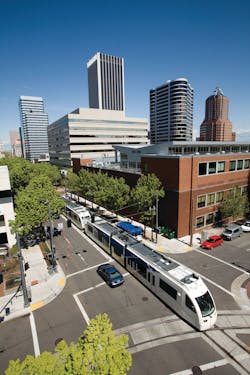
After nearly 12 years at TriMet, General Manager Fred Hansen will soon be leaving his post to pursue other opportunities. While he wasn’t ready to share any potential plans for the future, livability and the transportation connection will remain an important focus, as well as promoting greener transportation.
As one of our reader-chosen locations, TriMet ranked high as an agency people wanted to read about. Going to meet with Hansen after the announcement of his departure was a first for Mass Transit magazine, but it provided a great opportunity to get an update on what’s happening in the Portland area and to get Hansen’s perspective on the transit industry and sustainability.
Keeping Service Running
The morning I visited TriMet it was in The Oregonian, the local paper, for service reduction and a fare increase. With one of the highest unemployment rates in the nation (the state is still at about 10.6 percent), the payroll tax, the principal funding for TriMet, is down.
Hansen says they haven’t had to take as serious reductions as other properties in the country, but as he puts it, it’s been, “exceedingly painful.
“We took a $31 million dollar reduction and then another $27 million we’re having to take in the upcoming fiscal year,” he states. “That’s about 12 percent and that’s serious.
“When we have to get to those kinds of numbers, we have to do some service reduction.” He continues, “We focused it on some of those frequent service lines that are every 15 minutes and pushed them up to about every 17 minutes.
“Of course that’s a little less convenient because there’s one bus out of the cycle, but it still is providing service.” Along with that, they looked at low-performing lines and either eliminated them or drastically cut them back.
TriMet also proposed a challenge to the community in areas where they were looking at reducing or eliminating lines. When people came forward and said not to cut those lines, TriMet proposed extending service for another six to nine months and the riders and local businesses along those lines are challenged to get ridership up.
“You who want this, you’ve got to work with us to be able to get ridership up because it just isn’t justified in these budget times to have as low ridership as we do on that particular line,” Hansen says. “We have to see whether the businesses and the individuals are going to step up to the mark or not.
“People wanted to say, ‘You’re the transit agency, you guys have to deliver,’” he says. “No. This has got to be a partnership; businesses have got to maybe provide transit passes or encourage their employees, individuals on the bus have to talk to co-workers, ‘Why don’t you come with me?’”
This process was started in April with results to be determined sometime this fall.
Riding the 17 to the TriMet office, I saw first hand TriMet leading by example as a business that encourages transit use. It’s standard that an agency provides its employees with free access to transit, but the amount of use I saw in my brief time at the agency was surprising with so many employees getting on and off at the stops in front of the agency.
Hansen stresses, “I think it is important to be a role model. People know that I’m a regular rider for my commute.”
Making Transit an Asset
Thinking of transit as a community asset as opposed to a utility is one of things Hansen thinks is very important. In Portland, he says it really is about how they build neighborhoods, how they build communities, how they really connect people.
“There isn’t a travel magazine that writes about coming to the Portland region that doesn’t talk about using public transit,” he says. “It’s really become a signature of this region.
“Every area needs to be able to think about how do they make their transit system become, likewise, a signature of that region.” He adds, “I don’t think there’s one simple answer that fits.”
One example he shares is of the community, Bend, Ore. Located in the high desert of central Oregon, the Deschutes River flows through the middle of the city. “They end up having a lot of people float the river in the hot summer months,” Hansen says.
“The transit system put together a Ride the River raft operation so they would have a trailer behind the bus to be able to pick up rafts and go back upstream.” He continues, “It was something that was very important in the community. It connected that service with what people wanted.”
He stresses, “Each community has got to be able to find those things.”
Over the next 25 years, the area expects a million more people moving in. Having transit as a community asset and preserving the livability of the region is key.
Hansen says that when he first came to the area, many places around the region would say no to light rail. The statewide land-use laws were originally created to protect farmland and forests that were being eaten up by sprawl.
“Now it really is about making compact urban areas really work,” says Hansen. And others see the importance. He says that when looking through the real estate sections, “Whether or not to rent this apartment or buy this house is usually how close it is to us.”
When talking about rail now, he says that he can’t go to a community that doesn’t now ask, “When do we get ours?” As he says, “That ability to put together partnerships, the ability to get the developers, the marketers and the others to be able to understand that and to see it in their own terms is key.
“The real challenge is, how do we grow in a multifaceted way that really protects communities, protects neighborhoods and really allows people to be able to get around in what we call the 20-minute neighborhood; to be able to get to all your essential services, or most of them, in 20 minutes: biking, walking or riding us,” says Hansen. “You’ve got to find ways to do that.”
Transit and Sustainability
As former chair of APTA Sustainability Task Force, I asked Hansen how he views where the industry is at. “I think that the industry as a whole is becoming more aware of the environmental, sustainability issue.” He adds, “I don’t think they’ve moved very far yet on the idea of a community, they see themselves principally as a utility and I still think they’ve got a long ways to go on the sustainability.”
He’s not sure the industry has evolved while he’s been in it, but feels it’s starting to. APTA’s sustainability effort has helped to get things started.
“We had to have aggressive goals, that even to become a signator, you had to do real things, real aggressive,” he explains. “If you were going to get into any of the higher levels, it was really going to be a stretch and ultimately, on the final step before the platinum level, for any property to sign up for it today, it wasn’t tough enough.
“I really wanted it to be able to be stretch goals and over time, these are going to have to become even more aggressive as we continue.”
He says he’s found that communities across the nation, communities of all sizes, think these issues are important and want transit to be greener. “They want them to be more sustainable; they need to be able to find ways to do that. There’s been a thirst for the tools to be able to do this. I think we can in fact pull the industry along.”
He adds that if we’re not the leaders in sustainability, we would not have a place at the table to be discussing federal legislation regarding climate change. “We had to be able to step up to the bar and be aggressive if we were going to be credible.
“My work in environmental protection, I always thought one of the most important issues has always been what our urban areas are just from a straight pollution standpoint and how they operate. And public transit is connected to all of that,” he says. While at the EPA, he and Mary Nickels put together for the first time, recognition in the EPA world that smart growth, land use, could be counted as a partner strategy to be able to address meeting the national air quality standards for ozone.
“We did that really by allowing the Portland region to be able to have in their state implementation, to be able to have as one of the strategies, land use that would in fact cut down on the amount of driving necessary.”
To make transit successful, Hansen says he’s seen many European communities in particular that have created places pedestrians want to be. What does that include? “Safe crossings at streets … slower traffic, it has to have interesting things to look at or coffee shops or various other things,” he says.
“A pedestrian-friendly city is key because every transit trek starts with a pedestrian. The question is how do we really make that work well together.”
While in Australia in the capital city of South Australia, one of his major messages to them was to make it pedestrian friendly. “It isn’t going to really work no matter what kind of transit, you’ve got to make it pedestrian friendly.”
A Look from the Outside
As one of the anomalies of becoming a general manager that hasn’t grown out of the transit world, Hansen has a different view of the industry.
“There are some exceedingly good people in the industry, but I do think that in the long run, the industry has to not be quite so insular.” He adds, “I think there is value to be able to have more people with different sets of experiences … being able to expand views is always important.
“I think that too often in any field, but the transit field in particular, people get very insulated and they, as a result, get very defensive and say, ‘Well if they just understood, or , If they knew what it was like.’ And the answer is, unless we are able to explain that in terms that people really understand and also take responsibility for the things that we do have control over, you’re never going to be able to get ahead of that issue.”
Leaving TriMet
Reflecting on his time at TriMet, there are four areas that he’s most proud of, including expanding service on the rail and frequent bus side, the participation of the community and then the use of technology.
“We have expanded the backbone of the system, that is the light rail,” he says. Three lines have been opened during his tenure, including the Airport Max Red Line, the Yellow Line, the Green Line and they’re halfway along the Portland-Milwaukie Light Rail Project.
The frequent bus service has been expanded from four to 16 routes. The all-day-long and into-the-evening service comes at least every 15 minutes seven days a week. “Frankly our high-frequency bus service is really the workforce of the bus side, it will always be very, very important,” Hansen says.
“As a regular rider, I know, we do the normal rider dance. Get to the bus stop, you look down to see if a bus is coming, you look at your watch, you proceed back and forth and repeat the process again,” he says. “If you know you can get a bus that comes at least every 15 minutes, at worst you just missed it so it’s 14 minutes, but on average, 7 1/2 minutes.”
He stresses, “You don’t have to think about it with the frequent bus. You don’t have to think about whether it’s on Saturday and therefore only comes every half hour or is it Sunday and it doesn’t come at all. It’s predictable.”
Expanding employment of minorities and women, as well as their participation in construction projects is the third point mentioned. One of the commitments he made when he came to TriMet he says, was to restore African American communities that had not been treated that well by other major public works projects.
“When we built the Max Line, we involved in direct hires and contracting people from those minority and lower income communities and we did it in such a way that really built capacity in those small contractors,” says Hansen. “They could bid on bigger contracts and such and we did it in a whole lot of very creative ways. We set the bar very high and in fact, is now the bar being used.
“Most recently the deputy secretary of transportation sent out a letter, a “dear colleague” letter and we were listed as one of the models.” He stresses, “I’m exceedingly proud of that.”
Finally, he says the fact that they are a leader on the technology side is something else he has been very proud of.
There’s an App for That
Open data has led to creative ways for riders to access information at their fingertips and at little cost to the agency.
“It kind of got driven by one individual, a real transit advocate, community activist, by the name of Chris Smith,” Hansen explains. “… three years ago he programmed his phone. He had three options to get home. He could either ride the streetcar or one of two bus lines. He programmed it so that when he wanted to go he would just pull up what the order of the arrival times of the three different options were.”
TriMet reviews any potential apps to make sure they’re supported and will work, and then they go on the system and people can make use of them if they choose to.
The day before I visited, five more apps were added. Hansen describes one of the newest apps. “… with the new 3G iPhones you can hold your phone up in camera mode, look down the street and it will show: the TriMet logos come up with the stop signs and it will also show you the arrival times of the vehicles at those stops.”
There are a number of reasons why Hansen thinks their apps have been so successful. “One is we have just excellent people in our IT department,” he stresses. “They’re leaders in the nation and could easily go get a job anywhere they wanted. So it’s talent.”
Second is that people at TriMet use the system. “As a result, you get kind of an instinctive understanding of what people want,” Hansen says. “People who ride the system know the same sort of thing. They want to know how to be able to really make use of our system and our data.”
In tight budget times and previously when looking at spending between $4,000 and $5,000 per stop for electrified stops with reader boards, phone apps are providing an inexpensive and rider-personalized option. “… people started having cell phones with this ability … so we said hold it, we are going to make the information available and let others use their devices to be able to access it,” he says. “And no with iPhones it’s unbelievably different,” he stresses. “Our goal is, except for in very heavily used areas, we’re not going to be supplying that information on reader boards, we’re going to expect people to use their own devices.”
Looking Forward
The longest Hansen has had off between jobs in his career has been 11 days. He says with a laugh, “I don’t mind getting that up to 12.”
He says there’s never a good time to leave but chose this time because, as he says, “I think we’re through the worst of the budget process. I don’t think there’s going to be additional cuts and our labor agreement will be in the final process for resolution.
“The opportunity to be more seriously involved, for me at my age, I get to do one more thing significantly. I want to be able to have time to do that.
“ … sustainability, environmental, land-use transportation connections regionally, nationally and internationally are very important to me and so I hope to stay involved in those.”