“Volcanoes Disrupt European Travel; Weakens Economy.”
“Coal Mine Explosion Kills 23.”
“Oil Spill Threatens Domestic Energy Supply; Harms Environment.”
These are recent headlines that heighten the need for America to move thoughtfully, but quickly to plan, build and operate a new transportation alternative that will help relieve congestion in virtually all modes of America’s transportation system. If powered by nuclear and renewable energy, this will reduce both the nation’s carbon footprint as well as its dependence on fossil fuels and potentially create and retain tens of thousands of good paying jobs.
Stimulus Spark
In February 2009, the Obama Administration announced that $8 billion would be included in the economic stimulus package, the American Recovery and Reinvestment Act of 2009 (ARRA), to begin work that would fulfill the president’s vision of high-speed rail service in America comparable to the service enjoyed for decades in Japan, in much of Europe, and now in China, Saudi Arabia and Russia.
In making his announcement, the president said: “Through the Recovery Act, we are making the largest investment in infrastructure since the Interstate Highway System was created, putting Americans to work rebuilding our roads, bridges and waterways for the future. That investment is how we can break ground across the country, putting people to work building high-speed rail lines, because there’s no reason why Europe or China should have the fastest trains when we can build them right here in America.”
According to the Department of Transportation’s “Vision for American High Speed Rail,” a publication issued late last year, “The president proposed a long-term strategy intended to build an efficient, high speed passenger rail network of 100–600 mile intercity corridors, as one element of a modernized transportation system.
“In the near term,” said the administration, “this proposal lays the foundation for that network by investing in intercity rail infrastructure, equipment and intermodal connections, beginning with an $8 billion down payment provided under ARRA, and continuing with a high speed rail grant program of $1 billion per year (as called for in the President’s FY 2010 budget proposal).”
The department said that the near-term investment strategy seeks to:
“Advance new express high speed corridor services (operating at speeds above 150 mph on primarily dedicated track) in select corridors of 200–600 miles.”
“Develop emerging and regional high speed corridor services (operating at speeds up to 90–110 mph and 110–150 mph respectively, on shared and dedicated track) in corridors of 100–500 miles.”
“Upgrade reliability and service on conventional intercity rail services (operating at speeds up to 79–90 mph).”
The administration is selling the concept of bullet trains — truly high-speed service. At the same time, the administration’s program is incremental, improving or upgrading present service and in some places introducing new conventional passenger rail service.
Through the stimulus package the administration is making what it believes to be strategic investments that focus on three primary areas that will deliver transportation, economic recovery and other public benefits:
- Building new high-speed rail corridors that will fundamentally expand and improve passenger transportation in the geographic regions they serve;
- Upgrading existing intercity passenger rail services; and,
- Laying the groundwork for future high-speed passenger rail services through smaller projects and planning efforts.
The initiative invests or encourages the investment in significant improvements to currently existing right-of-ways owned and operated by the various freight railroad companies and, in perhaps just two or three cases, it actually underwrites the planning and construction of what the administration terms high-speed rail express service — trains that will run at speeds up to 220 mph.
FRA Approach
In discussing the administration’s high-speed rail initiative before the House Transportation and Infrastructure Committee in October 2009, Federal Railroad Administrator Joe Szabo discussed in length why the administration took this approach, and further outlined what he termed the six challenges to sustainable high-speed rail. In part Szabo said:
Safety — “… In most instances, high-speed rail will not begin operations on dedicated right-of-way and infrastructure. Instead, most proposed systems will involve the use of rights-of-way and perhaps infrastructure owned and operated by America’s freight railroads. The co-location of high-speed rail and freight operations raises significant safety issues, not the least of which is determining what point high-speed passenger rail operations need to be separated from freight rail and the nature of that separation …”
Capability of the States — “Until enactment of the Passenger Rail Investment and Improvement Act last October, there was no statutory role for states in the planning and implementation of intercity passenger rail except for the occasional one-off grant contained in FRA’s annual appropriation. Until February of this year, there was no real funding to go with this authorization. There is now a significant and pressing need to help the states develop and maintain the internal staff resources and capabilities to oversee the management of planning and program implementation of high-speed rail ...”
The Status of Planning — “The challenge we face with the advent of the high-speed rail program is that there are many states playing catch-up. How can we bring them up to the point that they have a realistic high-speed program plan and implementation strategy so that they too can have the pipeline of rail projects like they have for other forms of transportation?”
Freight Railroad Partnerships — “… The challenge that we face is how to develop the infrastructure that permits emerging high-speed rail and freight rail to not only co-exist but to find the synergy to keep both world class. This will require a new level of partnerships between the freight railroads and the state promoters of high-speed rail … For many states used to solely investing in publicly owned infrastructure, however, the shift to investing public funds in privately owned assets may be a new and challenging experience.”
The Intellectual Infrastructure — “ …A major challenge that we face today at the advent of the new high-speed rail program is rebuilding this intellectual infrastructure in such diverse areas as track design, signal engineering, track-train dynamics, etc …”
And, Sustainability and Managing Expectations — “There have been many efforts to promote development of high-speed rail over the years. The challenge for the administration and Congress is to make this program sustainable … The public support for the [Interstate] program did not wane, in part because our citizens could both see early successes and they knew that eventually the Interstate system would serve them as well. Of all of our challenges, this may be the most important to address.”
Funding Reality
Moving forward to January 28th of this year, after a six-month interval during which 41 states in 12 designated high-speed rail corridors and the Northeast Corridor submitted 259 grant applications requesting nearly $57 billion for various rail improvements in the name of high-speed rail, President Obama and Vice President Biden traveled to Orlando, Fla., where they announced that 79 proposals in 31 states were the winners.
These winners included:
|
Project |
States |
Total Investment |
New Miles |
Upgrades |
Top Speed (mph) |
|
California |
CA |
$2.3 Billion |
800 |
880 |
220; 110 |
|
Chicago-St. Louis |
IL, MO, KS |
$1.3 Billion |
- |
570 |
110 |
|
Orlando-Tampa |
FL |
$1.25 Billion |
84 |
- |
186 |
|
Hiawatha |
WI, MN |
$823 Million |
32 |
144 |
110 |
|
Northeast |
9 States |
$706 Million |
0 |
363 |
150 |
|
Southeast |
VA, NC |
$620 Million |
- |
480 |
110 |
|
Pacific Northwest |
OR,WA, BC |
$598 Million |
- |
437 |
79 |
|
3-C Corridor |
OH |
$400 Million |
250 |
- |
79 |
|
Michigan |
IL, IN, MI |
$244 Million |
- |
300 |
90 |
|
Empire |
NY |
$144 Million |
- |
462 |
110 |
|
Albany- Burlington |
NY , VT |
$50 Million |
67 |
- |
79 |
|
Vermonter |
NY , CT, MA, VT |
$ 40 Million |
11 |
261 |
90 |
|
Downeaster |
ME |
$35 Million |
30 |
- |
79 |
|
Keystone |
PA |
$26 Million |
- |
111 |
110 |
|
Iowa |
IA |
$17 Million |
- |
- |
79 |
|
Albany- Montreal |
NY , Quebec |
$7 Million |
- |
3 |
79 |
|
Fort Worth |
TX |
$4 Million |
- |
- |
79 |
|
Total: |
|
$8 Billion |
1274 |
4011 |
|
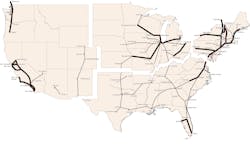
As the chart and map above indicate, the big winners in this first round of stimulus funding were the Midwest ($2.8 billion), California ($2.3 billion) and Florida ($1.25 billion). Amtrak’s Northeast Corridor also received substantial funding through a combination of ARRA and other funding, primarily through the Passenger Rail Improvement and Infrastructure Act of 2008 (PRIIA) ($1.5 billion).
In addition to these stimulus funds, the Department of Transportation, since mid-March, has issued at least six announcements and notices seeking proposals for high speed planning and construction projects in the various corridors already designated by the FRA. These projects will be funded from monies left over in the stimulus and PRIIA programs as well as FY 2008, 2009 and 2010 DOT appropriations.
The administration notes that these funds, now totaling more than $13 billion between ARRA and PRIIA, are just the beginning. Indeed, some estimate that the network of high-speed corridors reflected in the map above could cost as much as $1 trillion to complete over the next several decades, particularly if it is pursued in the incremental manner described by the administration.
History Revisited
Not since America launched the Interstate Highway System has the nation undertaken such a massive infrastructure project. Indeed, Congressman James Oberstar (D-MN) intends to seek $50 billion in the next multi-year surface transportation authorization bill as well as a variety of ways to pay for and sustain the initiative.
Among the various strategies under consideration are: establishing a long-term federal funding source like a possible dedication of revenue authorized through a climate or carbon reduction initiative, an expansion of the Build America Bond program, the use of public-private partnerships and possibly creating an infrastructure investment bank facility similar to one widely used to finance infrastructure projects in the European Union.
The development of American high-speed rail has, to this point, been a work in progress dating back at least to the mid-1990s. In 1997 the Department of Transportation produced a significant and rather comprehensive plan, but the winds of change blew and efforts to aggressively pursue the plan were set aside. In the last decade, quiet deliberations at the national level have gone on, but at the state and regional levels, serious discussions have ensued. California, various states in the Midwest, Florida, Pennsylvania and Texas have been hotbeds of planning and development, and in the Northeast Corridor Amtrak has been working steadily toward developing plans and executing efforts pointing toward the eventual deployment of truly high-speed rail service equivalent to the service currently experienced in Europe, Asia and other areas of the world.
National Plan Challenges
The next step in this process includes the enunciation of a nation plan. To that end, Congress directed that the FRA present a long-term strategic plan by mid-October. In response, the agency issued a preliminary national plan last October and on April 5, issued a request for comment on a final national plan with instructions that comments intended to affect the plan be received by May 3, and all others by June 4. While this is an objectionable situation, it does highlight the urgency of moving the high-speed rail initiative forward.
Additionally, the six challenges to sustainable high-speed rail outlined by FRA Administrator Szabo do require attention.
For example: While Greenfield development would be preferable, is there validity and a rational strategy to, as one local official described it, “go from gravel roads to a six-lane expressways”; i.e. go from virtually no passenger service to truly high-speed rail services?
Should America have national procurement standards for high-speed rolling stock, signals, switches and the other hardware required of high-speed rail systems included in a national high-speed rail plan?
Can we establish national safety standards and operational guidelines appropriate for passenger service operating on tracks shared with other rail services, while pursuing more appropriate standards for high-speed passenger rail service operating on grade-separated, dedicated and secure railways?
How will state transportation departments that have been thrust into a new role as administrators and managers of passenger rail services achieve success?
Can our nation’s education system and especially universities play a vital role in developing both the intellectual infrastructure of state transportation agencies as well as the capacity of workers in the industry to organize, plan and administer the new American high-speed rail industry?
Can we bring the Class 1 freight rail companies together to address their myriad of concerns, most especially indemnification from liability, to make passenger rail service and especially high-speed rail service in America a winning proposition for all concerned?
The Department of Transportation estimates that for every $1 billion invested in infrastructure development and maintenance, 20,000 jobs are created or retained. Additionally, according to the American Association of Railroads, each of those jobs support an additional 4.5 jobs in the general work force. But what are these jobs and how, given that most of the high-speed rail expertise in the world is found in Europe and Asia, will American workers be recruited and trained to operate America’s high-speed rail system?
The Department of Transportation has launched the Work Force Development initiative that aims to identify the needs of America’s transportation industry in the 21st Century. This effort will reach a milestone, but not the ultimate milestone, with a White House Conference on the Transportation Workforce of the 21st Century now being planned before the end of this year.
Even more important than a White House Conference, universities and other educational institutions, especially the DOT-sponsored University Transportation Centers, must initiate educational programs that will train and guide America’s 21st Century high-speed rail workforce.
Labor must be recruited to support the creation of training and retraining programs that will redirect the careers of American workers who have lost their jobs during this recession so that they may become highly compensated participants in America’s effort to rebuild its passenger rail system and ultimately build American high speed rail.
Public Education
The general public must be educated to understand that we are working now to meet the transportation needs of a future generation.
The U.S. Census Bureau estimates that the American population will grow by at least 100 million between now and 2050. While some would suggest that, based on today’s practices, people will still prefer to drive everywhere, and that the grossly inadequate level of rail service today could not imaginably be improved in the future, reason would suggest that is not the case.
Changes in life styles, changes in energy sources and use, sensitivity over the environment, limits on how much can be done to continue building and maintaining other forms of over-burdened, inefficient transportation and other societal needs will require the development of a transportation alternative like high-speed rail.
Climate and energy conditions dictate that we find and use transportation technologies that consume less non-renewable energy and reduce our carbon footprint.
There is a very narrow window of opportunity here to build the momentum to get this job done. The conditions of our climate and fast paced issues of this world’s times dictate leadership and action that will serve generations to come with American high-speed rail.