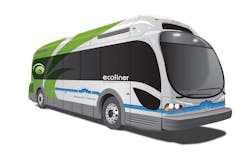
Listening to Foothill Transit’s director of operations, George Karbowski, it is easy to see how similar transit is to hobbies. In Seoul, South Korea, an amusement park tram is running on electric power fed from strips imbedded in the road — like a slot car track. And Karbowski’s zeal describing the new Proterra buses Foothill Transit unveiled this spring is like a kid opening his first electric radio-control car. And that’s what these new buses most resemble, not hybrids, not plug-in hybrids, but quick-charge radio control cars — although it should be noted the buses aren’t radio controlled.
“This is really a terrifically exciting project,” Karbowski says.
He explains that the whole project started while discussing what to do with some federal stimulus dollars Foothill Transit received. Karbowski says in a moment of weakness he raised his hand and asked about electric buses, and it just went from there.
“My wife said, that’s what you get for opening your mouth,” he laughs.
Karbowski says the Foothill Transit board has been the real motivating force behind the project. When it was brought to motion, the entire executive board seconded it, a first in Foothill’s history.
Karbowski says the order is for three buses by this summer with an option for nine more. That is if these new electric buses prove their mettle in service.
“The key to demonstrating this project, when everybody talks about electric buses they talk about how many miles can you go on a battery charge,” Karbowski says.
“Well, we’re deploying these buses within a system and that system includes an in-route charger. So we tell everybody the mileage is unlimited when it’s running in this system. It can literally run 24-hours-a-day seven-days-a-week.”
The initial three buses plus the option for nine more will allow Foothill to completely electrify one line. And it’s not just any line, it’s a critical line to the system.
“We’re not hiding this in the back corner. We put it on a line that carries about 5 percent of our annual ridership with only 2 percent of our buses,” Karbowski says.
“It is a very transit dependent line. It travels by schools, hospitals, DMVs, Social Security. It has a high wheelchair ridership. It’s a line that requires a workhorse bus.
“We don’t want to bring a niche electric vehicle in and say oh yeah we’re running it for the sake of doing it. We want to demonstrate that this is a true transit option.
“And then if we can validate the lifecycle costs, operating that kind of service then you know the future could be just about anything.”
Electric Power
Karbowski explains that the secret to these buses really lies in its batteries.
“There are a couple of things that lend themselves to making this project a reality, but probably the single most important item is the development of new battery technology, Karbowski says.
Karbowski explains that lithium ion batteries will accept huge amounts of charge and discharge very quickly.
“With a conventional lead acid battery or a NiCad or a variety of other batteries that are out there, when you try to charge or discharge them very quickly they build up really high heat because of the resistance in the anode and cathode,” Karbowski says.
“The lithium ion battery — the chemistry of the battery — it doesn’t do that. They do generate some heat during charging, so the battery system does have its own cooling system.”
The batteries Foothill is using were designed by Altairnano and are actually lithium-titanate because of the titanium used for the batteries anode and cathode. Karbowski says that they chose these batteries because titanium anode and cathode material has the highest charge and discharge amount.
“So again it’s a factor of you can plug huge amounts of electricity into the battery, but it either won’t accept it because of high resistance or build up a lot of heat. The lithium ion batteries do not do that, so that’s what is really the driver for the project,” Karbowski says.
“It’s a very complex piece and very expensive. And they’re very new to the market, but the lithium in them is recyclable. So, let’s say the battery pack lasts us six years, the battery can then be recycled by — and we don’t know what the process is because it's brand new — but the lithium does not degrade and can be used in a new battery by repackaging it.”
Composite Structure
To offset weight and to give the new buses a little more durability they are built using a composite structure. Karbowski says they hope this will also extend the bus life for a number of reasons.
“It’s non-conductive. It reduces weight, which all have impact on how we operate, but we can probably run [these buses] for 18 years without compromising the quality of the structure. And that’s critical in getting the lifecycle cost down,” Karbowski says.
“And we say composite, and in reality it’s probably about 11 different types of fiberglass resin combinations. In areas that require high strength [there is] some carbon fiber, but it’s predominantly fiberglass, so it’s really easy to repair internally.
“In fact, the company that is manufacturing the bodies for Proterra is a company that manufactures upscale yachts and prowler fishing boats which are pretty common in the fishing industry.”
Foothill Transit does all of its own bodywork, which can be costly and time-consuming. Karbowski says the composite structure of the new buses, though, helps mitigate that.
“It absorbs and distributes a lot of energy throughout the structure, so bodywork is one of the other factors with this composition structure that helps reduce lifecycle costs,” Karbowski says.
Weight is always an issue when it comes to transit buses. This is especially the case when it comes to something like Foothill Transit’s new electrically powered buses. Karbowski says the composite structure is probably 20 to 40 percent lighter than a conventional steel bus.
Whiles some past composite structure vehicles had a monocoque construction, Foothill’s new bus adopts a slight change to that design.
“While the stuff is all still bolted to the structure itself, they have some steel stiffener pieces built into it just to give it a little added strength,” Karbowski says.
“More importantly, it makes replacing suspension components later on in the life of the bus a little bit less of a challenge because they bolt up and on and off pretty simply.”
Maintenance
Karbowski says though the new vehicles have a ground-breaking electric drive system, they make maintenance easier by keeping things simple wherever possible.
“First of all, when you look at the bus itself, it is a very conventional bus. There is not a lot of fancy stuff on it that is going to require unique maintenance,” Karbowski says.
“I mean it has standard suspension, standard steering, standard electrical system, and lighting. Now some of the components, like the air conditioning/heating system, is all electrical, but those are still products that are understood from trolley buses and rail.”
Karbowski says even the new drive system isn’t overly complicated when you compare it to hybrid systems that are popular in transit agencies across the nation because they have an impact on lowering the emissions, but they don’t have a huge infrastructure impact.
“A hybrid bus is really similar to the electric bus, it has an electric drive system and a battery system, but the hybrid buses add an auxiliary power unit, a genset of some sort, which makes it more complicated than an electric bus,” Karbowski says.
“And when you go to a fuel cell bus, you make it even more complicated, so what we’re envisioning is that bus costs will be very similar to any other bus in our fleet.”
Karbowski says the technology is very simple, “Obviously it's different, and you know that is a challenge for today’s maintenance technicians, but I just have high hopes for this being a very cost-effective vehicle to maintain.”
Karbowski says one of the hidden profitability elements about these new buses may be time. Most transit fleets run throughout the day and when they come in at night they line up to be fueled and cleaned, which means that any maintenance for a bus must wait for a couple hours while it is fueled and cleaned. But Foothill’s new electric buses can skip to the head of that fueling line.
“We don’t contemplate with the electric bus doing any charging in the yard — all the charging will be in-route,” Karbowski says.
“So when that bus comes back to the yard, it basically has to get vaulted and cleaned. It doesn’t have to sit and wait to get fueled. That means it could be available a couple extra hours every day for any kind of maintenance procedures.
“So when you start looking at the grand scheme of things, a larger fleet of these that doesn’t require fueling in the yard means that you could help reduce system costs by lowering your spare ratio because the bus is available more.”
Footing the Bill
One metric Foothill will be monitoring closely is the vehicle’s lifecycle cost, which is especially important with less funding for transit today.
“With the huge impact on funds available for transit we’ve got to be a lot smarter on the technologies that we buy,” Karbowski says.
“The cheapest bus to buy is not necessarily the best deal for transit. So one of the design goals for this bus is to develop a lifecycle model that demonstrates that this bus, we hope, is going to be competitive with other types of alternate fuels technology. But again, it’s over a long lifetime.”
Karbowski says they are currently considering a battery change-out and drive motor change-out at about six years, meaning two change-outs in the bus’ 18-year lifecycle.
“One of the other very interesting things that the automotive industry is pursuing and it could have an impact on transit is the automotive industry is saying, you know since lithium is recyclable why don’t we look at not selling the batteries to people, let’s lease them to them,” Karbowski says.
“That way they know if they buy a vehicle and they want to keep it in service five years or 10 years or 15 years they’ll know that they can always have a battery that’s in top shape by a lease program.
“That might actually be attractive as we start looking at the lifecycle cost for transit, to lease the batteries from a battery manufacturer.”
Karbowski says there are a lot of factors involved with the success or failure of this project, but one thing he is determined to do is make sure everyone knows how they are faring.
“We are facing every problem head up, we make it very public. Because we don’t want anyone to speculate that well you know it’s a niche vehicle, they’re just doing it over here, they’re just doing it for publicity,” he says.
“That’s not the case. We’re putting it in the toughest service. We’re going to run it as hard as we can.
“I don’t want somebody to say yeah its zero emission, but you’re getting electricity from coal-fired power plants. Well, we want to buy only renewable energies so we’re exploring the use of renewable energy credits to use wind, solar, geothermal, any kind of energy but fossil fuel energy to further reduce or eliminate the carbon footprint of this vehicle.
“We have high hopes it's going to change the face of transit vehicle availability particularly in the state of California.”
(((BEGIN SIDEBAR)))
Large Format Lithium-Ion Batteries Proving Perfect Fit for Buses
By Mark Aramli
The benefit of hybrid electric and electric city buses has been well proven through many city trials of these high technology vehicles. Lower emissions, quieter operation, increased fuel economy and reduced operating costs are among the key drivers behind the adoption of hybrid electric and electric city buses. As orders for these types of city bus transit vehicles are approaching a significant market share of new vehicle purchases, the platforms continue to see refinement and performance improvement.
One such improvement making its way into the industry is the use of advanced batteries. Until just the last few years, the predominant energy storage medium used on many of these types of city buses was the traditional lead acid battery. Low cost but very heavy and lacking durability in electric vehicle operating environments, these batteries are now being displaced by advanced lithium battery alternatives.
The lithium battery as a replacement to lead acid energy storage offers many improvements to hybrid electric and electric city bus platforms. Lithium batteries are much better than lead acid batteries at moving large amounts of energy into the battery without overheating, enabling greater use of the regenerative braking feature of these vehicles. Regenerative braking allows energy from the wheels to be brought back into the battery system for later use, rather than being burnt up in the brake pads, thus increasing fuel economy. Top-off charging of the fully depleted batteries by stationary chargers can be accomplished in two or three hours with lithium, versus the six- to eight-hour charge time required by lead-acid batteries.
The lithium battery also offers dramatically improved cycle life and achieves substantially lower vehicle curb weight than prior battery technologies via lithium's outstanding energy density characteristics. For example, the lead-acid packs used on some of the original hybrid-electric city buses weighed greater than 3500 lbs., with the batteries benchmarking around 30 to 40 watt*hours per kilogram of energy storage. The nickel metal hydride cells being used in today's production hybrid cars benchmark around 70 watt*hour per kilogram, with lithium benchmarking anywhere from 90 to 120 watt*hrs/kg. As a city transit vehicle’s predominant mode is primarily start-stop driving, lower vehicle weight is directly tied to fuel performance. Therefore, the ability of the lithium battery to remove several thousands of pounds from hybrid-electric city buses is a clear benefit.
The lithium industry itself continues to evolve to better meet the needs of heavy-duty hybrid and electric city buses. Previously, this technology was available only in small flashlight-sized cells that had to be aggregated by the thousands to achieve the energy storage capacity needed by a full size city bus. Now, fortunately, new larger lithium cells are coming to market that are better suited to the size of battery pack needed on city buses.
International Battery is one such company manufacturing these new type of large format lithium cells. International Battery's cells are 5 to 20 times larger than the prior generation of lithium cells that have already found their way into transit use. These larger format cells offer much lower system integration costs when aggregated into large battery packs. Having an order of magnitude reduction in the number of cells also enables reduced number of battery interconnections, further improving the reliability of the battery pack.
International Battery's large format lithium batteries have already found use in several transit applications. They are one of the only lithium options available to the transit market today with all cell and battery pack manufacturing done entirely within the United States.
Mark Aramli is the transportation commercial manager for International Battery.
(((BEGIN SIDEBAR)))
INSERT BUS LINE PHOTO – Blueprint?
Fast Charge Battery Electric Transit Bus
Size: 34’9” x 102” x 10’6”
Curb Weight: ~25,500 pounds
Passenger Capacity: 37 seated, 34 standing
MPG: 17.5 to 29.5 MPGe (based on Altoona testing)
Battery Range: 35 to 50 miles
(((END SIDEBAR)