Cummins Launches QSK95 High-Speed Diesel with More Than 4,000 HP for Locomotives
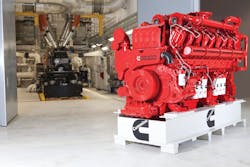
Cummins Inc. launched the QSK95 engine with more than 4000-hp (2983 kW) output at the Seymour Engine Plant, where the new engine will be manufactured for locomotive applications ahead of the Tier 4 ultra-low emissions standards taking effect in 2015. The 16-cylinder QSK95 introduces a new high-speed power capability for passenger and freight locomotives, surpassing the output of high-speed engines with 20-cylinders. The exceptional strength of the QSK95 will improve locomotive traction and increase acceleration, boosting performance with highly responsive quad-turbocharging.
The QSK95 engine leaps ahead of medium-speed engines in terms of ultra-low emissions capability with a combination of cleaner in-cylinder combustion and a fully engine-integrated Selective Catalytic Reduction (SCR) exhaust aftertreatment system purpose-designed by Cummins. The 95-liter QSK95 also brings the advantage of a much-reduced installation envelope compared with larger medium-speed locomotive engines that require much higher displacement to achieve a similar power output.
“The new QSK95 is already attracting strong interest from locomotive builders and rail operators from around the world who recognize the exciting potential this engine brings to the industry in terms of superior performance and ultra-low emissions capability,” said Kathryn Unger, Cummins general manager – Worldwide Rail Business.
“We anticipate that the QSK95 will power the first passenger locomotives to meet Tier 4 emissions standards in North America, using Cummins proven SCR exhaust aftertreatment. The inherent advantage of high-speed diesel efficiency and a more compact installation over medium-speed locomotive engines becomes even more apparent with the need to meet very low emissions levels.
“The arrival of the new QSK95 builds on the success of the QSK78 and the QSK60 in the locomotive engine market. Just as Cummins is a major presence in Diesel Multiple Unit (DMU) railcars, switcher locomotives and track maintenance equipment, we expect to become a force in the larger locomotive engine business," added Unger.
The QSK95 engine extends Cummins locomotive power by 900 hp (670 kW), which will provide rail operators who need more power with the same proven reliability and durability they experience by using Cummins power today.
QSK95 Flexible Power Solutions
For commuter and intercity locomotives, the QSK95 is capable up to 4200-hp (3132 kW) and can be installed with an auxiliary Cummins rail engine to provide electrical hotel power to the passenger cars, freeing up maximum tractive power from the prime mover. The QSK95 engine is also available rated from 3500-hp to 4000-hp (2610-2983 kW) as a highly cost-effective power solution for multipurpose short-haul freight locomotives.
For large line-haul freight locomotives requiring more than 4000-hp output, the QSK95 can be specified with a smaller Cummins locomotive engine as a combined power installation. A smart power-sharing system transfers work between the two Cummins engines to match the locomotive duty cycle more efficiently than a conventional single engine. This innovative approach provides full traction power when the locomotive needs it and the best possible fuel economy when running at lower power levels to reduce overall operating costs.
Cummins advanced electronics enable the QSK95 to be custom-calibrated for specific locomotive applications on a global basis, with the flexibility for performance to be optimized among fuel consumption, transient response and emissions reduction to suit different operational requirements.
Enhancing Locomotive Performance
Cummins next-generation Modular Common-Rail System (MCRS) enables the QSK95 to achieve high fuel-efficiency, even when operating at maximum-power output for long periods. With up to 2200-bar high-pressure fuel injection, MCRS reduces noise, offers smooth idle stability and eliminates visible smoke across the entire operating range.
Cummins new NanoNetTM fuel filtration gives superior fuel cleanliness and enhances the durability of the MCRS system. This provides an advantage for the QSK95 engine to power locomotives anywhere in the world with varying fuel quality.
A quad-turbocharging system, with one turbo for each 4-cylinder quadrant, provides outstanding responsiveness with the simplicity of a single-stage air handling system. For the locomotive, this traction power is delivered more rapidly across the entire rpm range to increase acceleration and reduce journey times.
When running at high engine-load factors, the QSK95 will power the locomotive with relaxed ease, operating well within its design capability. High power density is achieved with a hardened power cylinder featuring the strongest, single-piece forged-steel piston available in the industry.
Deep structural strength is provided by an all-new ductile iron skirted block. This increased strength contributes to higher engine uptime availability and the ability to achieve 1.7 million gallons and above of fuel consumed before overhaul, with the significant advantage of no midlife intervention required.
SCR Clean Exhaust Aftertreatment
Cummins locomotive engines will utilize a proven SCR aftertreatment system to meet EPA Tier 4 ultra-low emissions standards for locomotive engines in North America, as well as Stage IIIB limits currently in effect in Europe. The Cummins SCR system is purpose-designed as a highly flexible installation package intended to replace the exhaust muffler.
Depending on the application, the Cummins SCR system is capable of achieving incremental fuel savings of 5 percent to 10 percent, together with a corresponding reduction in carbon dioxide (CO2) emissions. The fuel savings will reduce the cost of operation by more than the cost of Diesel Exhaust Fluid (DEF) required for the functioning of the SCR system.
By using Cummins SCR aftertreatment solution, the QSK95 and other large Cummins locomotive engines avoid the need for an Exhaust Gas Recirculation (EGR) system on the engine to reduce Oxides of Nitrogen (NOx) emissions. This EGR-free approach avoids the inherent complexity of applying it to high-output engines and means that no compromise is made to serviceability. Without EGR, no additional heat rejection is generated by the engine for the locomotive cooling system to manage – avoiding both an installation cost and space impact.
The Cummins SCR system is designed with rugged durability to withstand the toughest operational duty cycles, able to provide life-to-overhaul equal to that of the QSK95 locomotive engine. Cummins experience with SCR technology is unmatched in the engine industry, with almost 250,000 engines supplied with an integrated SCR system.
Increased Uptime And Serviceability
The QSK95 locomotive engine has been designed with more inherent reliability to ensure the highest possible uptime availability. The engine is configured to provide faster and easier servicing procedures, with simple access to all cooling, oil and fuel system maintenance points on the engine. This engine-integrated design provides a useful installation benefit compared with medium-speed engines with off-engine systems and filters typically taking up increasingly limited space in the locomotive engine room.
For engine overhauls, the extra strength components of the QSK95 mean there is less to replace so that total life cycle costs are lower. With less weight and smaller than a medium-speed engine, the QSK95 can be removed from the locomotive at overhaul for a swing engine or rebuilt in-situ.