Bringing High-Speed Rail to America Part II - Global Examples
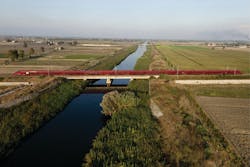
The United States High Speed Rail Association held its high-speed conference: Brining High Speed Rail to America in San Francisco last week.
Experienced high-speed rail experts met with business and political leaders to discuss challenges and opportunities of bringing high-speed rail to the United States. The conference was held at Autodesk, a leader in 3D design, engineering and entertainment software.
During “High-Speed Around the World,” presenters shared best practices and lessons learned in high-speed rail from across the globe.
Armin Kick, directory, HSR Development, Siemens Industry Inc., Mobility Division talked about HSR development in Germany. The government’s plan took off in 1973; they developed a federal transportration corridor plan. The plan was made for HSR with the policies and financing would come with that. “They didn’t know exactly how it would be built or when it would be complete,” Kick said. And, it’s still growing with other lines in development.
The first line went into service in the 90s. Germany’s very fiscally conservative, so when there’s no money, they reduce their efforts until there’s more money. They’ve halted build out three times but they have been inching along. With infrastructure projects of this nature, Kick stressed, “These things take time.”
While a lot of discussion has focused lately on HSR in China, when looking at HSR in the United States Kick said to reflect on how long it takes in other examples of democratic societies with environmental laws and processes. “It takes some time to do it and to do it right.” He added, “Twenty years is not unreasonable.”
Kick also talked about the European Train Control System (ETCS). In Europe there are many legacy systems in place and basically they each had their own ATP system. The European Union decided they needed a standardized system that would allow for one harmonized technical solution.
The public-founded Trans-European Networks (TEN) enforces the deployment of this system. And this system is establishing itself as an international standard. Europe is bound to this standard by law, but others have come on board, including Australia, China, India, Saudi Arabia, Brazil, Argentina and Mexico. The ETCS is something that could be used in the United States, too.
In France the first HSR line was commissioned in 1981 and then gradually the network expanded with the last line being commissioned less than six months ago. SNCF America CEO Julien Dehornoy explained that HSR doesn’t operate on just dedicated HSR lines, it also runs on conventional lines to get to more places. There are 1,300 miles of HSR lines and 5,000 miles of conventional lines used by HSR.
Some additional stats about French HSR are that they operate 700 domestic TGVs every day and 200 international TGVs. There are 250 stations, 230 of those in France. On the most-utilized routes, there are 130 trains per direction, per day. And even with that kind of volume, 81.2 percent of TGV trains are less than 5 minutes late and only 35 percent of such delays are due to SNCF operations.
The average occupancy rate is more than 74 percent occupied. Dehornoy said the trains are priced differentiation. “Like the airlines do here, there are different options.”
The first lines were less costly to build with the highest ridership, “thus the lowest level of subsidies and the lowest cost per passenger,” said Dehornoy. “Investment costs averaged $30 to $40 million per mile in the last sections (2010 numbers).
All lines are making operating profit, ranging to very low, which are the shorter distances, to very high, which is the 200 to 400-mile lines.
Dehornoy said the value created from HSR was $190 billion over 40 years, in terms of such things as time saved and increased productivity of transport system.
Train Italia has been operating in Italy for many years and recently, some investors wanted to compete with them. Those investors weren’t familiar with the rail business – the head of this company NTV – is the head of Ferrari – so NTV went to SNCF and they are strategy partners and 20 percent shareholders. The operation started in April of this year.
Public-Private Partnerships in the Rail Sector
In France there are four public-private partnerships, three of them are for the new high-speed rail lines. One is for a 100-mile line, one for a 200-mile line and the third is for 50 miles in an urban area.
For the 100-mile line, the innovative financing structure is the GSM-R model (Global System for Mobile Communication-Railway), it’s an availability-based PPP: The government is making payments for a system that works. They pay a fee every year based on the availability and how the system is performing. Debt is taken by the private sector.
The largest PPP in the world is for the 200-mile line and it’s a SEA model. The cost is more than $9 billion and half of the investment is still paid by grants and half the money coming from the passengers. SNCF will be operating on the line first and there will be access charges to private sector to recoup their costs. The public sector had to be involved at every step, bringing a lot of guarantees. There was a risk of not reaching ridership numbers.
It was stressed that rail PPPs around the globe are very diverse and there are close to 30 right now. The risks shared varies and a strong financial involvement of the public sector is necessary.
PPPs can be very efficient Dehornoy said. When it comes to the commercial risk, in many cases the private construction firms don’t have experience in HSR. And some of them lost a lot of money; HSR in many cases is a new market.
“In Taiwan when they created it, they had no idea,” explained Dehornoy. “But the trains were working perfectly and it changes everything for transportation in the country. But some people lost their shirt.”
Talking about shared corridors for high-speed passenger rail and freight was The Louis Berger Group, Technical Vice President Rail & Transit, Vinay Mudholkar. In the 150 to 250 mph range, “One of the points is that each solution you apply in different parts of the world is different,” he stressed. “You need to look at economics of the whole system and how much fail passengers can regard.”
Shared corridors bring long-term sustainability to the region. It is energy efficient, brings affordable fares to the general public and minimizes the taking of land. It can also increase profitability. “It generates the combined best return on investments for private and public sectors.” He adds, “One job in the rail industry creates 4.5 jobs in the supporting industries.”
Mudholkar talked about the West Coast Main Line upgrade in the UK. There was limited time possessions available for work at nights and blockade strategies were adopted on parallel routes. On this project in the UK, he said American firms and funds played a big role in the project. But when it comes to the United States, he said, “We are not delivering things and the taxpayers are getting hesitant. Too much discussion; not enough delivering.”
When looking at the HSR project in Saudi Arabia, the economic stimulus of the project was 40,000 to 50,000 jobs in construction to support and in operations in maintenance. The locomotives are U.S. EMD locomotives from Chicago.
“We have some very smart engineers here that can do their job,” said Mudholkar. “International projects can do a lot of good to us if we get involved in them.” He added that there is a lot of machinery being sent to other countries to be working on HSR. “$75 million worth in the next couple years.”