TRB Annual Meeting: Special Session on Sandy
The Transportation Research Board 92nd Annual Meeting is being held this week in Washington, D.C. This year there are nearly 12,000 attendees from around the world to participate in the more than 4,000 presentations covering all transportation modes and addressing topics of interests to all, including policy makers, administrators, researchers and practitioners.
A special session was held focusing on the impact to transportation by Sandy: Superstorm Sandy: Transportation Challenges and Research Opportunitis in the Afermath of a Disaster.
Jock Menzies, American Logistics Aid Network (ALAN) president, led the panel that looked at the impact on the transportation of people and goods, what has been learned in the recovery phase and what we can expect in the future with the climate trends
New Jersey State Climatologist Dr. David Robinson explained the role of state climatologists to monitor, understand and inform. Regarding Sandy, he gave background on why this particular storm was unique and so powerful and talked about the trends that impact severe weather situations.
The path of Sandy was that it formed in the Central Caribbean in late October, which is not at all unusual. At the same time, there was a blocking high pressure ridge south of Greenland, which shouldn't have been there as it was very unusual for that time of year. That ridge pushed Sandy back to the west. Finally, there was an inverted trough in the jet stream that almost helped pull the storm in. The combination of the three created an explosive situation.
Robinson talked a bit about what we are seeing in regards to climate change, including increases in very hot days and heat waves; increases in arctic temperatures; rising sea levels; increases in intense precipitation events; and increases in hurricane activity.
With a higher base of sea level and a warmer atmosphere -- which has more energy -- there is the potential for more violent storms. He stated we may be dealing with more intense forms of weather, making us susceptible to more disruptions in service
New York MTA
MTA New York City Transit Chief, Operations Planning, Peter Cafiero spoke about the impact of Sandy on transit infrastructure and operations. He talked about the storm preparations, the storm event, immediate recovery, longer-term recovery and preparations for the future.
In development since the mid 1990s, the MTA hurricane plan calls for suspension of service when sustained winds are forecasted to exceed 39 mph. The system shutdown begins eight hours prior to that period so there is time to allow for the securing of rolling stock, signals and employees.
He said that transit also supported the evacuation of low-lying neighborhoods in 12 hrs prior to shutdown.
The storm surge was on Monday evening, October 29. Prior to that they had constructed barriers to keep water out of tunnels, following the flooding they had experienced during Irene. The barriers didn't prevent flooding from Sandy, but it did reduce the amount of flooding in some areas.
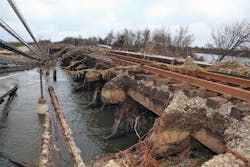
From the storm there eight stations with major flood damage. All of the tunnels flooded with two of them being flooded to the ceiling. Near the Kennedy Airport area the track was washed out and there was marine debris. On the bus side, there were trees downed blocking many of the routes
Cafiero said it was easier to plan for the shutdown than plan for coming back. One thing they hadn't counted on was a blackout in Manhattan; there was no power below 28th Street in manhattan. That delayed rail service restoration for four days following the storm and complicated bus operations after dark
Bus service started October 31 and initial subway service started November 1. They tried to get a skeletal system up and running and within 24 hours, had created a three-route, 330 bus fleet that provided service from Brooklyn to Midtown.
Ongoing updates were made to the website showing route service as routes changed, were restored and added.
Today, except by Kennedy airport and South Ferry station, the system is pretty much back to normal.
Cafiero explained there are a lot of long-term problems they're looking at, including corrosion and trash/sediment ingress and water damage. Longer term, he said, we need to understand those impacts and figure out how to create signal systems hat can survive salt water.
The Port Authority of NY and NJ
Stephanie Dawson, acting chief operating officer for the Port Authority of NY and NJ talked about the impact on their systems: airports, seaports, rail (PATH) and vehicular crossings.
"What you think about planning depends on where you sit or stand," Dawson said. "Three to four days is not a lot of time to make changes and preparations for something like this."
Their plans were built upon preparations/recovery plans from terrorism events and she said though everyone thinks of it in terms of security, while that's important, it's not the only element. Whether flu, biological attacks, hurricanes, what ever it may be, all of those are hazards and at the end of the day, she said, staff needs to know what they need to do differently for each
One of the opportunities for the future, she said, was in their corporate preparedness. As Sandy got closer they got increasingly detailed weather reports: each of their different lines of business had their own weather service that they used. Going forward, she said they need to use comparable or the same service so the message is clear
As facilities were hardened, staffing was readjusted in the immediate prelude and staff that was assigned to the emergency ops center was security staff. "What we really needed were those that knew the operations for each of the lines of business because corporate-level decisions needed them," Dawson said. "If you get one generator that comes in, where does it go?"
She said three to four days out, you are stuck with the plans that you have made previously. Seventy-two hours out, you are stuck with the preparations that you have made
One of the things they learned during the recovery was the importance of the collaboration with transportation agencies across the region and nation. They received repair parts and equipment from other systems for PATH, including from the MTA.
They also partnered with firms and consultant and, Dawson stated, "We probably nee to rethink how we partner with them because some of them re-opened their production facilities for us." One example she gave was GE opening its Puerto Rico facility. With PATH having some systems so antiquated, they needed to open their plant to supply some of the parts that are no longer available.
Important during the recovery was bus service across the lines of businesses. Tunnels and Bridges supported PATH in terms of creating bus shuttles and they managed the relationship with the bus companies. "That was the first and probably not the last time we'll need that interdepartmental cooperation," Dawson said.
Social Media During Major Events
The Role of Social Media in Preparation, Response and Recovery was presented by Sarah Kaufman of the Rudin Center for Transportation, NYU Wagner School for Public Service.
Kaufman explained preparation involves building your audience so that when you need to get out the information, you're ready. During a disaster you're going to have power outages, some people will have Internet, some will have phones: you need to reach out in as many channels as possible.
Pre-event messaging involves giving them information. Tell them about transportation access, give them warnings, prepare them for what they may need, provide responses to questions.
Once the disaster hits, the messaging goes two ways. Outgoing, you're giving instructions, providing information, giving access information, giving emergency management information. Equally important is the incoming messages so you can know what is happening across your system.
During Sandy, the biggest issue was timeliness versus quality. Is 90 percent accuracy good enough? Or should it be 85 percent? That's for your agency to evaluate and discuss ahead of time. People are going to find out incorrect information from someone else so evaluate whether a 90 percent confidence rate is better than incorrect information from somewhere else
Similarly, while there may normally be an approval process that A, B and C need to approve things before they go out, there should be discussions ahead of time to know during what situations is that required or during what situations does, say, only A need to approve, to keep information flowing quicker.
Kaufman talked about the importance of photos and videos during an event. She said it was essential when trying to share information because it got the public to understand what was going on and being patient with the recovery process. The MTA put a lot of photos on Flickr, she said, and videos on YouTube. One video had a half a million views and Kaufman explained to the audience, "That's like the Gangnam Style of transit."
(She added that if you don't know what that means, look to the youngest person next to you and ask them.)
The main powerhouse for information was Twitter. One of the challenges was that incorrect information was being put out by some, so watching and ensuring the correct information is getting out to the public is important.
Kaufman said when agencies are providing information through social media, they should also be providing information through open data: schedules and route information in machine-readable formats that people can put in third-party applications. "Get them information through what ever channel they can receive it."
For more information on the Transportation Research Board, visit www.TRB.org.