Planning for the Future of York
Part of the Greater Toronto Area (GTA), the Regional Municipality of York is made up of nine local municipalities: Aurora, Georgina, East Gwillimbury, King, Markham, Newmarket, Richmond Hill, Vaughan and Whitchurch-Stouffville. The 1,776-square kilometer area has a population of just more than a million residents and the area is growing. By 2031 it is expected to reach 1,500,000.
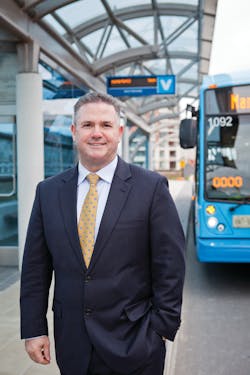
“In 2009 I was one of about 30,000 people that moved to this region,” says York Region Transit (YRT) General Manager Richard Leary. “Every year 25 to 30,000 people move to the York region because it’s a place that’s growing. It’s an innovative place and it has so much to offer.
“I wanted to be part of it and I was very grateful that I was selected to be part of that.”
Leary says he followed the footsteps of his father and started as an operator in Boston and eventually worked his way up in the Massachusetts Bay Transportation Authority (MBTA), eventually to chief operating officer. “I kind of followed in his footsteps, started in transit in 1984 as a part-time train attendant on the old elevated structure on the Orange Line.” He continues, “I was going to school during the day and driving trains nights and weekends and the college degrees provided opportunities for me when I moved over to the revenue department.”
Leary says, “It was an established organization that dated back to 1897, so there’s a lot of history there. It was a great experience and a great opportunity to learn and work at.
“The MBTA is such a large organization you meet peers throughout the industry.” He adds, “It’s all about partnerships and working together.”
In 2009 he retired from the MBTA and he started at YRT in November of that year.
Subhead
“I made the decision I was going to retire after 25-1/2 years and really looked around North America to see where the opportunities were at,” Leary explains. “This location appeared and the York region, it was a very exciting area of North America that really got it. It was committed to public transportation and committed to it in the sense of integrating transit with economic development and also the social and environmental benefits to all.”
He saw the province and the region had a commitment to public transportation as they were building subways into the area from Toronto, they were putting bus rapidways throughout the region and there was a huge investment in the region with transportation at the forefront of that investment.
“The financial support and backing is there to support, from both the federal and provincial government and Metrolinx. That commitment has been demonstrated all across the GTA,” Leary says.
When looking at York Region’s Vision 2051, many of the trends the region is looking to cope with are impacted by transportation options. The region is facing a quickly growing population, including a growing again population. They expect a 250 percent increase in the population over the age of 65 between 2011 and 2051.
The region is dealing with health issues related to lifestyle, particularly with children in relation to obesity, cardiovascular and respiratory diseases, Type 2 diabetes, mental illness and cancer with lack of physical exercise and poor eating habits being cited as contributing factors.
The climate is changing for the region with temperatures growing warmer and violent storms increasing in frequency.
Local, alternative and renewable energy sources are becoming more important for the region.
With the expected growth, a new approach in managing services is required, including transportation demand management and reduction in energy use, “with more emphasis on transit, walking, cycling and complete streets.” Moving around the region is a challenge and it notes that increasing mobility in the future will rely on a diverse range of transportation options.
One of the eight goals for 2051 is Interconnected Systems for Mobility, which entails providing access to all destinations using diverse transportation options for people in all communities, promoting active, healthy living, and safely and efficiently moving people and goods.
Transit Investment
Transit investment includes the Toronto-York Spadina Subway Extension Project and York’s Viva bus rapid transit (BRT). The subway extension will provide an extension for the Toronto Transit Commission (TTC) system between the city of Toronto and the York region.
The estimated $2.6 billion project is expected to begin service in fall of 2016. The federal government has committed $697 million, the province of Ontario has provided $870 million and the city of Toronto has committed to fund $526 million and the Regional Municipality of York has committed to fund $352 million.
Viva, YRT’s BRT, was launched in 2005 and is growing. VivaNext is the next phase of Viva and currently there are five projects underway.
Leary stresses, “We’re buying additional buses from Nova because we see the expansion of the service and the desire for more service.
“This region is the place to live, the place to work, the place to play. It’s about complete streets. It’s about communities.”
The commitment to the region to public transit was demonstrated, Leary says, by the region giving two free months of service following the three-month labor strike that ended at the beginning of this year. “They knew it was a negative impact on the individuals that lost their service, personally and financially, so all the savings from the transit that we derived by not providing service, the region reinvested that back to the taxpayer by providing free transit to make sure that those who had possibly changed their pattern of behavior because there was no transit.”
With three of the four contractors on strike, they were able to provide some form of service for 60 percent of their customers. Leary says, “We respected labor’s position but we still were able to maintain some service in this region for the majority of those who take transit.”
“It’s all contracted out,” Leary says of the operations. The operators and maintenance is contracted out while the region is responsible for determining the routes, the stops, schedules, fares, enforcement and the ticket vending machine process and finance.
“Most individuals that are residents in this region don’t even realize that the bus operators, those that operate the service, work for private contractors.” He continues, “Their training is very similar, it’s all under your transit brand and although we’re not in charge of the employees, we are in charge of the operation: policies, procedures, dress codes, scheduling.”
Advances
The York Region Rapid Transit Corp. works in collaboration with the funding partners and Leary says in the region there’s $4 billion investment toward BRT itself. “The region is putting rapidways on the major throughways within the region. We’re purchasing and building bus garages in the region, we have invested in terminals, bus stops, every aspect … has been taken into consideration as we do this.”
There’s been a large investment in BRT since 2005 and YRT is in the process of getting another 26 articulated buses. Leary explains they have priority signaling, jumping lanes, proof-of-payment on the vehicles, and in many of the areas there is designated rapidways to permit the buses to move around or through missed-use traffic.
YRT started implementation of the regional farecard Presto in July 2011. Presto is the GTA, Hamilton Area and Ottawa’s OC Transpo’s regional fare system. Presto was first released in 2009 and has been expanding since.
YRT initially introduced the card in lieu of the 10-day ticket and in 2013, will expand the card to replicate the monthly passes and they will look at the potential for loyalty schemes in addition to what they already have today.
YRT has a number of different fare categories and they didn’t start with every category at once. A lot of time was spent going out and setting up kiosks to introduce people to the new cards.
Not all systems in the Greater Toronto Area are onboard yet. It is a migration path started a short time ago and they are all moving toward integration.
“It allows someone to go from the York region to Brampton and down to Toronto on the commuter rail and we allow transfer timeframes, things that never occurred before,” Leary says. “It’s really putting seamless travel throughout the GTA.”
“We are all independent when it comes to determining our fare structure and yet we all now have one shared media that permit the customers to go from one fare structure to another.
“It’s about working together and collaborating to ensure it’s suitable for everyone and right now, I think if you ask anyone in the GTA that they’re relatively pleased with it.”
The 21st century technology helps eliminate the paper process and instead, they give away cards sitting in a kiosk showing somebody how to register online to add value.
Reliability and Partners
Leary says with a farebox recovery rate of about 40 percent, the customers are willing to pay for the quality of service they’re given. “Quality is all about reliability.
“When we spend a lot of time at public meetings and doing outreach for customers to find out what their needs are and to ensure that we provide transit that they’re asking for.” On-time performance right now for start time is in the 93/94 range with a goal of 95, he says.
When it comes to reliability, if you’re on the bus, you have the ability to go around any unexpected circumstance. “If there’s an accident or flood or medical emergency or breakdown or adverse weather conditions, there are so many of them, you have the ability [to go around them if] you properly monitor the system from the control center,” Leary says.
“You can prepare for and establish policies for deviations in service and again, the customer is expecting it because they hear on the news there’s been an accident … but they know they can depend on us to get them around and still get there. It may cost a little more time, but it’s doable.
It’s the technology that helps them maintain reliability. “A lot of technology, like Init, Trapeze, the chief part is knowing how to use the software to your betterment: taking it and making your organization better because of it,” Leary states. “It allows you to do things that were very labor intensive previously.
“Information’s about what happened a minute ago, not two days ago.”