InnoTrans 2012: A Market Overview
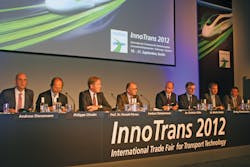
InnoTrans starts Tuesday, September 18, but Monday was an opening press conference and tour to get some highlights of what is in store for this week. (You can view photos in our Photo Gallery HERE.) Over the next four days, 2,515 exhibitors from 49 countries will present their rail technology innovations and services. On the outdoor display of 3,500 meters of track, 115 vehicles will be on display.
Messe Berlin GmbH Chief Operating Officer Dr. Christian Göke
Messe Berlin GmbH Chief Operating Officer Dr. Christian Göke said InnoTrans is the final highlight of a series of events in Berlin and its objective is to provide the best market overview of rail transport in the world. He said the main key figure in trade fairs is surface area and this year it is up to 94,608 square meters, up 17 percent from 2010. For the first time, the whole area has been rented out to accommodate the event. This exhibitor participation, he said, equates to the trust exhibitors have in this event.
Most exhibitors have increased the amount of space rented. And, when looking by region, China has grown the most, up 90 percent, followed closely by Japan with an 84 percent increase in square meters.
A key feature of InnoTrans is the amount of premiers at the trade fair. There are 147 premiers, up from just 52 two years ago. Exhibitors plan their unveilings to coincide with this event, which he said also illustrates the significance of InnoTrans to the industry.
He stated, "The success story of InnoTrabns is without parallel. Since its launch in 1996 this fair has gone from strength to strength. Despite a stagnating global economy, InnoTrans 2012 has expanded and set new records, thus underlining its undisputed standing as the world's leading trade fair for transport technology."
Association of the European Rail Industry (UNIFE) Director General Phillipe Citroën
Phillipe Citroën, director general of the Association of the European Rail Industry (UNIFE) talked about The UNIFE World Rail Market Study, conducted by Roland Berger Consultants and published by DVV Media Group , which provides data on the current world market for rail and gives an outlook out to 2017.
UNIFE represents European companies responsible for the design, manufacture, maintenance and refurbishment of rail transport systems, subsystems and related equipment.
Citroën stated since the last UNIFE World Rail Market Study was published two years ago, the global rail supply market has grown steadily. The total annual market volume averaged around 146 billion Euro for the years 2009-2011, equivalent to a compound annual growth rate of 3.4 percent compared to teh average annual market volumes for 2007-2009.
Since publication of the 2010 UNIFE World Rail Market Study, the infrastructure and rolling stock segments experienced the strongest growth in absolute terms.
Despite the recent economic crisis, countries have added rolling stock and infrastructure kilometers to their installed base, both about 4 percent. Alongside significant growth in very high speed trains, urban units have experienced considerable growth, too.
The rail supply industry has significantly outgrown the world economy, seeing its share of global GDP rise from .31 percent in 2004 to .38 percent in 2010.
Anticipated growth is 2 to 2.5 percent for infrastructure, 2 to 2.5 percent for rolling stock, 3 to 3.5 percent for rail control systems, being driven by the rollout of ERTMS in Europe and PTC in the U.S., and 2.5 to 3 percent for services.
German Railway Industry Association (VDB) Managing Director Prof. Dr. Ronald Pörner
From the German Railway Industry Association (VDB), Managing Director Prof. Dr. Ronald Pörner spoke about the dire need of rolling stock. VDB brings the manufacturers of railway vehicles, control and safety technology, and infrastructure, plus the suppliers and service providers associated with those, together and combines the interests of the sector.
Pörner said that there is an alarming signal and that the situation is not that safe and we should be slightly concerned that all the companies, especially locomotives, are in a tricky situation and that we need incentives.
In Germany alone they need 200 new train orders and they are struggling to finance these. “We have a weak locomotive business,” he said. To that, he suggested an environmental premium for old locomotives to be replaced with greener and quieter technology.
An environmental bonus awarded by the federal government could act as a catalyst. It would considerably speed up the rejuvenating of diesel locomotives in Germany and noticeably reduce the diesel emissions.
There are 3,200 locomotives in Germany, 1,300 of which are worse than UIC I standards and 600 that are older than 30 years old. “If not at a press conference I would call them stinkpots,” he said.
“We are focused on those 600,” he explained. If those were replaced, it would mean a 71 percent decrease in NOx, a 97 percent decrease in soot and a 21 percent decrease in CO2. At 20 percent off of the purchasing price, he said private rail agencies are getting interested. Discussions have begun with the transport and economics ministry, but not yet with the finance ministry.
Electro-Industry Association (ZVEI) Managing Director Herbert Zimmermann
Electro-Industry Association (ZVEI) Managing Director Herbert Zimmermann said we have every reason to be optimistic in the industry. ZVEI represents the interests of a high-tech industry with a very broad and dynamic product portfolio: the electrical industry.
While there has been a slight downturn in the electric rail industry, through the next 12 months, order projections are very hopeful, he said.
While there have been many global projects with funding difficulties postponed or altered, there are many high-ranking officials registered for attendance and, he added, they expect China to be a very important market.
Association of German Transport Companies (VDV) Managing Director Dr. Martin Henke
Dr. Martin Henke, managing director of the Association of German Transport Companies (VDV) talked about the importance of funding investment. VDV is the organization for Germany’s public transport companies and rail freight transport companies.
There are more than 600 operators in Germany, with more than half of them being rail. He said especially the smaller companies are struggling for funding to purchase vehicles, primarily because of the volume needed to purchase and they are still coping with the impact of the financial crisis.
There is 8 billion Euros of investment needed and the quicker we can be sure about funding investment, better for the companies and their funding investment partners, he said.
The German Research Association for Underground Transportation Facilities (STUVA) Managing Director Dr.-Ing. Roland Leucker
The German Research Association for Underground Transportation Facilities (STUVA) Managing Director Dr.-Ing. Roland Leucker talked about expected population growth and the gridlock that will mean. In 2012 there are 7 billion people and by 2050, we’re looking at 9 billion. “Tunnels are direly needed in this backdrop,” he stressed.
In 1996 the European Parliment adopted the Community guidelines for the development of a trans-European transport network (TEN). The "Stuggart 21" construction project is an integral part of a project classified by the EU as a "priority" within the scope of those guidelines. Despite the classification, the project is highly controversial with large sections of the population. As part of InnoTrans, the association will be addressing this issue with a prestigious group of expert panelists during hte "Infrastructures for Europe - Big Ambitions without Bigt Projects?"
He talked about a number of projects underway, including the Fehmarnbelttunnel connecting Germany to Denmark with 17.6 km of tunnels for cars and trains, expected to open by the end of 2021. He also showed examples of what happens when tunnels are put in place, how the city can be opened up to more pedestrian-friendly areas and the resulting quality of life improvements.