The Transit Leader’s Paradox — How to Stretch When Pulled by Opposing Demands
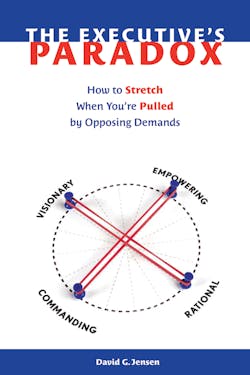
Trying to meet conflicting demands is familiar terrain to most transit leaders. Executives have been balancing competing goals for many years. But that's the point; it used to be all about balancing goals.
After a presentation at the American Public Transportation Association's CEO Seminar and additional interviews with additional transit CEOs, it is clear that today it's more about managing the tension between contradictory issues.
Based on interviews, The Top 20 Transit Challenges for transit leaders that emerged.
The Top Twenty Transit Challenges
- Manage funding cuts
- Follow new mandates
- Engage/motivate employees
- Implement service reductions
- Meet short-term objectives
- Innovate for the long-term
- Get more done with less
- Take time to coach/mentor others
- Deliver legacy projects
- Meet community's real needs
- Maintain standard IT platforms
- Adapt software to address local needs
- Become a regional mobility manager
- Address each city's issue
- Manage generational and cultural differences
- Adhere to uniform policies and procedures
- Gain buy-in to the accelerated pace of change
- Build a platform of stability
- Meet the increasing demands of work
- Have a fulfilling home life
How many of these challenges are affecting you? Most of the CEOs in the seminar said that they confront at least a dozen or more on a regular basis.
Review the list of the 20 challenges again, but this time read the list in pairs and between the first and the second, say, "… and at the same time …"
That gives you, "Manage funding cuts and at the same time follow new mandates. Engage/motivate employees and at the same time implement service reductions." And so on.
As the challenges are read in pairs, it is apparent the challenges transit leaders face in today's rapidly changing landscape are in fact paradoxes — they pull in opposite directions simultaneously.
The top 20 challenges can be reformulated into a list of Transit's Top 10 Paradoxical Challenges.
Transit's Top 10 Paradoxical Challenges
- Manage funding cuts and Follow new mandates
- Engage/motivate employees and Implement service reductions
- Meet short-term objectives and Innovate for long-term growth
- Get more done with less and Take time to coach/mentor others
- Deliver legacy projects and Meet community's real needs
- Maintain standard IT platforms and Adapt software to address local needs
- Become a regional mobility manager and Address each city's issues
- Embrace generational/cultural diversity and Adhere to uniform policies
- Gain buy-in to the accelerated pace of change and Provide a platform of stability
- Meet the increasing demands of work and Have a fulfilling home life
[[[pull quote]]]
"The voyage of discovery is not in seeking new landscapes but in having new eyes."
- Marcel Proust
From Balancing to Stretching
Trying to meet conflicting demands is familiar terrain to most transit leaders. Executives have been balancing competing goals for many years. But that's the point; it used to be all about balancing goals. Interviews with transit leaders suggest that today, it's more about managing the tension between contradictory issues.
Do you feel like you're balancing issues these days, or being pulled by opposing demands?
Why So Much Tension These Days?
Professors Wendy Smith and Marianne Lewis reviewed 360 separate studies on paradoxes and reported that paradoxical tensions are more prevalent and persistent when three forces are at work.
- Competing Stakeholders — Leaders experience increased tension when the number of stakeholders with conflicting agendas increases. Many transit CEOs are pulled to meet the divergent demands of community groups, regulators, sustainability advocates, a regional board of directors and local city councils.
- Resource Constraints — Despite passage of a two-year transit bill, most transit leaders confess that they have to do more with less. They feel pulled to manage their budget constraints while at the same time boost employee morale, exceed riders' expectations and invest in the future. Most would love to provide the city with everything they want, but they only have so much money to meet the entire region's needs.
- Accelerating Pace of Change — The speed of change is a bullet train to transit's future. Yet, these changes in technology, information availability, demographic shifts, among others, create an avalanche of continuous change. Keeping pace with the warp-speed of change demands numerous initiatives that often compete with each other. An example is feeling stretched to allocate resources between tactical — such as use new technology to increase bus-route efficiency — and strategic initiatives — like creating long-term, transit-oriented development plans.
Any of these forces — or all three — can hit transit leaders on any given day. That's why the transit leader's paradox is less about finding balance and more about managing the tension of opposing demands.
Unfortunately, ongoing workforce development research suggests that many executives don't stretch when they feel pulled by their conflicting issues.
Workforce Development — Transit Research at the Top
At the end of the presentation to the APTA CEOs two years ago, they and their senior executive teams were invited to complete a 360 assessment, called the eXpansive Leadership Model – XLM, as part of research in the transportation industry. The objectives of the research were three-fold:
- Identify which competencies are transit leaders' strongest and weakest
- Determine if these competencies predict leadership effectiveness
- Learn how well leaders actually manage paradoxical tensions
To date, 77 transit executives (16 CEOs and 61 executive team members) have rated themselves and invited 376 other people (boss, peers, direct reports ...) to rate them on the researched-based competencies assessed by XLM.
Which Competencies Are Transit Leaders' Strongest and Weakest?
Of the 16 competencies assessed by the XLM, the four that transit executives scored the highest in are:
- Execute with passion and courage
- Choose responsibly
- Serve ethically
- Clarify objectives and expectations
The four competencies that executives scored the lowest in (often referred to as "developmental opportunities") are as follows, with lowest scores listed first:
- Embrace ambiguity & paradox
- Know thyself & others
- Regulate emotions
- Cultivate innovative growth
Do These Competencies Predict Transit Leadership Effectiveness?
To measure leadership effectiveness, the XLM asks seven questions related to how well the leaders actually lead. The scores of these seven questions were averaged to derive a composite leadership effectiveness score. The data was then analyzed to determine how well the XLM competencies correlated with perceived leadership effectiveness in the 77 transit executives. In essence, it was being asked if these competencies actually mattered in the transit industry.
The correlations for the highest and lowest scored competencies are seen in parenthesis below and in this type of research, correlations greater than .30 are considered significant, while correlations greater than .50 are considered high.
The correlations of the competencies that executives scored the highest in are:
- Execute with passion & courage (.58)
- Choose responsibly (.52)
- Serve ethically (.43)
- Clarify objectives & expectations (.52)
The correlations of the four competencies that executives scored the lowest in are:
- Embrace ambiguity and paradox (.56)
- Know thyself and others (.57)
- Regulate emotions (.48)
- Cultivate innovative growth (.59)
Paradox Lost - How Well Do Leaders Manage Paradoxical Tensions?
Although the leadership competency "Embrace ambiguity and paradox" is highly correlated with leadership effectiveness (.56), it is the lowest ranked of the 16 competencies assessed.
As Mike Scanlon, past chair of APTA and CEO at SamTrans remarked, "Are you telling us that we are least effective in the most important competency – the one that can help in today's paradoxical environment?" Precisely.
Transit leaders are not alone in their need to develop this low-scoring skill. In a study of 1,000 organizations over a 20-year period, researchers found that leaders mismanage paradoxes between 38 to 45 percent of the time and suffer poor performance because of it.
The most common error was addressing one issue of a paradox independently of the other. The good news is that these authors, as well as others, have also reported that small improvements in managing paradoxical issues significantly increased firm performance.
How to Stretch When You Feel Pulled by Opposing Demands
Managing a paradox is analogous to sailing a small boat on a windy day. When the wind grabs your sails and starts tipping you over, you don't pick one side and stick to it for the entire trip. Nor do you drop the rope and let the wind have its way with you; you scramble to the other side of the boat and hang over the edge while holding the ropes. You get where you want to go by managing the tension between your hands and the wind — the two "elements" of this paradox. Harnessing the tension keeps you moving toward your destination. Which of the four below might keep you moving on your journey?
1. Look through other's windows. Our point of view is not the only view. Understand that how we perceive our business challenge and environment at the present moment is not reality — it is our view of reality.
We can embrace paradoxical thinking by pretending we are on the outside of a house looking through one window into one room. Whenever we are dealing with a paradox, we can assume we do not know what is going on throughout the entire room. Our view improves if we invite the "loyal opposition" to share their perspective from their windows. This will help develop the "flexible thinking" that Joe Calabrese, general manager of Greater Cleveland Regional Transit Authority, identified as critical in today's transit leader.
2. Fail fast, small, and learn. Leaders who embrace contrarian thinking often conduct little experiments to test assumptions and address issues. As Charles Odimgbe, CEO of Rhode Island Public Transit Authority, pointed out during the interview, "We must think outside the bus. This increases our agility to respond rapidly to our changing environment."
3. Make the abstract concrete. Paradoxical thinkers are not dreamers disconnected from reality; they are visionary leaders who are in touch with their surroundings. They are possibility and probability thinkers. Like kite flyers, they let their dreams fly high while tethered to the ground.
As one CEO explained, adapting the "map the paradox" idea was the most beneficial because it helped others see the trade-offs in her paradox.
4. Map the paradox. To help "map the paradox," as an example, draw two small boxes on opposite sides, in the middle of a blank piece of paper. In the left box, write "City's Needs" and in the right box, write the budget. Brainstorm the answers to four simple questions:
- What are the benefits of meeting the needs of the city?
- What are the benefits of staying within the budget?
- What might be the unintended consequences of over-focusing on the city's needs?
- What might be the unintended consequences of over-focusing on the budget?
Answers to question one go in the upper-left quadrant of the sheet of paper; answers to question two in the upper-right quadrant; answers to question three in the lower-left quadrant; and answers to question four in the lower-right quadrant.
This created a variation of what Dr. Barry Johnson called a polarity map.
If there's an upside and a downside to both sides, should you meet the needs of the city or your regional budget?
In one example, that rhetorical question was used to lead a discussion with city officials about the tradeoffs of focusing on one side at the expense of the other — an idea led to a breakthrough with the city.
[[[pull quote]]]
"The greatest danger in times of turbulence is not the turbulence; it is to act with yesterday's logic."
- Peter Drucker
Competing stakeholders, resource constraints and an accelerating pace of change are all conspiring to pull transit leaders in opposite directions during these turbulent times. Adapt these ideas to help you stretch whenever you feel pulled by paradox at work.
Dave Jensen is a transit consultant and executive coach who transforms leadership tools into client success stories. As a leadership expert, he is also a speaker and facilitator at conferences, meetings and retreats. http://davejensenonleadership.com