Switches for Good Performance and Long Service Life
The Transportation Technology Center Inc. (TTCI) conducted a study of transit switch designs for the Transit Cooperative Research Program (TCRP) to determine which design features contribute to good performance in transit service. TCRP members observed that often the best performing switches and turnouts were some of the oldest designs.
The project was conducted to harvest the wisdom of the early designs and to retain the features that contribute to good performance in current and future designs. The Technical Advisory Group (TAG) selected a good performing switch design for the project. The tangential, spiral alignment was measured in a No. 8 turnout built in 1926 on the Southeastern Pennsylvania Transportation Authority (SEPTA). The performance of the turnout was modeled using the vehicle that typically operates over the turnout; i.e., a SEPTA B-IV car (length = 68 feet).
A series of parametric studies, in which switch/turnout properties were varied, was conducted. A comparison was made to an AREMA-style nontangential, circular curve alignment turnout. The studies showed that the SEPTA switch turnout is predicted to outperform the replacement switches significantly for the range of operations used (i.e., 5 to 15 mph). Key factors in the better performance were the tangential switch entry and the spiral alignment. Other features, such as a cast austenitic manganese steel (AMS) switch point, do not improve performance over modern rail steels.
Background
Transit switch designs in the early 1900s were quite sophisticated by today's standards, with features that have been rediscovered and are being implemented into modern high-speed switch designs. These switches gave excellent service for many years, often outliving the lower cost but simpler replacement designs that followed. Many of the designs became obsolete as most were unique to a particular transit system, and, in some cases, when casting patterns were no longer available.
TCRP members observed that often the best performing switches on their systems were the oldest switches. The original tangential and spiral geometry switches often had service lives of 50 years or more. Additionally, these switches would outlive their replacement designs by 100 to 1,000 percent.
The switches produced in the 1900s share some or all of the following features:
- Tangential geometry (no entry kink angle)
- Spiral geometry (variable switch curvature)
- Housed switch points
- AMS switch points and stock rails
- Guardrails in front of the switch
- Guardrails in the switch
As stated earlier, the TAG selected the switch design for the project. Table 1 lists the features of the SEPTA spiral switch turnout compared to an AREMA No. 8 lateral switch turnout. The objectives of the two switch designs are clearly different. The SEPTA switch turnout is built for ride quality, with smoothed transitions and spiral curves to minimize the rate of change of accelerations, and the AREMA switch turnout is built for economy, speed, and component durability.
By having a large kink (entry) angle and large radius closure curve, the design geometry of the AREMA switch turnout maximizes allowable speed under the "cant deficiency" rule — the Federal Railroad Administration's rule for speed in curves. The SEPTA switch turnout designers were not subject to this rule, thus minimum switch closure curve radius and maximum cant deficiency were not important issues for them.
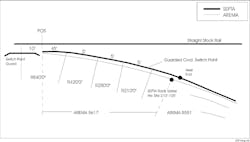
Figure 1 compares the layouts of the SEPTA and the AREMA switches. The figure shows the geometry and alignment differences. The SEPTA switch spiral geometry produces a lower entry angle for facing point and a lower exit angle for trailing point movements.
Predicted Performance
TTCI modeled the performance of SEPTA B-IV cars operating over a SEPTA tangential spiral geometry No. 8 lateral switch turnout, an AREMA No. 8 lateral switch turnout, and several variations of these two designs. The study was designed to learn which switch design features contribute to the good performance and long service life of the SEPTA switches. These design elements can be applied to a modern switch design to develop a low-cost, high-performance switch for future use.
No discussion of switch geometry is complete without including the rest of the turnout.
The selection of switch geometry affects the turnout closure curve alignment. The relative lengths of the SEPTA car versus the switch and turnout make inclusion of the entire turnout essential to the study. The switch is 13 feet long, with the lead length of the No. 8 turnout being 57 feet. The B-IV car is 68 feet long, with the truck spacing producing a 48-foot wheelbase. Thus, when the trailing truck of the car is moving through the switch, the lead truck is moving through the frog. Thus, the track modeled included the entire turnout with track beyond the frog being tangent at the frog angle.
To reflect the actual analysis done, the term "turnout" is used here, even though the focus of the study is clearly on the switch design. In most scenarios modeled, the switch produced the maximum forces or accelerations. However, in some operating scenarios, the turnout closure curve alignment may generate the maximum forces or accelerations.
The as-built SEPTA No. 8 tangential, spiral geometry switch turnout performs well in comparison to the per-plan AREMA No. 8 secant, circular geometry switch turnout. In its intended service of 5- to 15-miles per hour operation, the SEPTA switch is superior to the AREMA switch in minimizing loads and accelerations. However, the SEPTA switch turnout does show higher than desired accelerations under the 68-foot-long B-IV car operations. This may cause ride quality concerns at higher speeds.
Parametric studies of some design features were conducted to determine their effects on switch performance. Tangential switch entry is essential to the good performance of the SEPTA switch. Elimination of a kink angle and its resultant abrupt spike in dynamic loading produce a smooth ride and more even switch wear. The spiral switch entry and exit curves are effective at smoothing the ride through the switch by minimizing jerk or evening out the change in the accelerations. However, the very small radius of the closure curve may adversely affect the ride quality of certain types of equipment (i.e., longer cars) or service (higher speeds).
Figure 2 shows the relationship of maximum lateral wheel force to speed and switch design for No. 8 (~59-foot lead length) turnouts. The SEPTA switch turnout is labeled Tangential Spiral. The AREMA design is labeled Secant Circular. A variant of the AREMA design with tangential alignment and a smaller closure curve is labeled Tangential Circular.
In this particular case, the advantages of the SEPTA switch turnout are not fully realized because of the longer length of the B-IV cars. These cars are longer than the turnout (as well as the cars operated when the switch was developed.) The extremely short radius closure curves of the turnout cause the cars to "stringline," creating relatively high lateral forces. These forces increase rapidly with speed. The AREMA designs, with their larger radius closure curves, better accommodate the longer cars at higher speeds.
The use of AMS castings for the switch points in the SEPTA switch produces a tough and durable switch point. When introduced, the AMS point was vastly superior to rail steels of the time. However, modern rail steels perform as well as AMS in curve wear. The layout of the switch, with good geometry and guardrails, make the advantages of AMS almost redundant. The high cost of fabricating AMS switch points makes it an uneconomic choice for modern switches.
The housed switch point is a feature that provides benefits for switches with significant diverging traffic. The switch point is thickened to make it more robust and to diminish the risk of split switch derailments (Figure 3). The stock rail is diminished to accomplish this, which may result in a foreshortened life for this component. Housing would help to eliminate the sharp dynamic loading and localized wear at the point of switch on AREMA switches seen in the field, as well as those seen in NUCARS simulations done for the study. The running surface discontinuity at the point of switch seen at the gage face is especially important if guardrails are not used in the switch.
Use of guardrails in the switch is needed for safety reasons. The guardrails ensure that a safe operation is maintained as the switch wears and deforms. The guardrail and back of wheel flange contact are nearly vertical, even on worn components. Thus, wheel climb is less likely than with worn wheel flange/switch point contact. As for switch performance, the dynamic loads in the switch are little changed. Switch point life is improved by transferring wear from switch point to guardrail.
Summary
The parametric studies identified design features that contribute to the good performance of early 1900s vintage transit switches. A comparison was made to an AREMA-style nontangential, circular curve alignment turnout. The study showed that the SEPTA switch turnout is predicted to outperform the replacement switches significantly for the range of operations used (i.e., 5 to 15 mph).
Key factors in the better performance were the tangential switch entry and the spiral alignment. Other features, such as a cast AMS switch point, do not improve performance over modern rail steels. The particular circumstances of the line operations will affect the results of any such study. Key operating parameters include the desired operating speed, the percentage of diverging traffic and the length of the vehicles.
David Davis is a senior scientist with the Transportation Technology Center Inc.