Creative Transformation of Former Maintenance Facility to Transit Police Headquarters
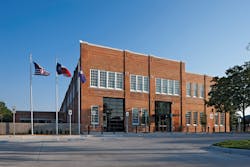
The Monroe Shops building at Illinois Station in South Dallas, Texas, has a unique history dating back to its initial construction. Built of brick in 1914, the building served as a critical maintenance facility for the Texas Interurban Railway, which linked much of north Texas during the heydays of local passenger rail.
The Interurban, however, closed its operations in 1948. Subsequently, the facility housed a paper mill and a U-Haul business, interspersed with long periods of vacancy. When Dallas Area Rapid Transit (DART) bought the building in 1991 as part of the land acquisition for the southern Blue Line segment, the facility was in disrepair.
"The roof had collapsed and the building looked like the old gothic ruins of a cathedral," said Steven Bourn, DART's architect and project manager.
In the following years, DART took measures to stabilize the building and used it for various purposes, including a museum and health center. In 2007, DART succeeded in adding Monroe Shops to the National Register of Historic Places. Despite these efforts, the city of Dallas and DART had a long-standing desire to put the facility back into productive transit-oriented use. Also, the DART Police Department, which had operated out of rented facilities for a long time, wanted to build a dedicated headquarters to meet the needs of its growing workforce. Following a needs assessment, DART determined that placing the police headquarters in this historic facility was the most expedient solution to both objectives.
Facility Features
In 2008, DART commissioned TRACK, a joint venture team consisting of Lockwood, Andrews & Newnam Inc. (LAN), APM & Associates Inc. (APM), Aguirre Roden Architects, and CP&Y Inc., to transform Monroe Shops into a state-of-the-art, sustainable police headquarters facility. LAN, a planning, engineering and program management firm, provided program management services while APM & Associates Inc. was responsible for structural and civil engineering services. Aguirre Roden acted as the architect-of-record with Brinkley Sargent Architects serving as design architect (Brinkley Sargent also provided the original needs assessment). Other members of the project team included: Berkenbile Landscape Architects, Bowman Engineering & Consulting, URS, Phillips May, Journeyman Construction, Triad, BKM Total Office of Texas, Move Solutions and Outcome CX Henderson Engineers.
The approximately 35,000-square-foot building was transformed into a modern 65,000 square-foot, three-story facility encompassing a public lobby with room to display a historic trolley car, meeting areas, spaces for police records, hiring and recruiting, police training, patrol, criminal investigations, internal affairs, police administration, evidence processing and storage.
Other amenities included locker rooms, a large central break room, physical training space and a large exercise room. The $20 million facility is the first publicly owned building listed on the National Register of Historic Places to achieve Leadership in Energy and Environmental Design (LEED) Platinum certification, the highest level possible.
"Re-purposing an existing structure is always challenging. Re-purposing a 1914 historic structure in disrepair brings a whole new meaning to the word challenging," said Patrick E. Jolly, P.E., vice president and business group transit leader of LAN. "Initially, every step in re-purposing the facility revealed critical stability issues that required innovative structural solutions that not only repaired the condition but also adhered to the stringent requirements imposed to preserve the historic elements of the building."
Preserving the Historic Fabric
Following the building's historic designation, one of the primary goals of the project team was to retain the building's original identity; the design had to be sensitive to any modifications made to the existing historic fabric. Working closely with DART and the Texas State Historic Preservation Office, the TRACK team came up with a creative building-within-a-building solution.
"It's unlike anything that I have seen before," said Lt. James Foster, DART Police Department's AM Patrol Commander. "There is the original building followed by a 3-foot standoff for the majority of the building, and then you enter our facility. It's almost like an egg shell."
The building-within-a-building solution ensured that the exterior brick walls were left untouched, except in places where structural elements were needed for support. In addition, a number of elements were incorporated to provide employees and visitors a glimpse of the facility's history. The original single pane windows in the brick walls, which were rotting out, were replaced with metallic double pane windows of identical design. A large, open lobby enables everyone to get a feel of how the building looked in the past. An Interurban street car that ran all the way from Denton to Waco sits in the lobby to remind visitors of its heritage. All the historic materials salvaged from the building were preserved, and original signs and fire doors were reincorporated.
"As the project progressed, we modified the design a few times to make sure that we didn't affect the original structure," said Greg Read, AIA, principal of Brinkley Sargent Architects. "We took every opportunity to showcase the existing structure throughout the facility."
Greening the Building
In keeping with DART's commitment to sustainability, the TRACK team was also tasked with achieving the highest possible LEED certification. Accomplishing this goal in a nearly 100-year-old building made the task more challenging.
As a first step, the project team remediated the site scarred by years of neglect. Nearly 90 percent of all construction waste from landfills was diverted during abatement and demolition. The heat-island effect in the roof and parking lot was reduced significantly through the use of high-solar reflective materials. Preferred parking for fuel-efficient and low-emitting vehicles further enhanced the sustainable character of the site.
The building-within-a building solution created an interstitial air space that helped alleviate the lack of insulation from the existing brick exterior. An under-floor air distribution system, another novelty, was installed on the second and third floors, which allowed cooling air to be supplied at a warmer temperature than an overhead distribution system, saving substantial energy in the process.
To take full advantage of available natural light, daylight-responsive lighting controls were installed within 15 feet of exterior windows or skylights. Efficient lighting fixtures reduced the lighting power density by as much as 36 percent. Furthermore, Energy Star-rated equipment and appliances equal to 98.4 percent by rated power were used throughout the facility.
Emphasis was also placed on maximizing the use of sustainable materials and resources. More than 20 percent of the total materials were manufactured using recycled content. Also, 34 percent of the materials were manufactured within 500 miles of the project site, and more than 50 percent of the total wood-based building materials were harvested from FSC-certified forests.
The building's proximity to the Illinois light rail station, the availability of five bus lines within a quarter mile, as well as newly installed bicycle storage and shower facilities provided a number of alternative transportation options, boosting the building's connectivity and green appeal. Other sustainable features implemented included water-efficient plumbing fixtures, low-VOC adhesive and sealant products, CO2 sensors in densely occupied spaces, as well as a green housekeeping system.
"What makes this project so different from other adaptive reuse projects around the country is its sustainability," said David Powyszynski, AIA, senior vice president of Aguirre Roden Architects. "The fact that this is the first publicly owned historic building to achieve LEED Platinum certification is a matter of great pride for us."
Other Project Challenges
The complexity of the project presented a number of additional challenges to the project team. Foremost among them was the discrepancy in available space to satisfy the project's requirements. The program for the police headquarters called for a facility of about 65,000 square feet, while the existing building had a footprint of only approximately 35,000 square feet. The main section of the building, the former train maintenance area, consisted of one long, narrow space for the entire length of the building and had a vertical clearance of only 30 feet from floor to bottom of the historic steel roof trusses that spanned the space. An area almost half the length of this main space had a similar vertical clearance. The other two sections of the building, which were added at a different time in the building's history, lacked sufficient clearance to fit more than a single floor.
To solve this problem, the project team squeezed three floors into the original two sections of the building. The under-floor air distribution system on the second and third floors reduced the need for ducting and data cabling. Some vertical room was added to the 30 feet by pushing the top floor up until the existing trusses matched the tops of the door frames. This allowed an extra two feet of space for the floors below.
Another challenge was the compressed project schedule. With the lease in the police facility previously inhabited by DART expiring soon, the construction completion date for the project was expedited. To start construction early, the TRACK3 team split the project into three contracts: foundation, building structure and interiors. Additionally, the overlapping of these contracts necessitated a significant amount of coordination and attention to detail among the different project members.
"By using a divide-and-conquer approach and constructing the project in phases, we were able to save almost six months," said Milton Richter, P.E., LAN's senior associate and program manager.
Conclusion
In March 2011, the Monroe Shops was rebuilt, remodeled and transformed into DART's police headquarters. To date, this project has received a number of awards, including the 2012 Preservation Dallas Achievement Award, the 2012 Preservation Texas Award, and the 2012 Regional Hispanic Contractors Association of North Texas Green Project of the Year Award, as well as recognition from the American Institute of Architects Justice Facility Review.
In addition to meeting DART Police Department's requirements, the facility also has had a revitalizing effect on the neighborhood. According to the TRACK3 team, the new headquarters has improved the security for the residents in the community, increased the area's property values and encouraged more development and investment.
Nearly 100 years later, this historic building has come full circle and is once again playing a pivotal role in serving Texas' transportation needs.
Jay Srinivasan is a technical writer for LAN. This article was written in collaboration with Milton Richter, LAN's senior associate and program manager.