Closing the Gap - Bike Shares Help Complete the 'Last Mile'
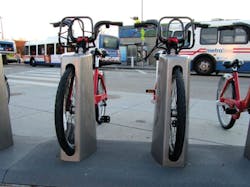
A person’s transit experience starts before the step onto the bus or train; it starts the moment they leave their house, office or any other starting point. Likewise, it doesn’t necessarily end the moment the step off the bus or train. Rather it ends at their final destination. Bike share programs can help connect passengers from their starting point to the bus stop or rail station and then complete their last mile after deboarding.
Bike sharing has many advantages – providing greater mobilization for the public, health benefits, it’s good for the environment and so on. However, a bike share program can be challenging to get started. One major hurdle is funding because bike sharing doesn’t fit into the U.S. Department of Transportation’s current definition of public transportation. For example, Denver Bike Sharing received funding from the Federal Highway Administration not the Federal Transportation Administration.
“The interesting thing about that was we awarded those dollars [from the Federal Highway Administration] last summer and are still working through the really incredibly complicated intergovernmental process, and it’s partially complicated by the fact that bike sharing is so new that the bucket we fit in doesn’t really fit us. It’s highway construction so we’re quite a simple technology and installation and minimal disruption of the land surface, but we’re regulated like a highway construction project,” explains Parry Burnap Executive Director Denver Bike Sharing. “So it’s slowed us down but we’ve learned a lot and I think maybe down the road we’ll figure out how to fast track this a little bit because it’s such a great solution for transportation challenges like congestion and climate and fuel reliance and all that stuff.”
However, while the FTA can’t fund the bicycles directly, it can help fund a lot of the infrastructure for a bike share program. According to the FTA, some of the major formula programs, such as the Section 5307, the Urbanized Area Formula Program, bicycling amenities, stationary furniture, bike lockers, things of that nature would be eligible expenses under that program.
“Then we also have, especially in this era we’ve had several different discretionary programs like bus loadability that would also sort of tailor toward the multi-modal aspects of bike sharing and bicycling to public transportation,” according to the FTA.
The FTA now has a new page on their website dedicated to available funding opportunities for bicycle projects. You can find more information on available funding at http://www.fta.dot.gov/13747_14400.html.
Bike Friendly Cities
Both the physical and political environments of a city need to be bike friendly for a bike share program to be successful. For example, in Denver Burnap says they have more than 300 days of sunshine a year, which helps for good riding conditions. The city is also laid out with wide streets on a grid-based system, which makes riding a bike in traffic less daunting, she says. Likewise, when Denver Bike Sharing was in the development stages in 2009 then mayor, now Colorado governor, John Hickenloope was extremely supportive.
“We had a mayor who is hugely supportive and helped us by talking about it every time he opened his mouth. In speeches just about and also helped us raise some money. We had the full support of the city,” Burnap says.
In Seattle, this is creating some challenges. “We’re thinking of a bike share program here in Seattle, and we have a number of challenges. We’ve got a very hilly topography with weather challenges and we have a bike helmet law here in Washington State,” explains Kevin Desmond, general manager of King County Metro.
Both Burnap and Desmond agree that the city already needs to have a certain amount of biking infrastructure in place or have a plan to improve or add it, including a network of bike lanes or bike paths.
“In your city if your urban grid is bicycle unfriendly you know people aren’t going to use it because they won’t feel safe,” Desmond says. “I think it definitely has to be in a bike friendly environment where people feel comfortable and safe biking. The hard core bikers are probably not bike share people because hard core bikers area already on their bike. So you’re looking to attract a different market that I believe places their own personal safety quite high.”
Payment and Funding
Most bike sharing programs, from China to the United States, have a fee system based on membership. There are usually a few membership options — daily, weekly, monthly or yearly. Denver Bike Share has three options for access fees, 24 hours, seven days or yearly. When a customer comes up to the bike share kiosk, if they are purchasing a 24 hour or 7 day membership, they swipe their credit card and then have unlimited 30-minute rentals during that period. However, if the bike isn’t returned to a kiosk in 30 minutes, a usage fee begins to be charged. This helps to ensure that bikes stay in circulation, Burnap explains. For users who purchase a year membership, they receive an access card with a magnetic strip on the back. In addition, Denver Bike Share has an agreement with the bike share program in Boulder, Colo., and the memberships can be shared between the two programs.
While capital acquisitions are paid for using grant and gift money, all recurring operating and general administrative costs, such as payroll, fuel, parts, rent, etc. , are paid using membership fees, user fees and sponsorship, explains Burnap.
In Hagnzhou, China, the same fare card can be used on the transit system as well as the bike share, according to Desmond, who traveled to China in 2011 as part of the Transit Cooperative Research Program TCRP international transit study mission.
In Hangzhou people can also buy a fare card that is specifically for the bike share as well. “People need to get a public bicycle service card or normal transportation card, but first users have to register the system, and need to pay 200RMB deposit, and the charging structure is: Ih is free, 1-2h is 1RMB, 2-3h is 2RMB, over 3h, is 3RMB/h,” explains Li Shanshan, Institute for Transportation and Development Policy bike sharing project manager.
Burnap and Desmond both stress the importance of having financial partners to help fund the program.
“ I think what we see is a sense of partnership with various different public entities and various other private or corporate entities, whether it’s through a big advertising deal or here in our city [Seattle] for example we’re looking at hospitals and education institutions and health insurance companies because part of the angle is the healthy lifestyle. We’re thinking of the public health angle a little more to help get it off the ground,” Desmond says.
Working with Transit
Denver Bike Share works very closely with Denver RTD and Denver Bike Share has placed a number of its kiosks at or near RTD bus stops and light rail stations. The two work together to promote multimodal transportation and have joined forces on a marketing campaign. RTD’s head of planning even sits on Denver Bike Share’s board of directors.
In Guangzhou, China, the bike share program was created along side the bus rapid transit line. “We saw in Guangzhou in particular was the direct relationship between the city’s vision for their bus rapid transit corridor and biking,” explains Desmond. “At each station stop they had bike share stations with lots of bikes so that people could then complete their trip on the bike. The corridor itself was constructed with a lot of greenway and pedestrian paths and bike paths so you don’t have to bike on the road itself with all the very congested traffic so it was a very pleasant and easy and seemingly safe bicycle riding experience. But the concept was to really integrate the growth in the market for the BRT itself with the bike share.”
In 2011, Guangzhou had 113 stations with about 5,000 bicycles and was experiencing very rapid growth in utilization, Desmond says.
In Hangzhou, the bike share program was not set up directly with the public transit. However, the bike stations are located close to BRT stations and bus stops.
“Public bicycle is part of public transportation, it is solving the ‘last mile' problem for the city, and long distance walking trip and short distance bus trip can change to use public bicycle. The stations are located very close to the BRT station and bus system. The payment also integrated with BRT system, people can use one card to access to the bus, BRT,” Li says.
At the end of 2011 Hangzhou’s bike share had 2,670 stations with 65,000 bikes. and more than 85 million trips, Li says. The sheer volume of Hangzhou’s system has really helped in its success, Desmond says.
“I think the relationship between a transit system and a transit network and a biking system is pretty strong as well, and they leverage one another and you can say ‘look if you keep your car at home all the time or most of the time and you use public transit whether a train or a bus and we’ve got this thing called bike share around so you can complete your trip so it makes the public transit system that much more convenient for folks,” Desmond concludes.
About the Author