Port Authority: Creating Transit Connections
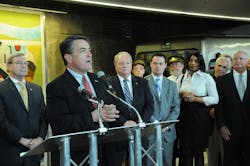
The first thing Steve Bland, CEO for the Port Authority of Allegheny County in Pittsburgh, Pa., warned his wife when he met her was that in transit, there’s only one company in every town. So they’ve lived in their fair share of towns.
And with moving around to different systems, he says it’s important to bend over backwards to spend a huge amount of time to understand the fabric of a particular community and what makes it work.
“Once you sort of get a handle on that, it’s pretty common threads,” Bland says. “The principles are the same, the general rules of the market are the same. People will use or not use transit for a lot of reasons, whether they’re in Albany, New York or Pittsburgh, or Gloucester, Massachusetts.
“But you do have to find out what that fabric is to figure out how to get the right things done.”
As Bland puts it, he’s one of those rare animals that went to college to study transit and has never done anything else.
“I went to the Indiana University of Bloomington,” Bland says, “Got both my bachelor’s and my master’s there.” His master’s degree is in public administration and went to Dallas for a management training program for post-graduate folks.
“To kind of date myself,” Bland says, “one of my assignments there was not with DART, it was with the old Dallas Transit System; the pre-DART phase.
“Actually DART had been formed at that time, but they hadn’t yet taken over the city bus system.” He continues, “So I worked for the city of Dallas under Dallas Transit in the vehicle maintenance area.”
Dallas was a one-year internship and then after that he worked at a number of agencies in Boston, Syracuse, Yorth and Albany. And then he came to Pittsburgh. As for how long he’s been here, “In Port Authority years, about 24,” he says with a laugh. “I’m wrapping up my sixth year here.”
The Pittsburgh Region
Bland talks about how every community is unique, and the same goes for Pittsburgh, as he explains. “My wife was born and raised here,” he explains. “From the time I met her I said she’s always had the worst sense of direction of anyone I’ve ever met.
“Then I moved to Pittsburgh and I had to apologize profusely.”
He continues, “There’s no such thing as north, south, no such thing as a street grid. You look at a map, think you have a direct shot and then you run into a hillside that nobody could traverse.”
For the routing structure, he says they really have to take into account the terrain.
“One of the biggest advantages we have, we have a pretty significant mode share, particularly for a city this size,” says Bland. “One of the big advantages here is you really have limited options if you’re trying to get to downtown Pittsburgh and Oakland, which are the two dominant economic generators in our region.”
There’s also not a lot of parking which equates to high parking prices. “All of that is a real advantage for transit, that people really have a reason to try it,” he stresses.
But then on the flip side, he says that when they’re looking at a busway project or a light rail project, if it’s more than a mile, chances are they’re going to be building a bridge or digging a tunnel to get it done.
North Shore Connector
The North Shore Connector is a 1.2-mile extension of the Port Authority’s light rail system, the T. It goes from downtown Pittsburgh to the North Shore area. And, as Bland said about projects requiring bridges or tunnels, the connector included the boring of twin tunnels under the Allegheny River.
As for lessons learned from the project, Bland says laughing, “First thing is always have a back-up plan.
“When the project kicked off, when the project started in the planning stage in the mid to late 90s, it coincided with the city’s master plan of doing a huge redevelopment of the North Shore area.”
Central to that redevelopment was a new baseball stadium and a new football stadium and it also tied into an entertainment complex, office and hotel development. It is also adjacent to the Community College of Allegheny County and there was a casino that located out there.
Bland says, “I came in and we were just about ready to award the construction contract, just in the immediate period post-Hurricane Katrina – the building boom. The construction index was going really out of control so we were seeing bids come in way above our estimates.”
“It was a real challenge to the project,” he stresses.
“Large public-works projects are controversial no matter what the nature is,” he says. “And rightfully so. People should argue about where public dollars are spent.
“So this project was no different; hugely controversial.”
Bland continues, “We were fortunate that we have an outstanding project team -- both our internal engineering and external construction staff.” And they all knew the environment the Port Authority was operating in. “With hose bids coming in high, the team – and when I say that, the true sense of the word, our people, our construction managers, designers, and contractors – they brought in about $40 million of cost-reduction into the project.
With bids coming in above $600 million, at the end of the day, Bland says it ran right around $512 million.
Aside from the tremendous amount of value engineering, he says the group should also be proud of the change orders on the job amounted to only about 2.5 percent of project value. “They really kept change orders down to a minimum. And frankly,” he says, “some of the change orders were done as enhancements to the project when we knew those funds would be available.”
The North Shore Connector opened for revenue service March 25 of this year. As a regular rider, Bland says at rush hour it’s running with about four-minute headways and at his station, there’s typically 100 to 150 people boarding. Mid-day it’s running at about seven-minute headways and in the evenings it falls off to about 10 or 15 minutes.
“We’re analyzing overall ridership now,” Bland explains. “We want to get past the novelty stage.” Anecdotally, he shares that there are a lot of venues over there and after the first major event, the Pirates opening game, they got a letter from the Pirates.
“By their counts, about 13,500 of their fans, or 13,500 trips were being made opening day by the subway, which accounted for about 25 percent of the game travel.”
And all that controversy that comes through planning and construction, he says pretty much disappeared on March 26.
“It took about a week to say, ‘Where can we extend it further,’” he laughs. “The newspaper that was the most critical of it did a follow up about this parking garage located right on top of one of our stations and it went from about 70 to 90 percent capacity within a week.
“It’s been hugely popular and I think what will be interesting to watch is that there’s still room for development on the North Shore.”
“Hope for the best but plan for the worst,” was one of the lessons learned, Bland says. “Always have a backup plan in terms of funding and financing and then for me, a personal role, when you challenge people to a specific role, you can be very pleasantly surprised with the creativity that they put into it.
“Have high expectations of your project team. We have pretty bright people here so they really came through.”
Bus Rapid Transit Before Bus Rapid Transit
The Port Authority has three dedicated busways, which are essentially highways just for buses. The initial one was the South busway, which started in 1977. The Martin Luther King Junior East busway went into service in 1983. And then more recently they extended that line and added the West busway, within the past 10 years.
They are completely grade-separated and have dedicated stations. They were built on what had been surplus of rail right of way. “When the manufacturing economy collapsed, we had an awful lot of freight rail capacity that wasn’t necessary, so the busways were typically built in that excess rail right of way.”
“All told, the three busways carry about 40,000 passenger trips per weekday,” says Bland.
The two dominant economic generators of the region are downtown Pittsburgh, which has about 110,000 jobs and the Oakland area, which has about 40,000 jobs and about 80,000 students. “They’re only separated by three or four miles,” Bland explains. “And the neighborhood in between is relatively underdeveloped.”
However, they don’t have the excess of rail right of way to utilize in that area. Between downtown and Oakland, there is a huge amount of transit service, every three of four minutes during peak hours, but it gets stuck in traffic. “It’s slow, it stops every other block, that type of stuff,” says Bland.
“We’re really looking at developing an on-street bus rapid transit situation, similar to what Cleveland did with the Euclid Avenue Corridor.” With the streets in the region not being as wide as Euclid Avenue, Bland says they will be, “trying to figure out how to get that 20 gallons of water into a 5-gallon jug.”
Currently the Port Authority is doing about 18,000 trips in that corridor. With downtown and Oakland being built out, there really isn’t much vacant land for universities or hospitals to expand. Uptown, on the other hand, is underdeveloped, Bland explains. “There’s definitely potential if we can do a convenient, fast, reliable, easy-to-use transit connection between downtown and Oakland. The institutions have said, ‘Yeah, we need more space.’”
The Uptown neighborhood also did a neighborhood visioning study before the Port Authority even began looking at bus rapid transit. The neighborhood identified significantly upgraded transit as crucial to its future development.
Bland says the Port Authority is working with about 30 stakeholder groups to advance this. “We’re not looking at it as much as ‘Here’s a big project the Port Authority’s going to do to create bus rapid transit.’ I would say our approach is probably more organic, saying, ‘There’s a role for the Port Authority to play in delivering infrastructure and service to make that go, there’s a role the city of Pittsburgh has to play. And there’s a role for the institutional partners to play.’
As of now the project is in the alternative analysis phase and they expect that process to be completed right around the end of the year.
“One of the things we’ve always advocated as an advantage of bus rapid transit is we’ve always said we can do it incrementally,” explains Bland. “We can make incremental improvements.”
Getting Smart
Another major project for the Port Authority right now is the upcoming ConnectCard smart card system. The prime contractor is Scheidt & Bachmann and the Port Authority is at the point now where all of the onboard equipment is in place and ticket vending machines are starting to be installed.
There are U-Pass agreements with three of the universities in the area. Essentially the universities pay a lump sum and then staff, students and faculty have universal access to free rides on the system.
Coincidentally, at the same time the Port Authority was advancing its smart card planning process, the University of Pittsburgh was completely redoing its university ID system. “Right now the University of Pittsburgh ID is a smart card that’s compatible with our system, so already we have the 40,000 students and faculty essentially tapping to board the system.
In the last month, Carnegie Mellon University indicated that it is also moving in the same direction and will begin to pilot it next year.
“We’re right now in the process of piloting our various products internally,” Bland says. The Port Authority just entered into an agreement with the largest supermarket chain in the region, Giant Eagle, to host its point-of-sale terminals so people will be able to buy and re-value cards at those locations. Bland says they expect a full retail deployment of smart cards by early next year.
He says they’ve been talking to systems extensively that have been through it to ensure a smooth transition. “The over-riding message is everybody spends a ton of time and a ton of money focusing on the technology; you need to focus on the marketing end and the sales end and the customer service end.”
Going along with that idea, there are a couple of things Bland says they have started to restructure internally. He said they heard from both Atlanta and Boston, “If you’re customer service function isn’t ready for this, it’s going to be a disaster.”
He says they outsourced their treasure function. Historically it had been their own employees that would go to the bus divisions and the rail stations to pick up the cast, go to the central location, count, etc.
“We knew because of the changes – we were installing 60-some ticket vending machines – we were going to have to significantly increase staff or we were going to have to think of a different way to do it.”
Now the treasury function is outsourced to Brinks and with the cost-savings, they are essentially deploying more people in the customer service function so if and when someone has an issue with their card or need to check values, customer service can work on that.
Another consideration that has led to a number of discussions is whether you set the fare structure to encourage the use of the smart card or to discourage the use of cash. “That’s the nature of the debate and how you get people to convert over.”
The consulting group that’s working with them on this is LTK and the project manager was also involved with the Metropolitan Atlanta Rapid Transit Authority’s Breeze card.
By rolling the card out in waves, it creates a help with the learning curve. How do I tap? When do I tap? And it goes for operators, as well as customers. But in waves, it’s built in, Bland says, “’Oh, I know how to use that, let me help you with that.’ I think that’s an important part of it.”
And the biggest question ...
The big concern on everyone’s mind in transit is, of course, funding. In Pennsylvania, the dominant funding source is from the commonwealth of Pennsylvania. “Pennsylvania puts more money into transit than almost any state in the nation and that’s historically been true,” Bland says. “And that’s true on the highway side as well; Pennsylvania maintains more miles of state road than any other state in the nation, so they’re very dominant in the transportation area.”
Like other North American transit agencies, the Port Authority has seen significant cuts in funding. “Our fiscal year 2011 to fiscal 2012 saw about $53-1/2 million reduction,” Bland says. And that was after three or four years of no growth in either state or local funding, he adds. They’re projecting to start the next fiscal year with a $64 million deficit.
“Our total operating budget is about $360 million and that’s after the last five years, frankly, of putting in a huge number of efficiency changes, including service reduction.” He says in the last five years, they’ve reduced the overall sub-service level in terms of hours by about 30 percent. “We’re still at about 95 or 96 percent of our previous ridership level and in fact, ridership over the past year has gone up.”
And talking to other agencies, he knows they’re not alone. “I talked to SEPTA last week and they have about a $5 billion capital backlog and they’re essentially spending down most of their reserves to get through operating without significant service reductions or fare increases.
“Our governor took office about a year and a half ago. He appointed a transportation funding advisory commission, which developed a number of recommendations that came out last summer.” Bland continues, “Frankly we’re all – when I say ‘we all,’ that’s the transit agency, the Port Authority riders, road and bridge folks – are just waiting for the governor and the legislature to take action on the report.”
Working in Transit
“Transit to me was always the best of the public and private sector,” Bland says. “We have a product, a service we’re trying to sell, market, and price.
“It’s a public service and we’re dealing in the public realm with the political end of it and trying to make the case more broadly than just directly with our customers.”