Preparing for the President
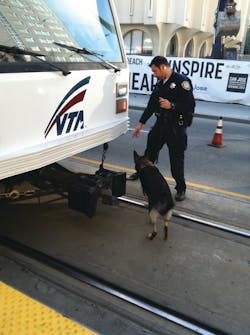
Three day's notice. Enough time to cram for an exam, scrub the house for your in-laws' arrival, or even to get your taxes done — assuming you don't have too many deductions. Enough time to plan logistics for the arrival of the president of the United States?
Last September John Carlson, superintendent of Service Management at Santa Clara Valley Transportation Authority (VTA) got a call from U.S. Secret Service: President Barack Obama would arrive in just three days and VTA's assistance was required. After 36 years at VTA, that call was a first for Carlson and it set the wheels in motion for a sprint — make that a marathon — for the entire VTA agency.
Carlson soon was dispatched to a briefing where Secret Service charted Obama's route for regional law enforcement and affiliated agencies. A seemingly simple visit with social media network LinkedIn and with notable campaign donors proved to be a sophisticated, logistical exercise that required cooperation at every level.
"It is amazing the amount of coordination and details that are covered when the president comes to town. Literally, there is no rock left uncovered by the teams assigned to protect the president," said Carlson. "I know the people I work with daily do a great job through any type of crisis or interruption, but they brought it up a notch to make certain we delivered our service with as little inconvenience to the public as possible and at the same time met the necessary safety precautions for the presidential visit."
At the request of the U.S. Secret Service, the FAA can restrict airspace around the president for up to 30 nautical miles. For Obama's brief stay in Silicon Valley, not only was airspace restricted but the Secret Service originally planned to shut down light rail service through downtown San Jose—one of the most highly traveled routes in the VTA system — for more than 12 hours.
VTA negotiated a compromise: Light rail would continue to run as scheduled but every vehicle would have to be swept by law enforcement K-9 teams for explosives at the light rail station stop prior to coming into range of the president's hotel. Rail stations closest to the hotel were temporarily closed.
Carlson enlisted the skills of his colleagues at VTA operations. Bill Capps, VTA deputy director of Operations, was dispatched to Moffett Field for the arrival of Air Force One. At the direction of the Secret Service, Capps would give the word to stop trains along the route of the presidential motorcade. As Capps awaited instructions, he found himself surrounded by black suits and sharpshooters on the roof above.
On Sunday, September 25, shortly after 5:30 p.m., Air Force One touched down at Moffett Field in Sunnyvale. The air was clear and warm and all eyes were on the high-profile guest. The VTA team and its Secret Service colleagues coordinated through precise and well-timed communication measures.
From Moffett Field, the president was whisked off to meet with campaign donors at the Woodside home of Symantec chairman John Thompson. Then he was off to the Atherton home of Facebook Chief Operating Officer Sheryl Sandberg before settling in for the night at the Fairmont. Monday morning President Obama attended a town-hall style meeting hosted by LinkedIn at the Mountain View Computer History Museum, where he spoke about job creation. VTA buses were placed between the street and the museum as blast shields to protect the president.
Working behind the scenes, VTA personnel accompanied law enforcement officers with bomb-sniffing dogs through every VTA vehicle on the downtown route. Dogs "swept" all areas inside and out. German Shepherds patrolled exteriors while more affable Labrador Retrievers searched inside — an easier presence for already ruffled passengers.
Mike Hursh, VTA deputy director of Maintenance and Security, rode in the California Highway Patrol lead "route" car along with a Secret Service agent. The car drove about 10 minutes ahead of the presidential motorcade to coordinate light rail service suspension in advance of the motorcade and to clear potential hazards, including disabled vehicles whose drivers were instructed by the CHP to leave the highway.
By noon on Monday, Air Force One had departed San Jose airspace and the team at VTA breathed a collective sigh of relief. VTA Chief of Operations Dan Smith soon after received a letter from the San Francisco Secret Service expressing gratitude for an outstanding effort. "... Every member of the VTA team who participated contributed to a flawless visit through some very dense portion of downtown San Jose and beyond." In turn, Smith circulated a memo of thanks to staff for accommodating the needs of the president while minimizing the impact on service and passengers.
"The event was a public display of the teamwork that VTA employees practice every day in the delivery of world-class public transit service. I'm proud of our operators, mechanics, supervisors, support staff and managers every day, but on that particular day I was especially proud to say I work for VTA," said Hursh at the end of the project.
Added Capps: "Being personally involved in President Obama's visit to Silicon Valley was definitely one of the highlights of my career at VTA, and something I will always remember. I can't say enough about the multi-jurisdictional coordination that took place to support the President's visit, and I am particularly proud of the high level of professionalism demonstrated by VTA staff who worked diligently to accommodate the additional security requirements while still delivering the high quality service our riders have come to expect."
Carlson offered his own conclusion: "The people I work with really deserve the credit as they are the ones who made us shine."
Robin Doran is a community outreach specialist at Santa Clara Valley Transportation Authority.