Creating 21st Century Transportation
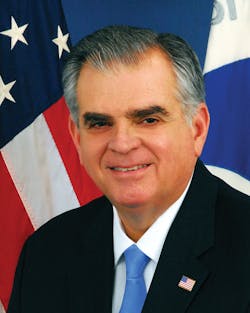
While at the U.S. Department of Transportation I was chatting with some DOT staff members while waiting for my interview with the department's 16th Secretary of Transportation, Sec. Ray LaHood. It was a conversation about LaHood's determination about doing everything the department can, to ending distracted driving.
U.S. citizens can read about his commitment on Distraction.gov, the website created and dedicated to this topic; "Fast Lane," the official blog of the U.S. Secretary of Transportation; YouTube; Facebook or Twitter. LaHood has made it his mission to be a visible figure promoting what he feels is important.
When it comes to the problem of distracted driving, I learned that is something he started with no additional budget and the department has been using available technology and Web social sites to get the message out to the nation.
This highly visible, vocal nature is one of the things LaHood has been known for in his post as secretary of DOT. And, to make sure he understands what America's transportation needs are, he's constantly learning, listening and traveling across the country talking to people.
"I've been to I think now 46 or 47 states," he says when I meet with him. And that doesn't count the trip to Alaska he was going to have shortly after our meeting. "I was just in California, while I was there I met with the governor on high-speed rail and I met with other officials on other transportation issues," says LaHood. "And Monday I'll be in Minneapolis in the morning and Charlotte, North Carolina, in the afternoon." He adds, "There are many, many unmet transportation needs all over America."
Thinking big, making sure we take care of our crumbling infrastructure and putting Americans to work is what the secretary's message is now. Passing the American Jobs Act so bridges don't have to be closed, America's infrastructure can be kept state-of-the-art and progress can be continued on transit, roads and bridges.
The American Jobs Act
Congress passed an extension of the surface transportation bill through March, six months of funding. LaHood says, "Our goal really is to work with Congress to persuade them to pass the American Jobs Act, which has $2B for transit and $4B for high-speed rail, which are both high priorities for the President."
"We've invested more than $10B in the last two-and-a-half years in high-speed rail in America. That's 10 billion more than has ever been invested in high-speed rail," LaHood says. "My view is that President Obama and this administration take a back seat to nobody when it comes to being responsive to transit because we believe this is what the people want.
"That's why we think we have a very good story in going to Congress for the American Jobs Act. You invest in transit, what you're investing in is green jobs, green transportation and the opportunity for people to have state-of-the-art repair transit, newer transit, and make sure that people have the availability of it."
At the US High Speed Rail Association's November conference in New York City, LaHood spoke to attendees about the administration's vision. He said, "Our goal, the president's plan, includes connecting 80 percent of America in the next 25 years." He continued, "All told, the American Jobs Act creates hundreds of thousands of quality jobs, laying or making 4,000 miles of track, enough to stretch from coast to coast over the next several years.
"Once track is laid, then states can start doing high-speed rail that will spur economic development; we know that," LaHood said. "It will generate quality jobs and small businesses all along the corridors."
Responding to Criticism
When critics question the administration's rail vision, LaHood says to look at the Interstate system and its success as this is exactly the same blueprint that was followed when building it.
"Maybe these are the same cynics or skeptics that existed when Eisenhower signed the Interstate Bill," says LaHood. "Fifty years later we have a state-of-the-art Interstate system.
"Maybe they're the same people that were around when Lincoln got the freight rail system going, the railroad system going in America. Look at what we have today. We have a great freight rail system. Class 1 freight rails are doing very well; they bring a lot of goods around America."
"When they started building the Interstate system, they built it in sections, it wasn't necessarily connected," LaHood says. "They didn't know where all of the lines were going to be, they didn't know where all the money was going to come from, but they knew this, if they built it, the people would use it. If you build high-speed rail, Americans will use it."
Though they didn't know exactly where all the routes were going or where every last bit of funding was coming from, Eisenhower set a goal. Through 10 administrations and 28 sessions of Congress, they got it done.
"It didn't make a difference who the president or members of Congress were," LaHood says. "What made a different is the American people kept prodding and making sure that whoever the president was, whoever the congressmen were, they carried out this vision. That's what we're asking now; carry out the vision for high-speed rail."
And he said they're telling Congress to not be dissuaded from doing anything because we're in tough times. At the USHSR conference he reminded the audience that as a nation, we've invested in big things when times were good and when times are tough.
"We built the Trans-Continental Railroad; we connected the coasts during the bloodiest war in American history," he said. "Abraham Lincoln's vision.
"We built the Hoover Dam and Golden Gate Bridge during the Great Depression. We built the Interstate Highway System through decades of stagflation." He said, "These are the transportation projects that made America the greatest country in the world; we're the envy of the world when it comes to our freight rail system and our highway system. These are projects that make our life and our way of life and our commerce possible."
He continued, "Our parents and grandparents sacrificed and they struggled courageously so we might have a chance to lead the life that we do by building a rail network. We can pay back our debt to them and we can give to our children and grandchildren the opportunity to connect to a new century of opportunity, a new century of transportation, the next generation of transportation.
"We want to put Americans to work; let's put them to work building the high-speed rail."
LaHood said, "Without a modern, up-to-date high-speed rail system, we will not do what our ancestors did for us, which is to take us to the next generation of transportation. That's what we have to keep in mind.
America's Aging Infrastructure
When I met with LaHood in at the DOT offices and at the USHSR conference, LaHood stressed that the investment in infrastructure and high-speed rail he's looking for isn't about status quo.
"Between Kentucky and Ohio they just closed a bridge because it was not safe for people," he says. "Thousands of people travel that bridge and our people are out there right now inspecting the bridge, trying to figure out what it will cost to fix it up."
This is one illustration of the unmet needs in America's infrastructure.
"The bridge is an important infrastructure for people to get back and forth across the river to go to work and go to church and go to school or whatever. But it's closed." He says, "That's symbolic of the crumbling infrastructure in America and we need to do what other Congress' have done; we need to do what other administrations have done."
Funding Transit
As for transit funding, LaHood says they've listened to transit officials around the county and enabled them to use part of the money that they have for operating. "Currently we allow transit systems to use up to 10 percent for operating, but in our legislation," he says, "we talk about a formula that would allow them to use 25-15 and then ultimately, based on what the economy looks like, maybe a lesser percentage.
"But the idea that we changed that we deal with transit systems is a recognition that we know it's a tough economy; we know that ridership is down; we know that many transit systems still have administrative costs and also a cost for their equipment."
Transit operators have been very helpful working with their mayors and communities, LaHood believes. With the high price of gasoline and the high unemployment, people are looking to transit as a means of transportation that's affordable and the transit industry has made their members of Congress and their senators aware of the importance of public transportation.
"It can't be all just on the president and all on us here at the DOT," says LaHood. "It has to come from the grassroots."
Another thing he wants to continue working on with transit systems is safety. And, he said they're trying to persuade Congress to reintroduce the Transit Safety Bill. "We want to work on safety and we've talked about safety since a couple of crashes occurred a few years ago," LaHood says. "We believe it's very important that we have some say in the safety of transit systems around America and we haven't had that kind of jurisdiction before.
High-Speed Rail
Regarding high-speed rail, "We've got tracks that need to be laid and trains that need to be manufactured in America; we've got private companies with the equipment and the manpower to do the heavy lifting right now," is the message LaHood delivered to the attendees of the USHSR conference.
"We've made a lot of progress; we've invested hard-earned tax dollars and the idea that these dollars are not well spent is absolutely nonsense." He continued, "We are making an America where 80 percent of the people have access to high-speed rail.
"We know that as this system emerges, economic growth and opportunity will follow. Every one of these corridors is an economic engine for communities that they run through, the jobs that they create; we know that every rail is an economic corridor."
To date, LaHood said, there are 30 rail companies from around the world that have pledged that if selected for high-speed rail contracts, would hire American workers and expand their base of operation in the United States, partnering with American companies.
"We know America will be home to a hundred billion additional people by the year 2050. That's the equivalent of another California, Texas, New York and Florida – combined," stressed LaHood. "Our highways and airports simply can't handle the growth. We need to do something or we'll be crushed by the weight of our own expansion."
Working Together
Congress has always found a way to make sure that transportation is bipartisan and found a way to pay for it, LaHood says. "There are no Democratic or Republican roads or bridges."
He talked to Wisconsin Governor Scott Walker when he was first elected and LaHood says, "He told me he didn't want high-speed rail money and that showed me where his commitment was for transportation and high-speed rail.
"There were a lot of disappointed people in Wisconsin, Florida and Ohio that have worked long and hard on transportation, particularly on transit and particularly on high-speed rail." LaHood says, "It's up to them; we will work with anybody that wants to get something done."
He also says, on the day Florida Governor Rick Scott said he was not going to accept $2.3 billion, there were nine foreign companies in his state ready for him to agree to use them to help; they wanted to invest.
"I just arranged for Governor Brown to meet with representatives from China and Japan to talk about what they might be able to do to invest," LaHood says. "There are companies in America – in Illinois, in the Northeast Corridor, in California – that will be partnering with these states for their high-speed rail plans. It's happening.
"We believe in public-private partnerships. There are a lot of companies out there that want to invest in America, want to leverage some of their money against some of our money."
LaHood acknowledges it's a very difficult time right now. However, he says, "People have to set aside politics, think about policy, think about good policy, think about getting our friends and neighbors to work.
"The quickest way to put our friends and neighbors to work all across America is to pass the American Jobs Act. If there's something you don't like about it, change it. But do something," he stresses. "When America's been hurting in the past, what has Congress done? They passed an opportunity for America to go to work. This is pretty simple; this is not complicated.
"Put politics aside for a brief moment for the benefit of the American people."
###
Spreading Transit's Message
Gov. Tommy Thompson serves as a senior advisor to the American Public Transportation Association (APTA) and R&R Partners provides support and research for him. He speaks to and for the business members in making the argument that wise investment in infrastructure is a proven way to create jobs and stimulate economic activity.
In 1987 Thompson became the 42nd governor of Wisconsin held that role until President George W. Bush appointed him as U.S. Secretary of Health and Human Services in 2001.
When I ask Thompson what the transit industry needs to do, he stresses, "They've got to tell their story."
At APTA's Expo in October in New Orleans, La., Thompson walked the show floor and talked to a lot of suppliers and manufacturers in the industry. "I wanted to find out what dollars spent by government will mean an increase in employment," he explains.
"We ran in to John Pierre with Nova Bus, he's the CEO. He put in a plant in Plattsburgh, N.Y." He continues, "He said he's got 400 jobs there and I asked him does that mean the total number of jobs for the amount of money you get when selling buses to New York and to Connecticut? And no, he said. 'Every time I create on job, I create five jobs from other suppliers.'
"I thought to myself, if you extrapolate that, for every dollar that a bus or light rail company creates manufacturing in the United States, you're going to create five other jobs. That's a lot of jobs."
Another manufacturer he talked to was Siemens where in the rail car, on one of the walls they had a list of all of their suppliers. "This is the message I want to see," he says. And as they were looking over the list they saw there were three different companies that were supplying manufactured materials and components for that light rail car that were from Wisconsin. "Three companies from Wisconsin make components in that care; that's powerful. I didn't know that.
"Three companies in Wisconsin, those are three different congressional districts and I'll bet you anything the congressmen from those three areas in Wisconsin don't know that these companies are manufacturing for light rail."
Telling Transit's Story
Thompson is working to help get the message out explaining the value, the economic development, job creations, transportation quality, efficiencies and how it lessens the transportation on highways.
After talking to manufacturers he says, "The problem is, nobody is bringing this together. Nobody's bringing the manufacturers, the suppliers, to talk to people in Congress about the importance of the transportation budget, that it creates a lot of good-paying jobs in a lot of different areas.
"We've been talking to ourselves," he says. "Let's do what the aerospace industry does. They target all their components on a big map when they go in to see Washington. That's what we've got to do."
"What we're trying to do is, we've got a message here; you want to change the economy in the country, you want to create jobs, let's do it. Let's be smart about it.
"Let's tell our complete story."