Bill Millar to Retire
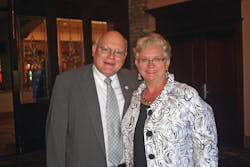
Fifteen years ago federal aid for public transportation was less than 4 billion dollars a year. Today, it's 11 billion. Along with that growth in federal funding in the last 15 years American Public Transportation Association CEO William Millar has seen growth in ridership by 31 percent. He said that's really gratifying because APTA and its members have done a lot of planning, a lot of work, and have really made a difference. "I'm very glad that I was able to be here long enough to see the results of a lot of the seeds we planted a long time ago."
Millar became CEO of APTA in 1996 after 24 years in transportation operations and management. He was the executive director of the Port Authority of Allegheny County (PAT) for 13 years prior to that. As head of one of the country's largest public transit providers, he directed a system that operates bus, light rail, exclusive busway, demand response and inclined plane transit service.
Before joining PAT in 1977, he developed and managed Pennsylvania's Free Transit Program for Senior Citizens, as well as other transit aid programs for the Pennsylvania Department of Transportation, including rural and other community-based transportation systems.
A lot has changed during Millar's transit career, from the technological evolution of the vehicles themselves to the better understanding and appreciation of public transportation.
"There are many parts of the county now that are investing now in public transportation that just never thought that they would need it," Millar said. "That's a big change."
There are a lot of things APTA and its members have done to change the image of public transit and Millar said he's very proud of what's been accomplished. "We worked very hard. First there was something called VIP and later something we called PT2 — Public Transportation Partnership for Tomorrow — and then today what we call RCA, Research, Communication and Advocacy program." The RCA has spun ideas like the Telling Our Story campaign and the Selling Our Story.
"We proved with PT2 that with using very traditional market research and then designing advertising and public campaigns, you could in fact sell transit much the way other industries have sold their image." He continued, "That may seem like an obvious statement as we sit in 2011, but I assure you, I was presenting those ideas in 1998, 1999, 2000 to our members and asking them to pay for it, it was very skeptical, indeed. But we proved you could do it and be very successful."
At the same time, utilizing this research for these various initiatives has organized the APTA members better to go back from Washington to talk to their elected officials. "We put a face on the statistics," said Millar.
And this research greatly increased the amount of statistics APTA's able to provide. When the topic of the country was global warming and climate change, APTA had hard data that showed how beneficial public transit was to reducing the amount of carbon that goes in the air. With the issue of jobs and job creation today, APTA's done the research to meet that challenge, as well, Millar said.
"With APTA having done the research, we can help people understand that every billion dollars of federal aid maintains about 36,000 jobs." He stressed, "Those kinds of raw, basic data are very important."
Having increased the research and statistics, the image and awareness, it's all improved the way APTA interacts in Washington. "We've worked very hard to raise the profile of APTA and public transportation so that we don't have to fight to get into meetings where important decisions are going to be made, but we're on the guest list and invited," said Millar. "I'm very pleased about that.
"We really increased our efforts to educate congress in a much broader sense than we ever did before."
And increased partnerships that have been established have created a stronger voice about the value of public transportation. Instead of having transit go off on its own, he said, APTA's worked with organizations in the business community. Being a founding member of the Americans for Transportation Mobility (ATM) and connecting with the various environmental groups or land-use and planning groups has strengthened the message. Millar said, "That whole effort of broadening partnerships has really been key to what we're doing."
There is also a much better understanding of how public transportation integrates with, supports, and makes possible, local economic development and community development programs.
"When I started the business 40 years ago, in most places transit was simply for low-income people. There's nothing wrong with that; public transit is often the first rung on the climb of the economic ladder." He continued, "As noble as that is and as important as that is, today, it's many other interests.” He stressed, “There is a much better understanding of how public transportation integrates with, supports and makes possible, local economic development and community development.
"It is a much more accepted service that people understand it's not just the bus going down the road, but it's what the people on that bus are going to do when they get there, whether it's to get to a job or to spend money or what ever it might be," Millar said.
Not only have views changed on the outside, they've changed within the industry, as well. Millar said, "I can remember when I first went to Pittsburgh, if you really wanted to get somebody angered, talk to them about transit in Cleveland.
"But today, when they undertake something in Pittsburgh, they're taking a more sophisticated approach. They'll give a call or send an email to the guy in Cleveland, see what they've done, see what they've accomplished. The attitude was I'm going to do what Pittsburgh needs, I don't care about anybody else. But, it turns out, everybody has very similar problems."
With this expanding communication and involvement, the industry is much better prepared today to support things like standards — a major activity at APTA.
"When I got to APTA, it [standards] had just gotten started and today it's a very significant portion of our activity," Millar explained. "Hundreds of employees from APTA member firms and transit agencies work on a consensus of standards just wouldn't have been possible 40 years ago.”
APTA Membership
One of Millar's goals when he came to APTA he said, was to make it a broader, more inclusive environment. "I have always viewed APTA as a big tent," he said. "I want anyone who has an interest in public transportation to realize that if they're going to pursue their interest, whether it's as a private business or a public agency, that they are much better to belong to APTA, to be active in APTA."
It was an industry that was very male-dominated and he said they took a lot of steps to make it much more inclusive and that when thinking about who's best to talk about various topics, they have a variety of people, not just the people from the big systems, the little systems and not just the men, but the women.
He has seen in increase in involvement from transit board members and in the businesses that work in the sector, as well. The more inclusive it has become, the stronger the organization has become.
And to the new members now, he said there's a lot to learn, go learn it. "Talk to our vendors, go to our technical sessions, go up and meet the authors of the papers," Millar stressed. "Use APTA for everything it's worth and it will really help you get to know the industry.
"I would also encourage them to find a niche that makes sense to you to get personally involved." He said they've found through their surveys that those that are active on a committee, who get involved, who helped make things happen were much happier than the ones who didn't.
APTA Moving Forward
When talking about the direction of APTA for the future, Millar said one of the biggest challenges to any trade association is defining the path that most members will support, as you can rarely get 1,500 members to agree. He said listening and taking the good ideas from all the different members and putting them together to go forward where everybody at the end of the day feels it was a good idea.
"APTA is a voluntary member organization; there's no law that says you have to join APTA." He continued, "When I was being interviewed for my job 15 years ago, one of the things when I was asked about my goals and what I wanted to do with APTA, one of the things I said that solicited a laugh, but I was dead serious about it, I wanted APTA members to enthusiastically pay their dues.
"I'm really proud of the fact that when I came here there were little over a thousand members and today there are 1,550 members so we were able to grow the membership," Millar stated. "In the last three years there have been a lot of associations in Washington that with the recession, have lost members. We actually gained.
"I'm very proud of that. Apparently APTA members understand the value of belonging to APTA even in very tough times. They could have saved money in their budgets, but they understood it was an investment."
And to continue APTA's growth, he said there's an internal program called APTA is a Learning Organization. "We're trying to give our employees, to get their skills sharp and up-to-date and give them the opportunity to really help us improve APTA," he explained. "I can speak well, I can do a lot of things, but if my 90 employees don't feel it, don't believe it, don't do their part, what I do means nothing because I work through them."
Memorable Moments
The First Lifetime Achivement Award
Millar's time at APTA has provided him with many memorable moments. One was when APTA first created the Lifetime Achievement Award and the very first award was given to Rosa Parks. "To have an opportunity to host an awards ceremony and to have Ms. Parks come and be willing to accept our award, that was an important part of history and it was a thrilling moment for me," said Millar. He added that of all the things they've done at APTA, that will remain on of the real highlights.
Preserving Transportation History
The Smithsonian Institute had decided after many decades that they were going to revamp their transportation exhibit and APTA was asked to come in as a major donor and work with them. "They had contacted Rose Sheridan," Millar explained. "Rose brought her creativity, her contacts, to help identify ways we could help and how we could leverage that.
"We didn't have a lot of cash we could give them but we were able, by working with our members, through in-kind service and some cash, to qualify as one of their million dollar-level donors." He continued, "So for the next 20 years or more, our name will be right there ... as millions of Americans will pass through that exhibit and see things related to public transportation that wouldn't have been there if we weren't there."
Meeting the Clintons
In September, 2008, Millar was going to testify before the Senate Banking Committee, something he's done many times in his career. "We go in and I remember seeing six chairs but only five nametags," Millar said.
"I dutifully sat down behind my nametag and there's a vacant chair next to me and the hearing was about to begin.
"All of a sudden, I'm sitting in the front of the room and there's this rusting around," he said, "and Hillary Clinton sits down next to me." This was just after she had completed her campaign, Barack Obama had been nominated, and she was there testifying as a senator from New York.
"It was just a thrill," Millar stressed. "I went up to her and I said, 'Hi, I'm Bill Millar with APTA,' and I got a chance to thank her for what she did and how my wife and I were so proud of the campaign she ran.
"In her long life of public service, she just looked at me like every great politician can and it was clear I was the only one who mattered in her whole life," he recalled with a laugh, "and she said, 'Thank you and be sure to thank your wife, too.'"
After the TEA-21 legislation was passed in 1998, Millar had been invited to the bill signing in the old executive office building. Millar explained, "When it was signed, I was invited to come in to a small room and there was President Clinton, towering over everybody, and like every great politician, he grabbed my hand, looks at me and said, 'Bill, I'm so glad you helped us do this for America.'" And from that meeting Millar was able to get a nice picture with him and a nice letter back at the office from him, thanking APTA for its efforts.'
On Retirement
When asked what he plans on doing after retirement, he responded, "Sleeping in on November 1st." Though he's looking at a number of different opportunities and some organizations have contacted him about ways I could help them out, he said he does mean this to be a retirement. "I don't have any interest in working full time, I don't want to run anything.
"I'm very well satisfied," he said. "I have several really concrete accomplishments in my career and I leave very satisfied that in the 40 years I worked in this industry, I helped make it better — a lot of people did — but I had my parts in making it better, and it is better. I feel good."