Union Station Bicycle Transit Center
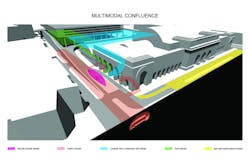
At the cusp of a livable cities movement, the Bicycle Transit Center is a highly visible catalyst promoting bicycle use and alternative transportation options by providing secure parking, rental and retail uses. At the doorstep of Washington's major transportation hub, Union Station, the sleek veiled form reflects the technology of its contents while complimenting its eminent Beaux Arts neighbors. Echoing a bicycle wheel's elegance and efficiency, arched steel tubes covered with an energy-efficient "skin" optimizes transparency in this sensitive historic context.
Union Station — an Intermodal Center
Union Station is the largest intermodal transportation center in the Washington metropolitan area and the mid-Atlantic region. Located just east of Washington's central business district and blocks from the U.S. Capitol, Union Station plays a major role in the travel and commuting needs of thousands of residents and visitors to the national capital region from D.C., Virginia, Maryland and the entire East Coast.
The original train station was completed in 1909., but many modifications have been made over the years. The original train station was designed by noted architect Daniel Burnham and is listed on the National Register of Historic Places. The most recent major upgrade and rehabilitation of Union Station's rail station occurred in the late 1980s. The Metrorail station at Union Station opened in 1976 and has undergone no major upgrade or renewal beyond routine maintenance projects and the addition of one mezzanine escalator and stair. As these adjoining stations experience new growth from expanded intercity travel, commuter rail's growing popularity and the renewal of adjoining D.C. neighborhoods, Union Station's many stakeholders have come together to begin extensive planning that will create a 21st century multi-modal transportation center.
Union Station is a complex of several structures and serves multiple functions. In addition to the Metrorail station, it contains Washington's Amtrak intercity passenger rail station, the terminal for MARC and Virginia Railway Express commuter rail services, a bus terminal serving intercity and local buses, a retail center of shops and restaurants, a community gathering place with meeting rooms and public spaces, and a tourist attraction.
Each weekday 23,000 commuters and intercity rail riders make 45,000 trips through the station on 229 Amtrak, MARC and VRE trains and 35,000 passengers enter and leave the adjoining Metrorail station. The Metrorail Station at Union Station is the busiest station in the Metrorail system, with close to 70,000 passengers entering and exiting daily, including 18,000 passengers transferring between Metrorail and railway services (Amtrak, MARC and VRE).
These travelers are joined by 350 intercity bus passengers served by three different bus companies, 200 to 1,000 tour bus passengers depending on the season; hundreds of individuals parking at the station's parking garage and more than 150 bicycle commuters and renters at the bike station.
The Bikecycle Transit Center
The Bicycle Transit Center (BTC) is strategically located in the heart of D.C. at Columbus Plaza. As a major intermodal Ccomplex, Union Station was chosen by the District Department of Transportation as an ideal site to test the viability of the initial BTC. Also chosen for its adjacency to the new Metropolitan Branch Trail, the Mall, the expanding NOMA District, and centrality to Washington's four quadrants, the BTC serves a range of users. Any resident, business person or tourist ready to don a helmet and join the growing ranks of bicyclists is welcome.
Sited between two turn-of-the-century landmarks by Daniel Burnham, Union Station and the National Capitol Post Office, the facility is available to thousands of tourists, commuters and neighbors passing through on a daily basis. Union Station, circa 1907, exemplifies a heroic strain of the example of American Beaux Arts tradition that came into fashion after the 1893 Columbian Exposition.
Grand iconic vaulted ceilings recalling Roman Triumphal Arches and Baths suggest this building representsis an "imperial transportation palace" as conceived by its renowned architect "Daniel H. Burnham. The "Carriage Courts" stood at each end of the Station but were later removed in the 70s to accommodate a Metro tunnel, as well as access to the garage behind the station. Now the highly visible location adjacent to the West Portico creates a fitting backdrop for the BTC Transit Center as our attitudes toward transportation have evolved and been shaped by sustainable goals.
Program
The approximately 1,750-square-foot structure is divided into two areas; bicycle parking and retail. The retail area will provide the following services: bicycle rental, repair and retail accessories. The facility will include the following program elements:
- secure parking for 150 bicycles
- non-secure parking for 40 bicycles
- short-term parking for 10 bicycles
- 50 square feet for a changing room
- 40 short- and long-term lockers
- 450 square feet of retail area
- 50 square feet of storage
In addition to providing these program elements, all stakeholders participating during the design process agreed that the center's prominent location could provide the opportunity to reach out to the larger public realm. Over time, the center could be a catalyst to stimulate bicycle use and alternative transportation means as an extension to the existing transit modes at Union Station.
Historic Precedents
Only 15 feet from one of the nation's major historic landmarks, the location posed some daunting design challenges. Coming to terms with Burnham's "Imperial Palace" demanded a healthy respect for an historic icon and its rich architectural vocabulary. The Triumphal Arch is repeatedly referenced in the monumental vaults and clerestories of Union Station, but within its order is clarity through an established hierarchy. The major halls are defined by stone clad and glazed barrel vaults with a more utilitarian shallow vault used in the train room where a larger span was required.
In sharp contrast to the stone clad surfaces, bronze frames, grills and light fixtures provide a rich vocabulary extending to the station's exterior and into the plaza. The original riveted steel platform canopies, out of sight but nonetheless relevant, are also recalled in the details of the BTC's intricate steel component construction. Though the intent of the BTC is to stand in contrast to Union Station, it also sits ais part of this family of the components that define Union Station. It stands in stark contrast to the massive granite walls adjacent to it, instead relating to its site context; reflecting the First Street bronze lamps and portal structures fronting Columbus Circle.
Design Issues
The adjacent vehicular and pedestrian circulation placed demands on the footprint of the structure and its location. Occasional bus access to the parking structure to the north required that the site accommodate two north- south access lanes west of the portico as well as the proposed (BTC). Just as significant were the approach vistas to Union Station from Massachusetts Avenue and Columbus Plaza. The West Portico of the station accommodates major entries to the station as well as containings the Metro entrance and retail functions.
Locating the structure to minimize obstruction to these vistas was a priority as well as minimizing disruption of the existing uses at the West Portico. Ideally, establishingmaintaininga comfortable separation between the structures would allow the new facility to compleiment Union Station while maintaining its integrity.
Design Approach
The Bicycle Transit Center is an extension to Union Station, presenting a new choice of transportation options for its users. Early in the design process KGP stressed the need to separate and differentiate the BTC from its predecessor neighbor in order to maintain the integrity of the historic Union Station and allow the (BTC) to clearly exhibit its unique function.
The center merges with its surroundings, adapting the vocabulary of the bronze portals and other landscape elements. The theme of "compatible differentiation" similarly extends to the center's detailing as a means of respecting its architectural surrounding and linking to its broader context.
In order to differentiate the structure from the verticality of Union Station and the monumental arches of the portico, the transit center maintains a low gentle profile, "bending" the ground plane to create a shallow vault. Vaulting glazed surfaces meet the concrete buttresses rather than "walls," allowing lines of sight to flow over the structure. As in Burnham's design of shallow utilitarian vault over the train room, the bicycle center similarly celebrates the shift in our transportation paradigm with its distinct but modest shallow vaulted glazed arches.
This "non-building," without walls and roof, per se, is transparent and distinctly different than the granite-clad walls of the station. In fact, the glazed panels are more like a semi-transparent lens that allowsing the station to be seen through it as one move around the plaza. At the same time it discretely showcases bicycles and potentially other alternative modes of transit for visitors and commuters.
Structure
Reflecting the structural elegance of a bicycle in the center's design was an ongoing challenge. The BTC solves the challenge of vaulting in a similar manner similar to a rim and spoke wheel. The length of the structure is spanned by longitudinal steel tube arches. They, in turn, are stabilized by a series of transverse tension members wrapping the vaults and carrying loads to the perimeter of slab.
The tubing "rim and spoke wheel" approach maximizes lightness and efficiency by responding to specific conditions. The rim, in pure compression, balanced and stabilized by the spokes, in pure tension, creates an enormously efficient and elegant structure. In a similar manner, the vaults are tied together longitudinally by the slab, minimizing loads transferred to the roof of the metro station below. Inherently stable and acting as a shell or "helmet," the structure provides a continuous and open flexible space accommodating the changing needs of the BTC as it evolves over time.
Environmental Issues
The BTC could be described as something between a canopy and a building. The entire structure partially open, takes advantage of passive airflow when possible. The temperature of the parking area is typically is moderated by passive means, with or minimal mechanical ventilation utilized only, but only during seasonal temperature extremes. Because of the more demanding requirements of the retail segment, it is possible to seal the enclosure and mechanically heart or cool the space.
The design of the building's skin takes a number of environmental factors into account. The east and west exposures are differentiated. Like an eye, the BTC opens to Union Station to the east with transparent glazing. To the west — the "eye lid" is more opaque and protected. The east orientation has minimal solar exposure, due to the adjacent west portico, where it is a series of rotated and warped glazed planes acting as horizontal louvers allowing airflow but protecting from the elements. The west orientation, exposed to direct sun as well as the elements, is a single warped plane. It contains is openings at the top and bottom to take advantage of the chimney effect to promote air movement through the structure. Vertical louvers help to shade the late afternoon sun. Additionally, low e-coated single glazing limits heat gain but allows visibility. Rotating west to east, the coating progressively diminishes in each "louver" allowing full transparency on the east- most surfaces.
To minimize mechanical venting, cooling occurs throughis accomplished with a staged environmental control system which initially uses automated vents maximizing natural convection. If required, fans provide two air changes per minute, equalizing temperatures with the exterior. If further cooling is required in the double glazed retail area, the automated vents close, sealing the retail area for effective mechanical cooling. In winter the automated vents close to take advantage of solar heating as is required.
Solar heat gain provides benefits as well as a challenge for maintaining a comfortable environment. Ceramic frit ands well as a low-e film allow for a reasonable balance between thermal solar and visible light. Double layered ceramic frit oriented to minimize the high midday solar gain, while allowing horizontal visibility, helps to maintain a reasonable amount of transparency at the pedestrian level.
Donald Paine is a principal, RA, LEED AP, with KGP Design Studio.