Extending Sustainability to Capital Projects
Sustainability isn’t exactly a new concept to the mass transit industry. After all, the U.S. Green Building Council awards points in the Locations & Linkages category for LEED, or Leadership in Energy and Environmental Design, certification which focuses largely on public transportation options. However, sustainability moves beyond the buses and rail systems transit agencies operate. The transit industry can be a leader in sustainability, and not just by offering the community a more sustainable way to get around. There are a number of ways to integrate sustainable principles into your facilities and capital projects.
“Public transportation is part of the sustainable story. If you look at the LEED score card, you get points for being in close proximity to transit. They recognize that transit is a more efficient way of traveling,” explains Seth Horton CPC, EIT, LEED AP, transit practice leader at Progressive AE.
According to the American Public Transportation Association (APTA), “sustainability is about practices that make good business sense and good environmental sense. It is balancing the economic, social and environmental needs of a community.” For the public transportation industry, APTA states that this means:
- Employing practices in design and capital construction, such as using sustainable building materials, recycled materials and solar and other renewable energy sources to make facilities as ‘green’ as possible.
- Employing practices in operations and maintenance, such as reducing hazardous waste, increasing fuel efficiency, creating more efficient lighting and using energy-efficient propulsion systems.
- Employing community-based strategies to encourage land use and transit-oriented development designed to increase public transit ridership.
“Once you develop a project that has sustainable features, it’s not like you check the box and say, I’ve done this, and move on. Sustainability is inherently part of continuous improvement,” explains Susannah Kerr Adler AIA, URS Corp., vice president/national director, Transportation Facilities. “So you may do a facility that is part of a program for a capital program that you can’t for a variety of reasons implement a whole slew of sustainable principles now, but you set targets and goals for the future where you either go back or implement other things that will help bring that project into a more sustainable side of things.”
Before a project can start, your organization needs to sit down and discuss your goals and objectives. Aliesa Adelman, LEED AP at Wendel Companies, stresses the importance of having all disciplines (design, engineering, the client, etc.) involved in the project to be thinking about it in the realm of sustainability. “Having it be a session where you have the landscape architects, the engineers there, the design team, including the owner, and bringing these ideas out and having it be a think tank, breaking outside of the mold and outside the box and being able to surpass what the client wants, being able to look at how this effects the community,” she says.
Kerr Adler agrees saying, “I think the first question an agency, and quite honestly any organization, needs to ask itself is what are the objectives, what are the goals for wanting to be more sustainable. For some it’s going to be we really feel it’s important to have a LEED certified facility from a perception standpoint, this is really critical. Others perhaps may be more focused on you know there’s the whole push on environmental impacts, we’re not building any facilities per say but we want to focus on being a carbon neutral or having a zero carbon footprint; that’s an objective we want to move to. Then once the objectives or goals are set for the short term you can define the specifics to support those goals.”
Jeff Remtema, director of sustainability at Progressive AE, says that before anything can start they need understand where an agency stands on sustainability as an organization and where their values are. “That’s when we plug it into a score card; that’s when we find out if you are at a [LEED] certified level or something higher than that,” he says.
Some of the options that exist include:
- Roof replacement
- Water Reclamation
- Lighting
- Permeable paving
Roof Replacement
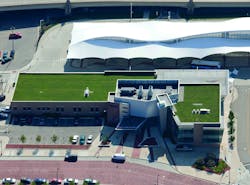
Traditional roofing is dark and absorbs the heat from the sun. A sustainable alternative is to replace the roof with either a white or green roof – or even a combination of the two. A white or reflective roof doesn’t absorb the sun’s heat like a darker roof does. Sean Beachy, an architect with Wendell Companies, says they recently worked on a project in which they replaced the client’s roof with a combination white and green roof.
“We also added a photovoltaic array on the roof that would power the entire facility and then we added a vegetated roof that would cover about 18,000 square feet of vegetated roof,” he says. “The benefits to that are it can nearly double the expectancy of their roof system and also it will reduce the amount of dust and things being kicked up into the air because the dust actually gets caught up in the vegetated roof.”
A green roof benefits more than just the building owner, however. The benefits extend to the surrounding community and even the city, Beachy says, “Because one of the benefits of the green roof is it reduces storm water runoff. That storm water runoff isn’t going into the public utility; it’s reducing the burden on that and also for the electricity they’re not taking power away from the grid, especially during day time when everybody might need it more; so they’re reducing the stress on the local grid.”
The green roof reduces storm water runoff by absorbing a large portion of it.
Adelman says: “From what the plants use from some of the soil, what’s contained there, and even when the water not being used by the vegetation turns into runoff, it slows down that process a little bit. Instead of just having a hard surface, an impermeable surface, where you have higher volume; you almost get a little filtration for that runoff as well.”
“As far as being a public building, have a green roof you can invite the public and educate the public with something so visual like that” says Horton. “There are a number of upsides to green roofs: you get the storm water retention piece of it, you get the insulation factor, and you get the reduction of heat island effect. There are a number of things a green roof in particular does.”
Water Management
In addition to reducing water runoff through a green roof, water collection is another sustainable option. Adelman explains that storm water mitigation is another big way to reduce the stress put on utilities. “There’s storm water mitigation, things such as using cisterns and doing gray water and capturing rain water, using that for landscaping, reducing the pressure on the potable water, reducing the consumption of the potable water,” she says.
Horton points to The Rapid in Grand Rapids, Mich., as an example of successful water reclamation. “When I talk about water reclamation for a bus wash, I can make the statement that we’re saving 9 million gallons of fresh water per year. That’s a substantial number,” he says.
Horton says that one option is to add a water collection system to the roof of operations and maintenance facilities, which tend to be fairly large. Water collected on the roof could then be used as gray water for flushing toilets and the like. “That building roof is large enough that we could collect a tremendous amount of water,” he says.
Switching from a hardscape – a concrete or asphalt drive – to more permeable pavements allows water to filter to the ground more naturally instead of being diverted into a storm sewer where the water will need to be treated by the local utilities, explains Beachy.
“We try to look at ways that water can get back into the ground naturally vs. controlling that in a different way. There are a lot of different ways to do it, but you have to make sure that that tradeoff at times doesn’t negatively affect the building,” Beachy says. “Some pervious pavements can’t handle bus traffic very well; in that case you can’t have that tradeoff. You can’t use that permeable pavement because it won’t last long and bus traffic can be tough on surfaces. That’s something we’re always carefully monitoring. You’re always looking at the positives and negatives of anything like that, but when it comes to say a pedestrian plaza or something like that it’s very easy to accommodate.”
Lighting Options
Lighting options —both interior and exterior — is an area that can really reduce energy cost. Kerr Adler poses this question: “Do you really need to add all these extra light bulbs or can you design your building in a way that makes use of the natural light surrounding?”
The answer is simple. You don’t need to be adding all the extra light bulbs.
“That’s a way to kind of take a step back and think about what is the context in which we are doing the facility, what are the natural attributes that we can tap into that would help create a healthier work environment, but also, quite honestly, cut back on our operations and maintenance costs,” Kerr Adler explains.
When you can reduce the number of lights that are turned on in a facility, or even lights in outdoor areas, you save electricity, Beachy explains. “The more natural light you bring in, the less you need artificial light potentially and you’re always trying to have that tradeoff between the two.”
“There’s a lot of emphasis on day lighting and more passive solar as opposed to not renewable energy,” says David Taylor, CNU, HDR Engineering Inc. senior vice president, national director, Sustainable Transportation Solutions. “For example, L.A. is doing renewable energy for its operations and maintenance facilities so they can actually generate more power and then put it out onto the grid.”
Adelman says using natural light in all areas – maintenance, administrative and in intermodal stations where passengers are waiting – is important. “You’re kind of taking away from that feeling of being in a very closed-up structure and having that connection to the outside,” she says.
Beachy says there are a few ways to add more natural light, particularly in the maintenance bay. He says it starts with glazing. Wendel Companies also tries to incorporate large north facing windows. This way the light coming in is not direct sunlight, which can be bothersome.
“One other thing you can incorporate is a white reflective maintenance floor. As the natural light comes in, it hits the floor and then it’s reflecting up. Where that goes, a lot the time when you’re working on a bus the mechanics are under the bus and they have task lights under there and the task lights aren’t always efficient. When you’re bringing in natural light and it’s bouncing off the floor under the bus, it’s providing them additional light,” Beachy adds.
Wendel is currently working on a project in which there is an opportunity to use a hybrid of solar and wind energy in the exterior lighting, Adelman says. “You can capture the energy on a battery and then store it for when it’s needed. It’s really a great thing, especially when there are always security concerns where you have to have lighting that is really going to affect your energy; this is a great way to offset that,” she says.
With solar thermal, that’s one opportunity to use a solar thermal system to heat water. There’s a solar thermal wall that can be used, and these types of walls as air comes in it warms that air and it takes a little bit of the load off the HVAC system during the heating season.
On the Construction Site
Construction can create a lot of waste, but it doesn’t all need to end up in a landfill. There are a number of ways to minimize the waste that results from a construction project. Kerr Adler says it’s important to reduce idle times of the construction equipment.
“Think about how you’re sequencing construction activity and when the vehicles are on the site and operating, looking at doing hybrid or rebuilding the engines to limit emissions,” Kerr Adler says.
She points to a project at Chicago’s O’Hare airport as an example. “What Chicago O’Hare Airport did on their construction requirements has been pretty robust. I would expect some of that – because contractors work across modes – that that’s going to be moving more into the transit arena and the transit industry,” she says. “They were pretty stringent on requiring certain types of emissions on construction vehicles and the only way you could engage in work on the project was literally to rebuild all your engines or buy new equipment. It was a very hard core - you’ve got to do this to do work for us, and we’re serious about it.”
Outside of design, construction is a huge part of sustainability, according to Adelman. She says collaboration with the construction company and contractors is a must. Erosion and sedimentation controls need to be in place.
“Making sure that the least amount of disturbance that is possible for the site and the surrounding areas and to the water shed, and along with that communicating with the contractor what the goals are,” Adelman says. “They need to be able to understand where this project, where the client wants it to go, what we’re trying to accomplish.”
It’s important to have goals set ahead of construction about what percentage of materials needs to be recycled. To monitor this, Adelman suggests having someone onsite who can police the recycling effort in addition to sorting bins that are clearly labeled. This makes it easier for the contractors to get on board.
Adelman also points out that monitoring materials to be used in construction is important. Be sure to keep materials protected from water. Water damage can promote mold growth later on she says.
Taylor suggests considering selling materials from the construction site for reuse. “For example, let’s say they are tearing up roadway and driveway areas, they might make a contract with someone to come in and pulverize that and use it for building materials for a completely unrelated building project. Same thing with asphalt with the recycling instead of bringing in new petrol chemicals, you just recycle it right on the site through a mechanical process that recycles it and goes through, it gets re-characterized as new asphalt but it is old asphalt that has been reconstituted,” he says.
Or, materials from the site can be repurposed for part of the project, Beachy suggests. “What we’re doing [on one project] is taking some of those materials and actually reusing them elsewhere in the site. We’re trying to reduce the number of materials actually taken off the site. You look for ways you can reduce anything taken off the site,” he says.
Sustainability doesn’t stop once the project wraps. It’s important to have a plan and goals for the future in place.
“Sustainability is about that continual improvement process and it really is a journey. It’s not just one stop and you’re done. It’s about long term commitment and a broad definition, not how one organization applied sustainability or defines, it might be a little different to another organization and that’s OK. Figure out what your goals are and objectives and there’s a whole slew of resources that will help take you there.”
About the Author