NCTD: Looking at Transit Differently
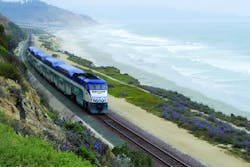
On my Coaster ride up from San Diego to Oceanside, I had little background knowledge of the North County Transit District (NCTD), its services or its executive director, Matthew Tucker.
The Coaster commuter rail service is just one of a number of services provided by the NCTD; they also have the Sprinter light rail service between Oceanside and Escondido, Breeze bus service and Lift paratransit services.
I didn't feel too bad once I found out Tucker himself didn't know about the agency until a phone call from a recruiter telling him of a job opening. "I never heard of it," he laughs. And to the recruiter he said, "What do they do?"
When he heard about all they had going on and after he came to see it first hand, he thought it was the place for him. With a young family - a daughter that's 8 and a son that's 6 - and a work-family balance that had been out of whack, the NCTD offered unique challenges and the right balance.
Oceanside is a quiet military town, with the Marines in town on the weekends. As Tucker says with a laugh, if you're looking to go downtown, you're going to downtown San Diego.
But this place with a small-town feel is a regional transportation hub with connecting rail service to San Diego, LA's Metrolink and Amtrak.
Challenges Build Experience
Tucker came to the NCTD in December of 2008, previously serving as the director of the Virginia Department of Railway and Public Transportation, working for the governor of Virginia. A native Virginian, he went to school in Richmond, was in the ROTC and served his military obligation and when he returned from that, it was a down cycle in the economy and he says, "I couldn't find the types of jobs that we all hope for after we spend all that money and take out those student loans."
Like many others, Tucker started at ATE. He started as a finance intern and continued to grow in the company and worked his way up in transit at various locations.
He spent two-and-a-half years at the Virginia Department of Rail and Public Transit. "The challenges are really, really big," he stresses. "You're working really 24/7.
"We had one of the biggest projects in the history of the commonwealth, which was the Dulles Rail Extension." He continues, "During that time period I was there, you'll remember a little discussion about the tunnel going underground; I was the poor guy that was having to work through all of those issues.
"It was probably the most challenging job that one could ever think of, but it was probably the most rewarding in terms of just really giving you experience and insight in to how transportation really comes together in a really multi-modal way."
During the interview process with the board of the NCTD, it was laid out that the system faced some significant financial challenges. They were looking at a deficit that was approaching about 80 million dollars over a five-year period.
"What was clear to me was that we sort of had a shared philosophy of saying, 'OK, let's thing about this in the context of a business and let facts and analysis drive our decision and business-making process," Tucker says.
"During the interview process with them I was laying out every possible scenario that I could see with this transit system because there were some really significant financial challenges and no one batted an eye."
"When we started looking at the different things we could do, you could drop off service levels probably 30 to 50 percent and you would still have a financial problem," Tucker says. "So what does that mean? That means that you have massive layoffs and massive service cuts and still be in a terrible way." He stresses, "I don't see how that benefits anybody."
Looking for Solutions
There are a lot of questions in our industry about funding, profitability to grow systems, business cost models, the fluctuation of funding and service levels and as a result, Tucker says, "The public is sort of left with the viewpoint that it's a difficult to transition to make to transit because they don't know if the service level is going to be here today and then gone tomorrow."
The decisions they've made at the NCTD Tucker says are significant policy matters and from their viewpoint, the best solution for their agency.
"I think a real important matter for communities to consider when they have a transit system and they're trying to figure out what they want their transit system to be," says Tucker. "That's the real big issue that you're raising and that's really a question at the local, state and national level.
"There are lots of different answers dependent upon which community that you live in," Tucker says.
The decision for the NCTD to privatize was the best solution for them. "This was not about a political issue," says Tucker, "because so much of this decision-making process about whether you should be privatizing or not, people try to put it in to a political context and actually it's not.
"If you operate under the premise that we exist to provide a service to customers and that really all of our resources are about providing services to customers; that gives you a business framework for you to operate."
He says, "If you agree with that as your first premise, then you also have to balance that with the fact that in order to deliver that service, you have to have good people." He continues, "You have to balance those two issues, that they're not competing. To be successful you have to have both of those upfront or appropriately aligned."
As they went through the analysis process, Tucker says they had to be pragmatic and put everything on the table. "We started to look at if you reduce wages and benefits, can you get there? We couldn't get there.
"We looked at various models of contracting out partially or total. When you look at the size of our bus system, partially doesn't really get us there," he says.
"When you look at the whole system, you're like wow, that doesn't solve the problem, but it's part of a series of steps that we can take to get to a point of achieving financial stability."
As Tucker explains, they didn't' hide anything and they weren't shy about it. Meeting with employees more than once a month, he shares budget outlooks, he gives them spreadsheets. "I said to folks, 'Here's a suggestion box. If you come up with an idea better than the ideas I have, let us know about it.'
"We worked with the union. We actually negotiated an agreement with the wages and to discuss outsourcing." He says, "You know, sometimes people get confused and they think we actually imposed. No, we negotiated with the union."
Tucker says, "No one debated that we didn't have a financial problem because you had the state eliminating state transit assistance that typically had been like $10.5 million to us. Some years it was a lot less, like $5 million, but there's a certainty about zero." He also adds that the sales tax was supposed to have been about $52 million, but they actually got $37 million.
With the deficit they were facing, they decided it was best to move forward with contracting out. They had completed all of the analysis, it was presented to the board in an open public meeting where the employees could come in and comment.
"Quite frankly there were no secrets because I had been out briefing the employees and the board gave us authorization to release an RFP and we had given them an estimate of what we thought we could save," Tucker says.
The RFP came back and there was a contract proposal from First Transit for the first seven years of the contract. "We saved about $53 million a year," says Tucker. And the other side of the equation he says, it allowed them to maintain service levels to where we had them at that time.
Moving to Private Service
Tucker explains how the employees were transitioned. "For our senior employees that have been here they were able to retire from our system. The agreement that was worked out with First Transit is that senior employees got 95 percent of their pay. So that means an employee with 20 years of service is getting 95 percent of his pay from the private sector.
"I would probably argue for people that this is the best thing that could happen and use the last five to 10 years of work life to be able to accrue that kind of savings.
"For our junior employees, 19 years or less, they will take 85 percent of their wages and that was something that the union negotiated because we had developed an agreement based on an agreement that was basically 10 percent off the top for everyone."
He says to some degree that was sort of negated by the fact they were paying 8 percent into the pension plan, so the real nominal impact was 7 percent immediately for those employees.
"We did a separation bonus for every employee of $5,000 now and for senior employees they got $8,500," Tucker explains. "When it gets to July of next year, they get a 5 percent increase so they're real take-home impact will be less than 2 percent."
Tucker says, "I won't say that it's perfect because they don't have the defined benefit pension plan that they had before, they have a 401K plan that isn't where it needs to be, but the bottom line, I can still go and talk to all of my employees because most of them will say they still have jobs.
"As I've said to them over and over again, one of the key things is that as an individual, you always have to act in your best interest. As the economy improves, obviously we realize there are going to be wage pressures. Of course transit is going to have to manage that but right now what we've done is we've given you the capability of continuing to make money while all of us are going through a pretty difficult time."
It used to be about 41 percent of the employees were contracted. By fiscal year 2012, about 88 percent of the workforce will be contracted. "Eight-eight percent of every dollar that's coming to this agency is going directly to the private sector," Tucker says.
A New Business Model
Paratransit is one area were agencies are struggling with managing high costs and the NCTD was no different. "If you remember when the mandate came out in 1991/1992, when we were implementing, all of us looked at the business model that we sort of knew," Tucker explains.
"That was a business model where we did something in a facility that we owned under the right rules that we had and when you look at ADA service for all of us, you have one side, you have the regulations that say we're going to limit how much you can actually assess to recover costs.
"If you look at most transit systems, typically less than one half of one person of your total ridership is going to ADA but 10 percent of your total costs is going to paratransit." He stresses, "You really have to step back and say, 'Woah!'"
He continues, "This is an important service, that's the bottom line. I tell people heck, one day I may need that service. But we have to think about how can we cost-effectively provide that service and I would argue that our business model as mass transit providers, it doesn't really fit that kind of model."
One of the things that attracted Tucker about coming to the NCTD was that the board was allowing him to think out of the box as long as they were going to do their homework and be very deliberate about where the process took them.
Spending in the high 30s for each of those trips, with the average trip being about 9 miles, it was something that needed a change.
When you look at the private sector in terms of taxi cabs and all of the other transportation providers, Tucker says, they're sitting out there with a ton of capacity and would love to be able to say they can book 80 percent of their day with guaranteed revenue.
The NCTD contracted its paratransit service with American Logistics Company, who leverages a fleet of dedicated and non-dedicated vehicles coordinated under one management to deliver efficient service. Real-time route optimization algorithms are used to determine the best vehicle utilization with flexible resources available to meet the varying service requirements.
"I think all of us have to look at where we are as an industry and really think about where we're going in the future," Tucker says. "The American Logistics [Company] contract in ADA service is something all of us in the industry really have to think long and hard about it.
"The ALC model, you know, we look at a brokerage model that's not being implemented, where by we would get out of the whole business of having to own infrastructure, having to come to the table with the traditional work rules." He continues, "The traditional work rules, where you're paying when the driver is not being productive ... you're going out and coming back and you're not making any money."
He says, "What we've done is develop a business model where the only time we're paying is when we have a fanny in the seat and if we can group fannies in the seat, we're paying the cost of that one move.
"With the ALC business model, we really wanted to fundamentally rethink the business model and say, hey, we need to really be thinking about the future. The model we have today is not working. Let's take a risk, but the risk has to be measured."
The NCTD put out a performance-based specification where it didn't dictate and tell people how the work was to be performed, it requested the most efficient and effective way to provide the work.
"We'll work to develop some performance metrics, of course," Tucker says. "You've got to have the penalties, opportunities for reward if you exceed or meet performance goals." And with the ALC model, he says they saw close to a 30 percent reduction on the cost per trip and that they didn't have lots of risk in terms of fuel.
Making Contracted Service Work
Tucker says he's been asked about the impact of having so much of their service contracted out. "My answer is straight forward. I've been in public sector agencies that are directly operated that did not operate so well. I've seen private sector operations that did not operate so well.
"Well the basis when I got here and looked at the workforce that we had and quality of service, I tell people I stacked us up with anybody in the country." He continues, "The employees, the direct employees for the NCTD are also performing work, just working for First Transit today."
At the same time, it was built within the contract framework for evaluation, evaluating success and failure. "We are very involved. In fact, I get on my pager instant messaging anytime a bus is late or not pulling out," he says.
"At the end of the day, I don't view the decision to contract out or operate directly to mean really a change in business model. Here's the thing," he continues, "if you hold yourself to a certain standard when you directly operated, great. If you contracted out, you hold the same standard.
"But if you contract it out and say you want to hold the contractor to this high standard when I held myself to a standard below here, then you sort of have a mismatch."
He stresses the key is identifying a standard, holding folks accountable to that standard and being consistent about that standard. He also adds that he believes all of us need room to make mistakes from time to time, but we have to learn and grow from those mistakes.
"Over time, if you demonstrate you can't do the work, I'm perfectly comfortable with the notion of finding somebody who can. That's the process," he asserts.
Tucker says, "At the end of the day, I think managers, general managers, we get too much credit when our organization does well and probably get too much blame when things don't go well because the hard core of the work is being performed by those bus operators and those fleet and facility personnel.
"If you have good organizational culture and people with high sets of values that are committed to customers, I can argue that the transit system can function pretty well. It may not reach all its strategic plateaus that we would like to see, but the heart and core, don't ever be confused, are those folks that are turning those wrenches and operating that bus."
Rethinking Service Models
Tucker says they also thought about how that business model could be expanded to other areas of their services. The service area of the NCTD is about 1,100 square miles, including far out rural areas where they're trying to connect to the core.
To connect with fixed-route service, you're spending a lot of money. When you use up your resources and try to give everyone service, you're making the service poorer for everybody.
The belief that if you want transit service, you live where the core of services can be provided in an efficient and effective manner is what Tucker and the board leaned toward. "If you decide you want to live outside of the core, we should not reward that higher cost, that increased difficulty in providing service at a rate that is the same for someone living in the core that we can efficiently serve."
They're developing business models that will allow them to apportion a greater deal of their cost and reduce their risk exposure by transferring responsibilities to the customers who have chosen to live outside the network, but still giving them mobility options to connections to the core of the system.
That's not done by scheduling a 40-foot bus riding out there and hoping that there will be people to pick up, Tucker says. It's by developing services that give people a little more control; when they want services, they can get services. But they are going to have to pay more for those services.
"We're advancing right now a proposal that says the maximum subsidy that we're going to pay is $3," he says. "Today, we subsidize trips to these rural areas at a significantly higher level. It's going to mean for customers that rather than paying a buck or a buck-75, you may be paying $10, you may be paying $14.
"It's significantly more, but still, if you look at the value of that service that we're providing, ,you compared to if you had to own your own car or if you decide to get a taxi cab, it's significantly less." And, he stresses, it allows the agency to focus its resources on the core while allowing those folks to connect to the core.
Growing Business
Step one was getting over the financial hurdle, that the agency isn't going bankrupt and step two is focusing on ridership and revenue increases and positioning themselves and designing their service to really maximize the services they've got to grow the business.
Tucker says it's shocking with all of the work that transit does, working so hard, but we as an industry keep coming up with ideas that reflect the thought process that the world is about us when the world is really about the community that we serve and how we can incorporate within that community so that transit is seen as part of the community and as a resource to the provide the mobility options and to support economic development.
"We spend so much money on marketing that is inside curveball marketing, only to us; we're the only ones that get it," Tucker says. "Ridership growth and development isn't hand-to-hand combat, it's relationships.
"You have to put boots on the ground and you have to start with where are my best opportunities?"
And when it comes to building relationships, the NCTD also has to work at relationships with the different transportation providers they cross service areas with. "It's always funny because depending on who you talk to, it's always the other guy," Tucker says laughing.
"I think as we continue to talk and learn more about each other's perspectives and how we operate, it opens up more opportunities for collaboration."
One of the key issues when he came to the NCTD he says, was how well they collaborated and worked with the cities in their service area. "I find a little bit disheartening when you hear the whole 'them and us' type thing. 'Us' is 'them' and 'them' is 'us' to the degree that we're doing well, then you're doing well and vice versa."
He elaborates, "We're an asset for you; we're not the enemy. We're a part of this community.
"It's something that we've tried to work hard on and we've made some significant progress with our cities to foster a notion of greater collaboration. This was something that was started even before I got here."
He says, "Collaboration doesn't mean I've made up my mind and I tell you want I want to do. It means that we have to all get at the table ... get all the ideas on the table and give and take and come up with a solution that everyone can buy in to."
When talking to Tucker, he sounds confident in the decisions that have been made at the NCTD because of the background analysis that was done prior to making any decisions and because the agency is moving forward, as opposed to digging further in debt.
It was good to run into him a few months after the interview to hear firsthand about honors they've received validating their approach.
The San Diego County Taxpayers Association (SDCTA) awarded the NCTD the Grand Golden Watchdog Award, the highest award presented during the ceremony, for the agency's commitment to sound fiscal decision making.
NCTD Chair Chris Orlando said, "By transitioning bus operations to First Transit and paratransit service to American Logistics Company, we are on track to save San Diego taxpayers in excess of $50 million over the next seven years." He added, "Today, the District's budget is balanced. We've added service, reduced fares and increased ridership."