The Future is Here: Catenary-less Power for Light Rail
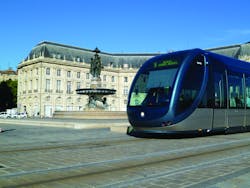
They are expensive. They are dangerous. They are unsightly.
They are the catenary lines used to power light-rail trains in the United States and Europe, and both manufacturers and rail lines and have been seeking to do away with them for years. Fortunately, several companies have made advances that may make that possible. Test systems have been installed in Bordeaux, France and Augsburg, Germany already with promising results. The introduction of these new, catenary-less technologies may indeed mean overhead wires will be a thing of the past for the mass transit industry.
The Case Against Catenary Lines
A traditional catenary system carries a number of challenges for rail lines — both those already in existence and those proposed. Cost, safety, maintenance and aesthetics are all concerns whenever light rail is discussed, particularly for U.S. cities proposing creating light rail. While the environmental benefits of electrically powered trams make a strong argument for local governments wishing to find innovative solutions to their public transportation issues, the baggage of overhead power lines often sinks proposals before they can be implemented.
?Cost
In addition to laying track, a catenary system requires miles and miles of electrical lines to be strung. That also requires poles, breaks, tensioning systems, and all the peripheral equipment associated with creating a catenary system.
Accorder to Rainer Hombach of Kinkisharyo, manufacturer of the e-Brid power system and ameriTRAM light rail vehicles, “Some estimates show $7 to $7.5 million per mile for double track installation.” And that’s not all.
“This includes many hidden costs beyond just the obvious wire, poles and substations,” Hombach adds. “There are significant costs involved in property acquisition, utility feeds, duct banks and cathodic protection that are often overlooked when estimating the total cost of electrification.”
Cities considering light rails therefore aren’t just looking at the cost of purchasing trains and the tracks they run on.
Moreover, overhead lines require a lot of maintenance given the direct contact of the pantographs and their constant exposure to weather. This too makes cost an issue.
“Conventional systems are very sensitive to particular atmospheric conditions such as particularly heavy storms and tornados,” notes Vito Siciliano of Ansaldo STS, whose TramWave system is designed to eliminate this problem. “The related maintenance and repair costs and service unavailability can become a major issue.”
Hombach agrees.
“Winter storms play havoc with overhead wire systems,” he says. “Ice accumulation can cause ‘arcing,’ which damages the pantographs and can even go as far as to cause ‘snags,’ which rip the pantograph off the roof of the car or pull down the wire. It is not uncommon for operators to schedule non-revenue ‘ice runs’ ahead of normal service just to clear the catenary system of dangerous accumulations of ice and snow. Weather-related non-revenue runs are costly, complicate service schedules, and are not an efficient use of the revenue fleet.”
And, of course, it doesn’t take a winter storm or a tornado to cause damage to a catenary line. Loose wires in the summer and wire breaks in the winter as a result of lines contracting and expanding with the temperature also create maintenance headaches.
?Safety
A catenary line is a live wire suspended in the air. Weather issues therefore become serious safety concerns. Tornadoes and high winds can bring them down, which then puts a live current on the ground, exposing anyone nearby to danger of electrocution. Heavy snows or ice storms also have the potential to wreak this kind of havoc.
And the danger isn’t limited to innocent passersby. Maintenance and emergency crews must also put themselves at risk to work on the lines and repair them, especially if a storm brings a line down. In the event of a fire near a line, ladders must often be raised near and above power lines, putting emergency workers at risk.
Severe weather and other emergencies aside, catenary maintenance is no picnic. Hombach describes the vehicle maintenance shop as “the most dangerous area on the system.” Workers must often work above power lines, and the only efficient way to move vehicles through the shop is via an insulated “hot-stick,” which forces employees to handle exposed contacts. Winches and pulleys are an alternative, but are much slower and less efficient. Eliminating overhead power lines increases safety across the entire system.
?Aesthetics
Even if safety and expense weren’t problems, catenary lines and their associated equipment do much to interfere with the visual aesthetics of a place. This is particularly true in historic centers of major cities. The view of the architecture is marred by power lines and their poles, creating a less-pleasing urban environment. Siciliano notes that catenary systems can cause a city to look “wrapped in a hank of wires” and observes that overhead wires are often the cause of municipalities choosing other public transportation solutions over light rail.
Catenary-less Solutions
All of these issues are solved by a catenary-less system. With the power source in the ground rather than above, there are fewer costs to install and maintain an electrically powered train. Safety is less an issue, because catenary-less systems do not supply power when the tram isn’t present (making them safe for pedestrians and other vehicles), and because the lines cannot be brought down by inclement weather or line breaks. Finally, urban centers are visually enhanced by the absence of lines and poles, thereby creating a more pleasing environment.
For all these reasons, a catenary-less system may be the ideal way to implement light rail lines, helping cities solve public transportation problems in ecologically and economically friendly ways.
Types of Catenary-less Systems
Catenary-less power comes in two forms: continuous contact from a ground-based system and onboard power cells. Each has advantages and disadvantages.
Ground-based systems rely on continuous contact with the power source much like a traditional catenary system, with two key differences. The first and most obvious is that the power comes from transformers buried beneath the rails rather than overhead lines. Secondly, electricity is only transmitted when the tram is over the rail.
This is accomplished by means of a segmented electrical system. Each segment is connected to the others, but is only powered when the train rolls over it. The tram moves across it, takes power from it, and thereby receives energy to move to the next segment, where the process is repeated. Tram pickups are insulated so electricity can only be transferred to the train, and, since a segment only gives power in the presence of the tram, pedestrians and other vehicles are not exposed to the discharge.
The downside to this system is that weather can still have an impact on running capabilities. Snow, ice, and sand accumulating on the tracks can interfere with the transfer of power. Without some means to clear the track before the train arrives, it could come to a stop on a fouled rail, unable to get power. Thus, not all environments are ideal for this system.
In the second approach, the trains carry giant batteries onboard that feed it power. This makes it possible for them to operate in all environments, since weather or other topographical features cannot inhibit power transfer. The batteries are rechargeable, making the system self-sustaining. Recharge occurs at stations or while the train is running on traditional catenary power in a hybrid system.
However, recharging can take awhile, which can make for long delays at the station. Thus, a battery-powered light rail may not be the most efficient and could suffer during peak hours.
Four manufacturers have developed systems using the above principles. Three (Ansaldo’s TramWave, Alstom’s APS, and Bombardier’s Primove) use the ground-based contact system, while one (Kinkisharyo’s e-Brid) is battery-powered. Each is detailed below.
Ansaldo STS TramWave System
TramWave provides power through a continuous conduit duct embedded in the ground running between the rails on the track. The power “line” is a series of segmented conductor strips that are insulated one against the other. Each segment is between three and five meters long, with a succession of steel plates that are 50cm each. The tram must be present for the segment to be powered. Presence is detected by simple gravity and electrostatic means.
The power collector is mounted underneath the train. A ferromagnetic belt in the conduit allows electricity to flow to the vehicle when contact is made with the power collector. The live area of the line is very short – only one meter – to maximize safety. Once the train has passed, gravity causes the magnetic belt to fall back into place, thereby cutting off the power supply.
Power is transferred via contact shoes of copper and graphite. The collector is lifted up and down over the contact line via its own magnets in a tiny pantograph. The EMI of these magnets is small enough to be safe for passengers on the train and does not cause interference with electronic devices onboard. Power is fed at a rate of up to 750vcc.
Moreover, Tramwave is adaptable to a variety of different vehicle types, including rubber-wheeled ones. It also is capable of switching between its own power system and a traditional catenary one. In the presence of overhead power, a safety system sets the in-ground power collector to the “off” position. It is therefore possible to install the TramWave system in urban areas and then transfer to a catenary one in the suburbs or rural environments.
The power conduit is easy to install along existing lines and costs about the same as a standard catenary system according to Siciliano. He notes that the maintenance costs of the TramWave are “potentially much lower.” He also notes TramWave is less expensive than other catenary-free systems.
Because it uses a contact system, TramWave is susceptible to ice or snow or sand on the lines. However, sweepers can be installed to clear lines as the train moves over them, and optional heating elements are available for cold climates where freezing is a concern.
Overall, the system is designed to provide great flexibility for light rail companies. It can be installed on a variety of vehicles, can be integrated with traditional catenary lines, and is cost effective for conversion of existing lines or implementation of brand new ones.
“TramWave (has) already been tested and (is) ready to be installed in any city that (needs) an innovative, carbon-free, and efficient mass transit system,” Siciliano says. “TramWave is a product ready to improve urban transit.”
Alstom Transportation Aesthetic Power Supply (APS) System
Like Ansaldo STS’s TramWave, Alstom’s APS system employs an in-ground power source. Power units are buried beneath the track at regular intervals. An electrical conduit is laid between the rails just like the TramWave. The conduit is comprised of eight-meter-long segments with three-meter insulating joints. Copper/graphite shoes receive the electricity and send it to the power collector.
Like other in-ground systems, APS’s conduit is only “live” when the train rolls over the segment. Antennae in the collector unit send a coded radio signal to the power unit, alerting it to when the tram is present. When the signal is received, power is transferred to the conduit and collected by the train at a rate of 750v DC.
APS is extremely versatile. It can switch from in-ground to traditional catenary power to accommodate hybrid rail solutions. It also carries an onboard backup battery, so the train can continue operating in the event of a power cut.
Alstom makes a special power unit for warm environments, designed to deal with the excessive heat of tropical climates. Although a solution for cold-weather obstacles such as snow and ice hasn’t been developed yet, the company partnered with Systra to implement APS in Bordeaux, France in 2004. Through April 2010, APS had successfully run over seven million kilometers of service since becoming operational.
Bombardier PrimoveSystem
Bombardier has also developed an in-ground catenary-less power system, but the principle is slightly different than those of TramWave and APS. Like the others, it features a conduit line running parallel to the track between the rails. However, Bombardier’s system features contact-less power transfer using induction principles.
The Primove system features eight-meter cable segments laid beneath the ground. Inverters along the track are connected to a power network at 750v DC. When a segment is energized, a magnetic field is created. Trains are equipped with pickup coils to receive this energy, which they convert into an electrical current that powers the tram. Just like the TramWave and APS, Primove’s conduit segments are only powered when the train is present overhead, making it safe for pedestrians and other vehicles.
Because it is contact-less, Privmove is able to operate in all climates. Snow, ice, sand, and salt on the rails do not impact its ability to run.
However, this advantage causes a unique set of challenges. EMC/EMI emissions can cause safety problems with electronic devices such as pacemakers. Bombardier has engineered the system to meet all EMC codes and standards.
“Primove presents no health or safety hazard to the passengers or to the persons near the system,” asserts Bombardier’s Maryanne Roberts. “It does not cause any interference with systems or equipment.”
Bombardier installed the Primove system in Augsburg, Germany last year. The experiment is along a .8km section of track leading into the fairground and is meant to test and demonstrate the system under real working conditions.
Kinkisharyo e-Brid System
Unlike other catenary-free systems, Kinkisharyo’s solution employs lithium-ion batteries. There are therefore no other costs associated with the system. There are no cables or conduits to lay. E-Brid carries the power onboard in its battery packs.
Trains can run for up to five miles on the batteries before needing to be recharged, making the system best for short-run trams with frequent stops. However, hybrid technology allows the batteries to recharge from catenary sources when the train is running on traditional power. Thus, trams equipped with e-Brid can run on battery in the city, then switch to catenary power out in the suburbs or rural areas where overhead lines are still used, taking advantage of this power source to recharge the batteries.
The downside of a battery-powered system is the threat of the power cells running out of charge. That could cause HVAC systems to fail, leading to passenger discomfort. Kinkisharyo believes it has solved this issue with the life of their Lithium-ion batteries. With a five-mile range and the ability to recharge from traditional catenary lines, trains employing the e-Brid system should not suffer any loss to HVAC capabilities.
“Battery technology has now progressed to a point where energy storage capacity makes catenary-less urban rail operation a reality without compromise in service performance,” Hombach says. “Passengers will have air conditioning and heating, and enjoy the same level of speed and acceleration expected from catenary-powered systems.”
Catenary-less Practicality
While a system that doesn’t employ overhead lines is ideal for a number of reasons, the real question lies in the practicality of how easily they can be installed. Each of the four manufacturers with catenary-less systems believes it has made this a non-issue.
In-ground systems like TramWave, APS, and Primove all require the laying of power conduits along track lines, but the cost of doing so is not prohibitive. Moreover, the savings of the new system make it cost-efficient in the long-term. The conduit modules are prefabricated and easily installed.
“Installation is very simple thanks to prefabricated modules that are installed in and along the track, and electric connections are done over connectors,” notes Roberts of Bombardier’s system. “In case of retrofit on existing installation, installation of the components are also very simple. . . .”
Likewise, Ansaldo STS, Alstom, and Bombardier have made the power collector units for their systems easily adaptable to existing trams of all varieties, and they are usable by rubber-wheeled vehicles as well, making switching to a catenary-less system easy despite whatever system is in place currently.
Kinkisharyo boasts that using the e-Brid system is even easier, since it only requires the installation of the battery system onboard existing vehicles. Without having to lay a new power system, there is less to spend and do to move to catenary-less propulsion.
“There is no need for the other types of proprietary and expensive wayside installations that often render (an) entire transit operation reliant on one company’s technology,” Hombach says.
Naturally, all four companies manufacture trains designed to operate on their own systems. Thus, adapting to catenary-less power can also be accomplished by purchasing new vehicles to run on the chosen system, and cities looking to install a brand-new light rail can simply choose the system that works best for their needs and buy all the appropriate equipment from the get-go.
The Future is Here
The advantages of catenary-less light rail are obvious: safer, more cost-efficient, visually attractive public transportation that is also more eco-friendly. With the advent of a variety of catenary-free propulsion systems, the future of mass transit is very exciting.
“The reality of catenary-less systems is here,” Hombach says. It is appears he is right.