Funding Streetcar Projects
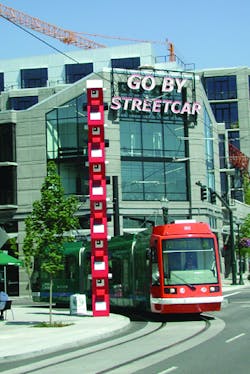
For communities seeking to build streetcar projects, the past 16 months were filled with hope as federal funding was provided to build streetcars in several cities, and policies adverse to streetcars adopted by the Bush Administration were rescinded or revised by the Obama Administration. Looking to the future, though, many concerns remain about sustaining that funding. The Federal Transit Administration (FTA) New Starts/Small Starts project approval process has proven challenging for streetcar projects, yet changes may make the pathway to funding more favorable. Congress is also likely to consider the surface transportation authorization bill in the 112th Congress that provides an opportunity to remove barriers in the FTA New Starts/Small Starts project approval process and to provide funding for additional projects to be built. Yet, the pressure to address future federal spending and disputes over defining the federal interest in transit in general, and streetcars in particular, heighten the challenges for securing sustainable federal funding.
Major Policy Changes
Projects evaluated under the New Starts program (projects exceeding $250 million in total project cost and seeking $75 million or more in New Starts funding) are evaluated based on six justification criteria: cost effectiveness, mobility benefits, public transit supportive land use, environmental benefits, operating efficiencies and economic development. The Small Starts projects (less than $250 million in project cost and seeking less than $75 million in New starts monies) are evaluated under three project evaluation criteria: cost effectiveness, public transit supportive land use and economic development. In response to industry concerns, Congress changed section 5309 in the SAFETEA-LU Technical Corrections Act (P.L. 110-241) that required FTA to "give comparable, but not necessarily equal consideration" to each of these criteria.
On July 29, 2009 the Obama Administration announced new policy guidance for New Starts projects that responded to the SAFETEA-LU Technical Corrections Act and assigned 20 percent weight each to cost effectiveness, land use, economic development and mobility benefits and 10 percent each to operating efficiencies and environmental benefits. For Small Starts, equal weight was assigned to each of the three project evaluation criteria. On January 13, 2010 Department of Transportation (DOT) Secretary Ray LaHood rescinded the March/April 2005 FTA Dear Colleague letters that assigned 50 percent weight to cost effectiveness and required a project to have a "medium" rating in order to be recommended for funding. Further, the rescission of the letters returned to the use of "multiple measure" approach, which allows a "medium-low" cost effectiveness rating to be offset by a "medium" or higher rating for land use and/or economic development.
Federal Funding for Streetcars
Beginning with the February 17, 2010 DOT announcement regarding the funding provided under the American Recovery and reinvestment Act (ARRA) for the Transportation Investment Generating Economic Recovery (TIGER) program, the Obama Administration has provided $309.5 million for streetcar projects. In addition to the funding in TIGER I, DOT has also provided funding in the Urban Circulator grant program announced on July 8, 2010 and the TIGER II program funded in the FY 2010 Transportation, Housing and Urban Development Act with project announcements made on October 20, 2010. These are very positive developments as the Obama Administration recognizes that transit investments can serve to revitalize metropolitan areas, attract economic development, expand housing and transportation choices and generate community benefits such as lowering energy consumption and reducing greenhouse gas emissions.
While these projects were eligible for funding under the New Starts and Small Starts program, in each instance they were advanced outside of the New Starts and Small Starts program. Moreover, not a single streetcar project was recommended for funding in FY 2011 from the New Starts or Small Starts program nor were any streetcar projects included in the Annual Report to Congress. Thus, to build on the success of the TIGER and Urban Circulator programs will require reform of the New Starts and Small Starts program in order to access a more sustainable source of funding.
Interim Program Changes for New Starts/Small Starts
Until Congress adopts a surface transportation authorization bill, the FTA follows current law in proposing any changes to the New Starts/Small Starts programs. Thus, FTA must continue to rely on the existing project review criteria and the project evaluation process for each program. In an effort to begin the dialogue towards making changes to the manner in which the criteria area measured for New Starts and Small Starts projects, the FTA published the Advance Notice of Proposed Rulemaking (ANPRM) on June 3, 2010 seeking comments. FTA is currently reviewing the more than 2,000 comments submitted prior to August 3, 2010, but has indicated that it is seeking to publish the Notice of Proposed Rulemaking (NPRM) in Spring 2011.
Specifically, FTA sought outside input in the following areas:
- Cost Effectiveness - The current measure evaluates the direct mobility benefits (any measurable change in travel times, walking, biking, transfer, and other attributes) of the proposed project compared to a "baseline" alternative expressed in travel time savings for the user of the system. The FTA recognizes that the current measure has limitations and sought comment on whether the "baseline" or some other alternative should be the basis for comparison. Further, the FTA sought input on what other benefits should be included in the evaluation and how can these benefits can be captured and quantified.
- Environmental Benefits - For several years the FTA has used an air quality approach based on a regional forecast of the changes in vehicle miles traveled for the proposed project compared to the "baseline" alternative. This measure is limited due to the minor effect a single project has on total regional air quality and the fact that the measure doesn't take into account the severity of the metropolitan area's air quality problems or the size of the population exposed to polluted air. The FTA convened several meetings and participated in studies to measure the environmental impacts of transit project in an effort to solicit perspectives of various industry experts. They sought input in several areas on whether there a better measure of environmental benefits, if that measure should consider both the natural and human environment, and/or whether it should address air quality emissions, energy use, greenhouse gas emissions, or water quality.
- Economic Development Benefits - The current measure rates the economic development effects of major transit projects on the basis of transit supportive plans and policies in place and the demonstrated performance of those plans and policies. In 2007, the FTA convened an expert panel to consider methodologies to measure economic development impacts. The FTA also published a discussion paper in January 2009 which served as the basis for the issues on which FTA sought comment. FTA sought input on whether the new measure should be a quantitative or qualitative measure, whether or not the project could generate "new" economic development or simply reallocated development that otherwise would occur in a region, if the measure should consider changes in land use values as evidence of potential economic growth in a station area or project corridor.
The Community Streetcar Coalition (CSC) submitted comments that sought to respond to the issues raised by the FTA. The comments were very extensive to review, but there are key points that the CSC urge the FTA to consider. The CSC encouraged the FTA to incorporate the livability and sustainability criteria issued by Obama Administration in June 2009 that seek to promote additional transportation choices, promote equitable and affordable housing, enhance economic competitiveness, support existing communities, value communities and neighborhoods and encourage coordination of policies across several agencies and leverage those investments.
The CSC expressed its appreciation on the return to the use of "multiple measure approach" that reduces the emphasis on cost effectiveness and returns to a reliance on all of the project measure as was the case in the Clinton Administration and consistent with the changes made in the SAFETEA-LU Technical Corrections Act. Further, the use of the current measure for cost effectiveness is a barrier to streetcar projects in that it measures a singular benefit (e.g. focuses on the commute trip, as opposed to capturing broader benefits such as those represented by the Obama Administration's livability and sustainability criteria). Moreover, streetcars are about trips not measured by travel demand models employed in most communities since a streetcar provides greater accessibility to transit; it reduces the length and number of auto trips, and the enhanced economic development and housing in the project corridor result in more walking trips.
The CSC supports the elimination of the "baseline" alternative. The baseline alternative is not based on a project that is funded or being considered within a community. It is a planning exercise that is not based on the transportation objectives of a community. Instead, the CSC urges reliance on the "no build" alternative since it compares the proposed project to current conditions in a project corridor.
The CSC believes that FTA's starting point for measuring economic development is faulty since it presumes that there is a limit to capital investment in a region and assumes that development occurring adjacent to transit is development that would have happened elsewhere in a region. This fails to account for the fact that the development is likely to be of a different character in terms of intensity of development and returns greater benefit to a community where it results in the redevelopment of a brownfields area versus a greenfields area that is separated from where current housing or employment opportunities exist. Further, CSC believes that these benefits should be measured regionally rather than in a specific corridor since that is the scale at which most benefits are measured and realized.
Surface Transportation Authorization Bill
The Safe, Accountable, Flexible, Efficient, Transportation Equity Act: A Legacy for Users (SAFETEA-LU) was adopted by Congress in August 2005 and expired September 30, 2009. There were several extensions to SAFETEA-LU as Congress struggled to identify long-term and sustainable funding for surface transportation program. Consequently, Congress relied on infusions of funding from the General Fund (GF) to sustain the Highway Trust Fund (HTF) and Mass Transit Account (MTA). The GF funds enabled the HTF to sustain current investment levels until the end of 2102. The Obama Administration has indicated that it will introduce its proposal for the surface transportation authorization bill with the introduction of the FY 2012 Budget in February 2011. In light of the HTF being exhausted by the end of 2012, it is incumbent on the 112th Congress to act.
The gasoline tax has not been increased since 1993 which has eroded its buying power and constrained federal investment in surface transportation. Congress has been able to avoid the enactment of any increase in the gasoline tax but this has required the use of the GF, which moves the program away from a "user fee" concept. The proverbial "day of reckoning" is upon the program as the Obama Administration and Congress must reduce the scope of the federal surface transportation, rely on private sector investment and/or shift the funding burden on state and local taxpayers. The CSC urges the Obama Administration and Congress to recognize the importance of a robust federal investment as surface transportation investments of all kinds are crucial to economic development and promoting interstate commerce whether it takes the form of moving goods or getting people to their jobs.
There has been much discussion of streamlining the New Starts project evaluation and approval process to resemble the Small Starts program. The CSC supports these efforts. Further, the CSC supports the use of a "Program of Interrelated Projects" that rewards non-federal investments in project segments and allows those investments to serve as match for projects funded from the New starts and/or Small Starts program. The CSC also supports utilizing Project Development Agreements to set forth the actions necessary to advance the project and the use of a "warrants-based" approach that assigns points to both primary and secondary measures for each of the criteria.
Jeffrey F. Boothe is a partner with Holland & Knight, LLP.