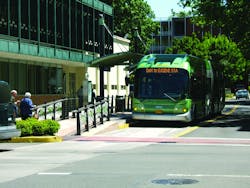
Bus rapid transit (BRT) has gained in popularity over the last few years; however, how it works often varies from agency to agency. Here we'll take a look at five different BRT systems – how they work, why they work and what their challenges are.
Brampton Transit Züm
In Brampton, Ontario, BRT is a new venture. Brampton Transit launched Züm in September 2010 on Queen Street and will introduce a line on the Main Street corridor in the fall of 2011. In 2012 Züm will launch on the Steeles Avenue corridor. The idea of BRT, however, has been floating around the city of Brampton since 2004 when the Transportation and Transit Master Plan (TTMP) were approved by the city.
"In the development of that plan it was determined to meet the growth of our city, the growth alone would not have the capacity and we'd need to look at a rapid transit solution," explains Sue Connor, executive director of Brampton Transit. "So that's when the planning started - initially looking at lobbying for funding for BRT. Once we got the funding confirmed we started more detail planning in terms of the infrastructure we put in place, the vehicles we used and how the service would operate. That work led up to our launch this past September 2010."
The first phase of the project opened along the Queen Street corridor and is 29 km. Once the first phase is complete it will provide 68 km of service along the three corridors.
"To give you an idea, right now since September … we're not at six months yet … we've seen a 25 percent increase in ridership in the Queen Street corridor. Overall our ridership at the end of 2010 over 2009 was up by 12.6 percent and then this year January we had an 18 percent increase over last January and February we had 17 percent. So overall for the first few months of this year we're seeing a 17 percent increase over last year – that's overall systemwide. Those kinds of numbers are surprising us. It's a good problem to have, but it's almost a panic because we didn't expect so many people to use our service. We were looking at maybe 8 percent to 10 percent. So it's quite a bit more."
Operation
Currently, the BRT vehicles operate in mixed traffic with signal priority. "Basically what we've done is extended the right hand turn lane and moved the island. Once you get to the corner, vehicles turning right can turn right, but the buses go straight through to get around the traffic in the intersection and the stop is on the far side. We have signal priority at those intersections," Connor says.
All of the stations along the corridor provide real-time information, including digital signs that list information about bus availability, route maps and information boards. This real-time information is also available on personal devices like smartphones. Züm station stops are unique to the GTA and feature modern design and functionality. Station stops vary in size and are equipped with spacious heated waiting areas, better lighting, security cameras and comfortable seating.
The system currently has two terminals — the Downtown Terminal and the Bramalea City Centre Terminal — and terminates in Toronto at York University, which is a major university in Toronto.
During this first phase of introduction, Züm is using the GFI fareboxes that are used on the conventional buses as well. We're just migrating to the Presto farecard that the province of Ontario is managing. Because we were new, we're actually launching that at the end of March, we did not look at an alternative fare system because it seemed kind of redundant for six months," explains Sonner.
Brampton runs New Flyer Excelsior hybrid-electric buses for its Züm service.
"We are the first transit system in North America to use that new vehicle from New Flyer. They are not only hybrid-electric but they are significantly less in weight. They are approximately 2,000 pounds less in weight than their normal 40-foot model," Connor says proudly. "We are seeing significant reduction in fuel costs, around 15 percent. Because we're new, we're trying to be approximate with those numbers because we need to fine tune them a little. We expected it to be around 8 to 10 percent fuel economy and we're seeing more than that."
Branding
Brampton Transit spent a lot of time and effort on branding the new BRT system. The agency hired a firm to develop the name for the service, which was a lengthy process. Connor says they started out with 160 different names before narrowing it down to Züm. "Züm was chosen because the thought was they wanted a contemporary European feel to the service to really attract people to see that it's new," she says.
The branding didn't stop with the unique name, however.
"The buses themselves we took a lot of time to decide on colors. Both the inside and the outside are branded. We've gotten comments from all over on the look. They're really noticeable on the street and everywhere we go with the vehicles we get comments," Connor says. "We were able to do some things at a really reasonable cost that really make the buses stand out. In the interior we've got seats that have more padding than our conventional buses with higher backs, the seat materials themselves are cloth and they have a pattern on them but we actually have the brand name, Züm, embroidered on the seat. The walls in the back of the bus are carpeted in light gray. Everything coordinates well in the interior.
"A lot of our marketing, what we were marketing to our customers, is what we call the three Cs: control, comfort and convenience. Comfort on the bus, comfort in the stations while you're waiting, the real-time information so you know exactly when your bus is coming, the real-time on your personal device so if there's a delay on your route you get that information automatically on your device, and when you get to the station you can type in the number of the station and it will tell you when the next bus is there. There's a lot of technology that we've introduced and it really seems to be paying off. The stations as well are branded to match the buses. We've used a lot of red in our branding. The stations have the real-time information, benches, they are quite large. The ones that are fairly busy there is plenty of shelter for the people waiting."
Greater Cleveland Regional Transit Authority HealthLine
For years the city of Cleveland debated how to best connect two major employment areas along Euclid Avenue. In the late 1990s, the term bus rapid transit began gaining familiarity and understanding. All it took was a trade mission trip to Curibta, Brazil, by former Ohio Gov. George Voinovich. After seeing the BRT system in Curibta he "called back to his colleagues in Northeast Ohio and said this might be the solution for Euclid Avenue. That was the genesis of the project," says Joseph Calabrese, Greater Cleveland Regional Transit Authority CEO.
GCRT went through the Federal New Starts process to obtain funding and the full funding grant was signed in 2004 and construction started shortly there after. "The system was opened in October 2008 on time and on budget," Calabrese says.
The total project is 9.4 miles on three different streets. The main BRT corridor on Euclide Avenue, Cleveland's "Main Street," is about 7.5 miles. There are 64 stations along the corridor and 21 rapid transit vehicles, which GCRT refers to as RTVs, were purchased for the project. "The goal was to reduce travel time from what was 48 minutes on the No. 6 bus line to what we modeled as 28 minutes on the BRT system," Calabrese says. "One of our goals was to increase ridership. The civic goal, the community goal and the business goal was to encourage economic development and investment along the corridor. Last we stopped counting, investments have totaled more than $4 billion since we broke ground. Ridership is up more than 50 percent."
Ridership is far exceeding estimates and Calabrese says that the whole project has exceeded all expectations – ridership, economic development, effect on community, etc.
Operation
Through the majority of the Euclid Avenue Corridor the HealthLine runs on exclusive transit lanes in the median. "We designed the system as one would design a light rail system, with possibly the only exception being the vehicles are being run on rubber tires instead of the rail," Calabrese says.
The stations, again in the median, are either center platform stations boarding the vehicle on the left side or side platform stations still in the median boarding passengers on the right side of the vehicle. The vehicle is 63-ft. long, has doors on both sides, three doors on the right and two doors on the left.
"Even the vehicle was designed like a rail car would be in terms of the door configuration. We engineered into the system level platforms and precision docking, so like a rail system the vehicles pull into the station so it's a quick on and off, no steps at all, minimal gaps," explains Calabrese. It has "all the technology that the most modern light rail system would have, including real time information, traffic signal authorization and off board fare collection."
The speed limit on the exclusive BRT lane is 35 mph, compared to the legal speed limit on the adjacent auto lanes which is 25 mph. The HealthLine has reduced the number of stops from roughly 100 to 64. "So it stops less, and when it stops, it's for a shorter duration because of the technology we built into the level platforms and precision docking, and things such as that," Calabrese says.
The HealthLine uses a signal priority system that is GPS based, as is the real-time information. A precision docking system was built into the vehicle, which Calabrese describes as a combination of mechanical and electronic, a radar-like detection system that advices the operators how close to the curb they are as they're pulling in.
As one of the earlier adopters of BRT, GCRTA worked with New Flyer to develop the hybrid electric compulsion vehicle. "It's a very rail-like loading feature, right down to the same horn or the same bell as our light rail vehicles," Calabrese says.
Branding
While GCRTA branded the BRT service like many agencies do, one thing stands out: it sold the naming rights. Originally slated to be named the Silver Line, the name was changed to the HealthLine after two medical institutions along the corridor – Cleveland Clinic and University Hospital – bought the naming rights. "They're paying us between $18 and $25 million over 25 years for those rights. So, they can call it anything they want!" Calabrese says with a laugh. "I think we're the first system in the nation to sell the naming rights to the system. We have naming rights for the vehicles, for the system and then we also with our two partners, the two hospitals, are selling naming rights to individual stations along the corridor. The combination of the system naming rights and the station naming rights could gross us anywhere between $18 and 25 million."
Plans for the Future
Up to this point, the HealthLine hasn't been expanded at all. Calabrese says there are discussions but no solid plans at this time. However, GCRTA is working with the cities of Cleveland and Lake Wood, a city west of Cleveland, to take some of the technology and characteristics of Bus Rapid Transit on a future project called the Cliffton Transit Enhancement Project that is currently in design right now. "We're currently looking for funding. It's not directly attached to [the HealthLine], but it takes a lot of what we learned there to do something similar but not to the greatest detail as we did on Euclid because we just feel the money won't be available," Calabrese says.
MARTA Q
In Atlanta, Route 121 along the Memorial Drive corridor, was a cause of congestion. On Sept. 27, 2010, the MARTA Q service began implementation to help alleviate some of that congestion.
"Essentially it was a service to enhance or provide an advantage for buses traveling on one of our heavily used corridors, Route 121," explains Johnny Dunning, Metro Atlanta Rapid Transit Authority senior director of planning. "The planning for this has been a journey. We've actually been planning this for the last three or four years."
MARTA received federal funding through the Congestion Mitigation and Air Quality Improvement Program (CMAQ) for the capital construction as well as the first three years of operation for the project.
Dunning describes the process as a journey because the project was slated to be in operation as early as 2009, if not the end of 2008. MARTA partnered with the Georgia Department of Transportation, which was working on a major interchange improvement project in the corridor as well, which helped with the MARTA Q project, but it slowed things down a bit.
Operation
The Memorial Drive corridor is approximately 8 miles long and the Q operates two services: The Q Express and the Q Limited. The Q Express runs between MARTA's Kensington Station and a free 150-car park-and-ride lot at Goldsmith Road and Memorial Drive. The Express only stops twice along the way at North Hairston Road and again at Georgia Perimeter College. The Q Limited also runs north along Memorial Drive from Kensington Station, but branches off at North Hairston Road on the way to East Ponce de Leon Avenue. The Q Limited has four stops along the way in addition to the same stops for the Express. The Q operates at 10-minute frequencies during peak hours.
The MARTA Q buses operate in mixed traffic with signal priority at 26 intersections along the corridor. Working with the DOT, MARTA had Q Jumping Lanes installed at two major intersections, which allow the buses to bypass long queues at the intersections using a unique signal before the directional is allowed to have a green light.
"What happens is the bus has the advantage to clear the intersection ahead of the traffic without having to be held up. Additionally, what signal priority does is when a bus is approaching the emitter is transmitting to the receptor at the signal and the receptor will hold the green for a specified time to allow the bus to clear the intersection. That's what you have, signal priority working to get the buses through holding green and then you have two jumping intersections that allow the buses to pass by traffic to get ahead," Dunning explains.
Currently MARTA Q doesn't provide real-time information for passengers, but Dunning says it is something they hope to look to do and it would come with a systematic approach.
"This was really the first shot at doing something like this in the region. We know in due time we'd like to have that type of real-time information," Dunning says. "This service does include a different type of bus stop as well, we have with those limited stops and express stops pavilions that provide shelter for a larger set of people. With the different type of shelter and treatment, that's where the minor branding we did for the service is. We have the Q service which is one brand and what people actually see out there is the pavilions or the different shelter amenities the customers have, and we think in due time we'll provide that real-time information and would do so in those pavilions."
In addition, MARTA Q is currently still using the Breeze Smart Card that is used on the traditional service as well. "At the park and ride lot folks can load the media at the Breeze machine there and then come on in, but at the same time they still need to load up like they would any other service," Dunning says.
However, off board fare collection is a service Dunning says they'd like to move to in future. The MARTA Q service uses the same vehicles as the conventional bus system. Dunning explains that MARTA recently had a procurement of 101 40-foot, CNG powered buses and "didn't get a chance to go out and get any unique buses for the corridor given the times that we're in. There has been some thoughts though that we may want to go with a full-scale BRT implementation, that you would want introduce some kind of high capacity vehicles, but we haven't gotten to that point yet."
So far, the numbers are pointing toward success for MARTA Q. Prior to the launch of MARTA Q, the local Route 121 was carrying approximately 5,500 riders. After the launch of the Q, it is still carrying about 4,000 riders. However, the two new services collectively are carrying 1,300 riders a day, and it only operates during peak hours.
"That is what we have seen so far preliminarily, I keep emphasizing that because we really want to continue studying that because we think it will be higher than that. We have about 300 new riders in the corridor associated with this service," Dunning says.
With only six months of service under its belt, the MARTA Q is off to a good start.
York Region Transit Viva
Back in 2000 the York region in Ontario knew it was time to look at its key corridors and implement a rapid transit system. It knew it had to be done, but how should it be done? It was decided to introduce rapid transit with a three-phased approach. The first phase of Viva, the rapid transit system, opened in 2005 and involved constructing shelters on the curbed side lanes and operating a BRT system in mixed traffic.
"That was something that could be done very quickly and it could be done without modifying any existing environmental assessments," explains Dale Albers, chief communications officer, York Region Transit.
Phase one included adding a mixed traffic BRT system to the main north-south and east-west corridors. Phase two was we will take the vehicles out of mixed traffic and put them into a dedicated lane, an exclusive upgrade busway, Albers explains. Eventually, phase three will convert those exclusive rapid ways into light rail. There is no set timeline for phase three and it will be dictated by ridership demand.
"We're taking a very large region that is in a process of quickly urbanizing; our challenge is to change the social behavior of that region from being a largely car driven society to a transit friendly community. Again, bringing it forward in phases, introducing them to rapid transit and other rapid transit elements and basically winning their loyalty and emotional connection to the system was a large part of our strategy," explains Mary-Frances Turner, president of York Region Transit.
Currently YRT is in the process of transition for the curb side service to the dedicated rapid ways thanks to $1.4 billion in funding from the Ontario government, according to Albers.
Viva stations are being designed to light rail standards to help ease the transition, as well as lower the cost, of the eventual transition to a light rail rapid transit system.
Operation
The Viva system covers approximately 80 km, with 67 km of the system being in its own segregated rapid ways. "The rest will be operating in mixed traffic due to whatever physical restraints primarily or really low ridership in that quadrant without traffic demands that warrant it," Turner explains.
While the Viva buses are operating in mixed traffic currently, they do have signal priority. Stations have been placed on the far side of the intersection so the buses go through the lights first and then they stop to pick up passengers or drop off passengers, explains Albers. The curb side stations feature automated scheduling and real time traveler information, showing when the next three buses are coming.
"Also along the bottom is a variable message [we can send] to that particular station if we need to, such as bus delayed due to car accident, or it could be a marketing initiative," Albers says.
Viva was launched with Van Hool's rapid transit vehicles. However, YRT has also just placed a new order for Nova buses, having received four of them thus far. Both vehicle types run on biodiesel fuel.
Viva uses off board fare collection, allowing passengers to board on any door without needing to engage in dialogue with the operator.
"You buy your fare at the station on the curb side. If you already have a ticket and just need to validate it you do that as well off board at the station at the curb and you can just jump on and jump off," describes Albers. "The tickets are good for two hours, so if you need to just pick up flowers, run a quick errand or get a haircut, you don't need to pay a second fare and then it's also transferrable to the local service, the conventional service. You take that same ticket and board on a YRT bus and it will take you into the residential areas."
The rapid ways will make trips up to 40 percent faster, Albers says.
"Gridlock has been and continues to be our No. 1 issue here in the region. So the community need for alternative ways to get around the community has been a constant factor and continues to be a constant factor with respect for needing this service," Turner says. "The challenge has really been about meeting that demand and in a timely way with the funding we need to do it. It's never going to be enough soon enough."
Ridership
Turner says Viva has exceeded expectations in overall ridership growth. Ridership has continuously and steadily grown across the system since Viva's launch. January 2011 saw a 10.8% increase over January 2010 with 803,903 total boardings.
"The ridership growth has been growing at a faster pace and a steadier pace than our actual growth, so in terms of measuring success, I can say we've stayed in front of just the pure growth. We know that we are reaching into a whole new marketplace which again was a ridership challenge, to reach beyond the riders that have to take transit to a whole new generation of riders."
Branding
"We spent a great effort on branding the service initially – everything from the fabric on the seats to the look of the bus, the paint of the bus," Albers says.
Along with the look of the bus, the name of the system was important to branding.
"We didn't call it York Region Transit or a more government type name. We called it Viva, which is like a celebration. It's very geared toward lifestyle and making choices on how to move about and how it shapes urban development, how the two sort of work together," Albers says. "It was a big effort to do that and to not confuse the public. We made it clear through our branding and marketing that it's two services in one system. You have the conventional service and the rapid transit service, but they work together in one system."
Thus far in phase two, one rapid way has been opened on the Viva system. Currently there are a number of other sections under construction now that will be completed between the year 2010 and 2015.
Lane Transit District EmX
Back in the mid 1990s Lane Transit District received a challenge from its board president: find something beyond traditional transit to really address what he saw as the next step in serving the community and attracting people who had a choice to ride transit.
"He just didn't see that traditional transit would meet their needs, so he challenged us to go see what other models were out there," says Andy Vobora, director of service planning, accessibility and marketing, Lane Transit District. "We did some research in South America and Europe and found the Bus Rapid Transit concept and brought that back to the board and they liked it. We started working with FTA and were deemed one of the first cities for a demonstration project, and the smallest of those 10 cities by far. We wanted to show that Bus Rapid Transit could work in a medium-sized community like ours."
BRT was adopted in the regional transportation plan in the early 2000s and Lane Transit District received approval for the first line, which spanned 4 miles connecting the two downtown centers – Eugene and Springfield. BRT made its debut with the opening of EmX in January 2007. Since then approximately 5.5 miles have been added to that original line; currently approximately 9 of the 61-mile planned system is built, Vobora says.
Operation
EmX uses three different lane types. The first two segments have sections of exclusive right of ways in which the bus operates in its own curbed lane. Then there are also segments that are transversable lanes, allowing other traffic to have access to business and intersections, Vobora explains. The third lane type, which was just implemented for the first time with the new Gateway line, is called a business access and transit lane – a BAT lane- and they are shared use lanes. Flexibility is the key to EmX's operation.
"That's one of the great things we've found about Bus Rapid Transit is the flexibility to react to the built environment and to look at the impact on businesses and realize some of those impacts are so significant it's probably a good tradeoff to go back into mixed traffic if you have to," Vobora says. "There are certainly areas that congestion is so significant that if you gave up the right of way there you would really damage your efficiencies. It's a balancing act but we really like that flexibility."
EmX uses signal priority for its buses. "The bus on the original line goes over loops that are in the pavement that signal the intersection. If it can buy us six or seven additional seconds of green time to get through the light it does," Vobora explains. "If it is in a red cycle, it will shorten that by six to eight seconds. It doesn't really affect the other traffic movement through the area and that's worked well."
Vobora says the original line has a number of segments of bidirectional exclusive bus lanes, meaning the bus travels in both direction in one lane using block signaling.
"As a bus comes into a station, for example, and is coming into a block that uses a single bidirectional lane, we have a signal system much like that used in rail that lets the driver know they have to wait for the other bus to get through," Vobora says. "Again, that's not an ideal for the system because it does cause delays, but it was what we could get approved through the original project and it works fine."
Real-time information on the platforms will be installed this summer. "It was partially waiting to find the right technology and technology changes so rapidly, and finding the right signs we wanted on the platform and with the gateway project enough time had gone by and we were finally to the point where we liked what we were seeing," Vobora explains.
EmX is part of a pilot ramp project through PATH in Oakland, Calif. For a vehicle guidance system. Sensors have been outfitted on one of the EmX vehicles and magnets are being mounted into the busway, creating a system where the vehicle is essentially driven by itself, with the driver only controlling braking and accelerating, Vobora says. While a number of tests have been done on the system, this marks the first test in a live revenue service.
"The reason we like it is in the long run it will allow you to narrow the guideway width, which saves on construction costs if this stuff works well. You have to leave a little bit of extra room on the guideways to allow for human skills, whereas if we had a guideway system that tracked perfectly you could narrow that down a little bit," Vobora says.
"One of the big issues in our town is you can't cut down trees that are 50 years old. So we've had to do these kind of meandering routes or lanes that avoided some of these trees; there are some tight movements in and out of the stations. The drivers get pretty good at it, but it still creates a situation where if they are off a little bit they are banging the tires on the platform coming in which causes tire damage or they are just not getting close enough so the gap becomes pretty big. Some drivers can get it down to a few inches others are 12 or 15 inches away and that creates a safety issue. The interest in participating in this project was to have that guidance so the bus comes up as close to the platform and consistently every time so that gap is reduced, much like light rail where it's always the 2 inches or whatever it is."
Vobora anticipates that the bus outfitted for the testing will begin running this calendar year, with approximately six months of testing and data collecting. "Hopefully that will become a model for others around the country."
Lane Transit worked with New Flyer, along with GCRTA, to develop a bus based on its 60-foot articulated design but modified with doors on both sides and a new look. The specially designed New Flyer buses are hybrid electric.
"We looked at a lot of different vehicles and because we wanted to have median stations we had to have a bus with doors on both sides so that was a big part of the initial research and design of our system and we just couldn't find anyone who produced something like that; no one in America did at the time."
Initially, the system operated for free. "The reason we delayed was primarily for a system like ours, the fare machines that a lot of systems buy for rail are really advanced – $50,000, $75,000 or $100,000 machines – and for our application with the limited fare choices we had, we didn't want to make that kind of investment and it really didn't fit on our station platforms very well."
EmX found a unique solution to its fare collection. Working with a French company that builds machines that vend parking tickets, it designed a machine that fit EmX's size and function needs. "They reprogrammed it and changed the face a little bit. It's not ideal, it's a little clunky and there are some revisions we'd like to see in the programming, but for $7,000 or $8,000 a machine, it really fit our budget better and in terms of size fit our platforms better. They've worked out quite well for us," Vobora says.
Branding
Lane Transit doesn't have much capacity for outreach and marketing, and thankfully it has strong ridership and doesn't need to do much. However, it really wanted to market EmX's fast reliable service, Vobora says.
"That's what we've always heard from non riders – if you are going to get me to ride transit it has to be faster and it has to be more frequent; I don't want to have to plan my life around a bus that comes every hour or half hour and the reliability, I can't miss my transfers and things like that," he says. "That's what we really tried to highlight."
The branding surrounding EmX reflects a light rail feel – from the look of the vehicles to the stations – but with a bus.
"We wanted to really look distinctly different, clean, unique, crisp and that was a big part of the advertising," Vobora says.
Ridership
The estimates were that BRT would increase ridership about 40% over a 20-year period. "That's one thing that we're learning; that the models don't predict ridership very well," Vobora says. "That segment served by traditional transit was averaging about 2,700 boardings on weekdays and in the first month of EmX service we had over 4,000 average boardings and it grew from there in the first year. By the end of the first year we were just under 6,000."
Vobora says ridership did dip slightly when the recession hit, but the whole system saw a dip in ridership at that time. He says it has all come back pretty strong over the last year.
"A couple of other changes have helped it to grow in ridership. Just because of the economy and changes in our system to save money, we cut out some routes with similar or duplicated parts of the EmX service, so that drove more people to ride it and that was good. It was a good use of those resources and it could absorb that," Vobora explains.
As of January, when the first extension was opened, ridership had grown to average 7,000 a day.
Vobora says before EmX the original line took about 17 to 23 minutes. The goal of EmX was to average 16 minutes or less, and it has attained that.
"We'll have trips that make it in 12 or 13 minutes and some that will go over the 16 minutes at certain points of the day, but we average under 16. So, it's about a six-minute savings on that trip. A lot of people didn't think that was a great investment to save six minutes, but that's pretty huge on 25% of your travel time," Vobora says. "Most people who were driving a car would pick a route that would save them that kind of travel time. For us, it means again that the same level of service with traditional transit service would have taken us another bus, so we saved a whole bus on operating costs. I think with just a few modifications and just a little bit more dual lane throughout the system instead of that single lane guideway, we could get the average down to 12 or 13 minutes. We can really move along."
Bus Rapid Transit has gained in popularity over the last few years; however, how Bus Rapid Transit works often varies from agency to agency. Here we'll take a look at five different BRT systems – how they work, why they work and what their challenges are.
Brampton Transit Züm
In Brampton, Ontario, BRT is a new venture. Brampton Transit launched Züm in September 2010 on Queen Street and will introduce a line on the Main Street corridor in the fall of 2011. In 2012 Züm will launch on the Steeles Avenue corridor. The idea of BRT, however, has been floating around the city of Brampton since 2004 when the transportation master transit plan was approved by the city.
"In the development of that plan it was determined to meet the growth of our city, the growth alone would not have the capacity and we'd need to look at a rapid transit solution," explains Sue Sonner, Executive Director of Transit, Brampton. "So that's when the planning started - initially looking at lobbying for funding for BRT. Once we got the funding confirmed we started more detail planning in terms of the infrastructure we put in place, the vehicles we used and how the service would operate. That work led up to our launch this past September 2010."
The first phase of the project opened along the Queen Street corridor and is 29 km. Once the
Right now the Queen Street is 29 km in length. Once the first phase is complete it will provide 68 km of service along the three corridors.
"To give you an idea, right now since September…we're not at six months yet…we've seen a 25% increase in ridership in the Queen Street corridor. Overall our ridership at the end of 2010 over 2009 was up by 12.6% and then this year January we had an 18% increase over last January and February we had 17%. So overall for the first few months of this year we're seeing a 17% increase over last year – that's overall systemwide. Those kinds of numbers are surprising us. It's a good a good problem to have, but it's almost a panic because we didn't expect so many people to use our service. We were looking at maybe 8% to 10%. So it's quite a bit more."
Operation
Currently, the BRT vehicles operate in mixed traffic with signal priority. "Basically what we've done is extended the right hand turn lane and moved the island. Once you get to the corner, vehicles turning right can turn right, but the buses go straight through to get around the traffic in the intersection and the stop is on the far side. We have signal priority at those intersections," Sonner says.
All of the stations along the corridor provide real-time information, including digital signs that list information about bus availability, route maps and information boards. This real time information is also available on personal devices like smart phones. Züm station stops are unique to the GTA and feature modern design and functionality. Station stops vary in size and are equipped with spacious heated waiting areas, better lighting, security cameras and comfortable seating.
The system currently has two terminals — the Downtown Terminal and the Bramalea City Centre Terminal — and terminates in Toronto at York University, which is a major university in Toronto.
During this first phase of introduction, Züm is using the GFI fare boxes that are used on the conventional buses as well. We're just migrating to the Presto fare card that the province of Ontario is managing. Because we were new, we're actually launching that at the end of March, we did not look at an alternative fare system because it seemed kind of redundant for six months," explains Sonner.
Brampton runs New Flyer Excelsior hybrid electric buses for its Züm service.
"We are the first transit system in North America to use that new vehicle from New Flyer. They are not only hybrid electric but they are significantly less in weight. They are approximately 2,000 pounds less in weight than their normal 40-foot model," Sonner says proudly. "We are seeing significant reduction in fuel costs, around 15%. Because we're new, we're trying to be approximate with those numbers because we need to fine tune them a little. We expected it to be around 8% to 10% fuel economy and we're seeing more than that."
Branding
Brampton Transit spent a lot of time and effort on branding the new BRT system. The agency hired a firm to develop the name for the service, which was a lengthy process. Sonner says they started out with 160 different names before narrowing it down to Züm. "Züm was chosen because the thought was they wanted a contemporary European feel to the service to really attract people to see that it's new," she says.
The branding didn't stop with the unique name, however.
"The buses themselves we took a lot of time to decide on colors. Both the inside and the outside are branded. We've gotten comments from all over on the look. They're really noticeable on the street and everywhere we go with the vehicles we get comments," Sonner says. "We were able to do some things at a really reasonable cost that really make the buses stand out. In the interior we've got seats that have more padding than our conventional buses with higher backs, the seat materials themselves are cloth and they have a pattern on them but we actually have the brand name, Züm, embroidered on the seat. The walls in the back of the bus are carpeted in light gray. Everything coordinates well in the interior.
"A lot of our marketing, what we were marketing to our customers, is what we call the three Cs: control, comfort and convenience. Comfort on the bus, comfort in the stations while you're waiting, the real-time information so you know exactly when your bus is coming, the real time on your personal device so if there's a delay on your route you get that information automatically on your device, and when you get to the station you can type in the number of the station and it will tell you when the next bus is there. There's a lot of technology that we've introduced and it really seems to be paying off. The stations as well are branded to match the buses. We've used a lot of red in our branding. The stations have the real time information, benches, they are quite large. The ones that are fairly busy there is plenty of shelter for the people waiting."
Greater Cleveland Regional Transit Authority HealthLine
For years the city of Cleveland debated how to best connect two major employment areas along Euclid Avenue. In the late 1990s, the term bus rapid transit began gaining familiarity and understanding. All it took was a trade mission trip to Curibta, Brazil, by former Ohio governor George Voinovich. After seeing the BRT system in Curibta he "called back to his colleagues in Northeast Ohio and said this might be the solution for Euclid Avenue. That was the genesis of the project," says Joseph Calabrese, Greater Cleveland Regional Transit Authority CEO.
GCRT went through the Federal New Starts process to obtain funding and the full funding grant was signed in 2004 and construction started shortly there after. "The system was opened in October 2008 on time and on budget," Calabrese says.
The total project is 9.4 miles on three different streets. The main BRT corridor on Euclide Avenue, Cleveland's "Main Street," is about 7.5 miles. There are 64 stations along the corridor and 21 rapid transit vehicles, which GCRT refers to as RTVs, were purchased for the project. "The goal was to reduce travel time from what was 48 minutes on the No. 6 bus line to what we modeled as 28 minutes on the BRT system," Calabrese says. "One of our goals was to increase ridership. The civic goal, the community goal and the business goal was to encourage economic development and investment along the corridor. Last we stopped counting, investments have totaled more than $4 billion since we broke ground. Ridership is up more than 50 percent."
Ridership is far exceeding estimates and Calabrese says that the whole project has exceeded all expectations – ridership, economic development, effect on community, etc.
Operation
Through the majority of the Euclid Avenue Corridor the HealthLine runs on exclusive transit lanes in the median. "We designed the system as one would design a light rail system, with possibly the only exception being the vehicles are being run on rubber tires instead of the rail," Calabrese says.
The stations, again in the median, are either center platform stations boarding the vehicle on the left side or side platform stations still in the median boarding passengers on the right side of the vehicle. The vehicle is 63-ft. long, has doors on both sides, three doors on the right and two doors on the left.
"Even the vehicle was designed like a rail car would be in terms of the door configuration. We engineered into the system level platforms and precision docking, so like a rail system the vehicles pull into the station so it's a quick on and off, no steps at all, minimal gaps," explains Calabrese. It has "all the technology that the most modern light rail system would have, including real time information, traffic signal authorization and off board fare collection."
The speed limit on the exclusive BRT lane is 35 mph, compared to the legal speed limit on the adjacent auto lanes which is 25 mph. The HealthLine has reduced the number of stops from roughly 100 to 64. "So it stops less, and when it stops, it's for a shorter duration because of the technology we built into the level platforms and precision docking, and things such as that," Calabrese says.
The HealthLine uses a signal priority system that is GPS based, as is the real-time information. A precision docking system was built into the vehicle, which Calabrese describes as a combination of mechanical and electronic, a radar-like detection system that advices the operators how close to the curb they are as they're pulling in.
As one of the earlier adopters of BRT, GCRTA worked with New Flyer to develop the hybrid electric compulsion vehicle. "It's a very rail-like loading feature, right down to the same horn or the same bell as our light rail vehicles," Calabrese says.
Branding
While GCRTA branded the BRT service like many agencies do, one thing stands out: it sold the naming rights. Originally slated to be named the Silver Line, the name was changed to the HealthLine after two medical institutions along the corridor – Cleveland Clinic and University Hospital – bought the naming rights. "They're paying us between $18 and $25 million over 25 years for those rights. So, they can call it anything they want!" Calabrese says with a laugh. "I think we're the first system in the nation to sell the naming rights to the system. We have naming rights for the vehicles, for the system and then we also with our two partners, the two hospitals, are selling naming rights to individual stations along the corridor. The combination of the system naming rights and the station naming rights could gross us anywhere between $18 and 25 million."
Plans for the Future
Up to this point, the HealthLine hasn't been expanded at all. Calabrese says there are discussions but no solid plans at this time. However, GCRTA is working with the cities of Cleveland and Lake Wood, a city west of Cleveland, to take some of the technology and characteristics of Bus Rapid Transit on a future project called the Cliffton Transit Enhancement Project that is currently in design right now. "We're currently looking for funding. It's not directly attached to [the HealthLine], but it takes a lot of what we learned there to do something similar but not to the greatest detail as we did on Euclid because we just feel the money won't be available," Calabrese says.
MARTA Q
In Atlanta, Route 121 along the Memorial Drive corridor, was a cause of congestion. On Sept. 27, 2010, the MARTA Q service began implementation to help alleviate some of that congestion.
"Essentially it was a service to enhance or provide an advantage for buses traveling on one of our heavily used corridors, Route 121," explains Johnny Dunning, Metro Atlanta Rapid Transit Authority senior director of planning. "The planning for this has been a journey. We've actually been planning this for the last three or four years."
MARTA received federal funding through the Congestion Mitigation and Air Quality Improvement Program (CMAQ) for the capital construction as well as the first three years of operation for the project.
Dunning describes the process as a journey because the project was slated to be in operation as early as 2009, if not the end of 2008. MARTA partnered with the Georgia Department of Transportation, which was working on a major interchange improvement project in the corridor as well, which helped with the MARTA Q project, but it slowed things down a bit.
Operation
The Memorial Drive corridor is approximately 8 miles long and the Q operates two services: The Q Express and the Q Limited. The Q Express runs between MARTA's Kensington Station and a free 150-car park-and-ride lot at Goldsmith Road and Memorial Drive. The Express only stops twice along the way at North Hairston Road and again at Georgia Perimeter College. The Q Limited also runs north along Memorial Drive from Kensington Station, but branches off at North Hairston Road on the way to East Ponce de Leon Avenue. The Q Limited has four stops along the way in addition to the same stops for the Express. The Q operates at 10-minute frequencies during peak hours.
The MARTA Q buses operate in mixed traffic with signal priority at 26 intersections along the corridor. Working with the DOT, MARTA had Q Jumping Lanes installed at two major intersections, which allow the buses to bypass long queues at the intersections using a unique signal before the directional is allowed to have a green light.
"What happens is the bus has the advantage to clear the intersection ahead of the traffic without having to be held up. Additionally, what signal priority does is when a bus is approaching the emitter is transmitting to the receptor at the signal and the receptor will hold the green for a specified time to allow the bus to clear the intersection. That's what you have, signal priority working to get the buses through holding green and then you have two jumping intersections that allow the buses to pass by traffic to get ahead," Dunning explains.
Currently MARTA Q doesn't provide real-time information for passengers, but Dunning says it is something they hope to look to do and it would come with a systematic approach.
"This was really the first shot at doing something like this in the region. We know in due time we'd like to have that type of real-time information," Dunning says. "This service does include a different type of bus stop as well, we have with those limited stops and express stops pavilions that provide shelter for a larger set of people. With the different type of shelter and treatment, that's where the minor branding we did for the service is. We have the Q service which is one brand and what people actually see out there is the pavilions or the different shelter amenities the customers have, and we think in due time we'll provide that real-time information and would do so in those pavilions."
In addition, MARTA Q is currently still using the Breeze Smart Card that is used on the traditional service as well. "At the park and ride lot folks can load the media at the Breeze machine there and then come on in, but at the same time they still need to load up like they would any other service," Dunning says.
However, off board fare collection is a service Dunning says they'd like to move to in future. The MARTA Q service uses the same vehicles as the conventional bus system. Dunning explains that MARTA recently had a procurement of 101 40-foot, CNG powered buses and "didn't get a chance to go out and get any unique buses for the corridor given the times that we're in. There has been some thoughts though that we may want to go with a full-scale BRT implementation, that you would want introduce some kind of high capacity vehicles, but we haven't gotten to that point yet."
So far, the numbers are pointing toward success for MARTA Q. Prior to the launch of MARTA Q, the local Route 121 was carrying approximately 5,500 riders. After the launch of the Q, it is still carrying about 4,000 riders. However, the two new services collectively are carrying 1,300 riders a day, and it only operates during peak hours.
"That is what we have seen so far preliminarily, I keep emphasizing that because we really want to continue studying that because we think it will be higher than that. We have about 300 new riders in the corridor associated with this service," Dunning says.
With only six months of service under its belt, the MARTA Q is off to a good start.
York Region Transit Viva
Back in 2000 the York region in Ontario knew it was time to look at its key corridors and implement a rapid transit system. It knew it had to be done, but how should it be done? It was decided to introduce rapid transit with a three-phased approach. The first phase of Viva, the rapid transit system, opened in 2005 and involved constructing shelters on the curbed side lanes and operating a BRT system in mixed traffic.
"That was something that could be done very quickly and it could be done without modifying any existing environmental assessments," explains Dale Albers, chief communications officer, York Region Transit.
Phase one included adding a mixed traffic BRT system to the main north-south and east-west corridors. Phase two was we will take the vehicles out of mixed traffic and put them into a dedicated lane, an exclusive upgrade busway, Albers explains. Eventually, phase three will convert those exclusive rapid ways into light rail. There is no set timeline for phase three and it will be dictated by ridership demand.
"We're taking a very large region that is in a process of quickly urbanizing; our challenge is to change the social behavior of that region from being a largely car driven society to a transit friendly community. Again, bringing it forward in phases, introducing them to rapid transit and other rapid transit elements and basically winning their loyalty and emotional connection to the system was a large part of our strategy," explains Mary-Frances Turner, president of York Region Transit.
Currently YRT is in the process of transition for the curb side service to the dedicated rapid ways thanks to $1.4 billion in funding from the Ontario government, according to Albers.
Viva stations are being designed to light rail standards to help ease the transition, as well as lower the cost, of the eventual transition to a light rail rapid transit system.
Operation
The Viva system covers approximately 80 km, with 67 km of the system being in its own segregated rapid ways. "The rest will be operating in mixed traffic due to whatever physical restraints primarily or really low ridership in that quadrant without traffic demands that warrant it," Turner explains.
While the Viva buses are operating in mixed traffic currently, they do have signal priority. Stations have been placed on the far side of the intersection so the buses go through the lights first and then they stop to pick up passengers or drop off passengers, explains Albers. The curb side stations feature automated scheduling and real time traveler information, showing when the next three buses are coming.
"Also along the bottom is a variable message [we can send] to that particular station if we need to, such as bus delayed due to car accident, or it could be a marketing initiative," Albers says.
Viva was launched with Van Hool's rapid transit vehicles. However, YRT has also just placed a new order for Nova buses, having received four of them thus far. Both vehicle types run on biodiesel fuel.
Viva uses off board fare collection, allowing passengers to board on any door without needing to engage in dialogue with the operator.
"You buy your fare at the station on the curb side. If you already have a ticket and just need to validate it you do that as well off board at the station at the curb and you can just jump on and jump off," describes Albers. "The tickets are good for two hours, so if you need to just pick up flowers, run a quick errand or get a haircut, you don't need to pay a second fare and then it's also transferrable to the local service, the conventional service. You take that same ticket and board on a YRT bus and it will take you into the residential areas."
The rapid ways will make trips up to 40 percent faster, Albers says.
"Gridlock has been and continues to be our No. 1 issue here in the region. So the community need for alternative ways to get around the community has been a constant factor and continues to be a constant factor with respect for needing this service," Turner says. "The challenge has really been about meeting that demand and in a timely way with the funding we need to do it. It's never going to be enough soon enough."
Ridership
Turner says Viva has exceeded expectations in overall ridership growth. Ridership has continuously and steadily grown across the system since Viva's launch. January 2011 saw a 10.8% increase over January 2010 with 803,903 total boardings.
"The ridership growth has been growing at a faster pace and a steadier pace than our actual growth, so in terms of measuring success, I can say we've stayed in front of just the pure growth. We know that we are reaching into a whole new marketplace which again was a ridership challenge, to reach beyond the riders that have to take transit to a whole new generation of riders."
Branding
"We spent a great effort on branding the service initially – everything from the fabric on the seats to the look of the bus, the paint of the bus," Albers says.
Along with the look of the bus, the name of the system was important to branding.
"We didn't call it York Region Transit or a more government type name. We called it Viva, which is like a celebration. It's very geared toward lifestyle and making choices on how to move about and how it shapes urban development, how the two sort of work together," Albers says. "It was a big effort to do that and to not confuse the public. We made it clear through our branding and marketing that it's two services in one system. You have the conventional service and the rapid transit service, but they work together in one system."
Thus far in phase two, one rapid way has been opened on the Viva system. Currently there are a number of other sections under construction now that will be completed between the year 2010 and 2015.
Lane Transit District EmX
Back in the mid 1990s Lane Transit District received a challenge from its board president: find something beyond traditional transit to really address what he saw as the next step in serving the community and attracting people who had a choice to ride transit.
"He just didn't see that traditional transit would meet their needs, so he challenged us to go see what other models were out there," says Andy Vobora, director of service planning, accessibility and marketing, Lane Transit District. "We did some research in South America and Europe and found the Bus Rapid Transit concept and brought that back to the board and they liked it. We started working with FTA and were deemed one of the first cities for a demonstration project, and the smallest of those 10 cities by far. We wanted to show that Bus Rapid Transit could work in a medium-sized community like ours."
BRT was adopted in the regional transportation plan in the early 2000s and Lane Transit District received approval for the first line, which spanned 4 miles connecting the two downtown centers – Eugene and Springfield. BRT made its debut with the opening of EmX in January 2007. Since then approximately 5.5 miles have been added to that original line; currently approximately 9 of the 61-mile planned system is built, Vobora says.
Operation
EmX uses three different lane types. The first two segments have sections of exclusive right of ways in which the bus operates in its own curbed lane. Then there are also segments that are transversable lanes, allowing other traffic to have access to business and intersections, Vobora explains. The third lane type, which was just implemented for the first time with the new Gateway line, is called a business access and transit lane – a BAT lane- and they are shared use lanes. Flexibility is the key to EmX's operation.
"That's one of the great things we've found about Bus Rapid Transit is the flexibility to react to the built environment and to look at the impact on businesses and realize some of those impacts are so significant it's probably a good tradeoff to go back into mixed traffic if you have to," Vobora says. "There are certainly areas that congestion is so significant that if you gave up the right of way there you would really damage your efficiencies. It's a balancing act but we really like that flexibility."
EmX uses signal priority for its buses. "The bus on the original line goes over loops that are in the pavement that signal the intersection. If it can buy us six or seven additional seconds of green time to get through the light it does," Vobora explains. "If it is in a red cycle, it will shorten that by six to eight seconds. It doesn't really affect the other traffic movement through the area and that's worked well."
Vobora says the original line has a number of segments of bidirectional exclusive bus lanes, meaning the bus travels in both direction in one lane using block signaling.
"As a bus comes into a station, for example, and is coming into a block that uses a single bidirectional lane, we have a signal system much like that used in rail that lets the driver know they have to wait for the other bus to get through," Vobora says. "Again, that's not an ideal for the system because it does cause delays, but it was what we could get approved through the original project and it works fine."
Real-time information on the platforms will be installed this summer. "It was partially waiting to find the right technology and technology changes so rapidly, and finding the right signs we wanted on the platform and with the gateway project enough time had gone by and we were finally to the point where we liked what we were seeing," Vobora explains.
EmX is part of a pilot ramp project through PATH in Oakland, Calif. For a vehicle guidance system. Sensors have been outfitted on one of the EmX vehicles and magnets are being mounted into the busway, creating a system where the vehicle is essentially driven by itself, with the driver only controlling braking and accelerating, Vobora says. While a number of tests have been done on the system, this marks the first test in a live revenue service.
"The reason we like it is in the long run it will allow you to narrow the guideway width, which saves on construction costs if this stuff works well. You have to leave a little bit of extra room on the guideways to allow for human skills, whereas if we had a guideway system that tracked perfectly you could narrow that down a little bit," Vobora says.
"One of the big issues in our town is you can't cut down trees that are 50 years old. So we've had to do these kind of meandering routes or lanes that avoided some of these trees; there are some tight movements in and out of the stations. The drivers get pretty good at it, but it still creates a situation where if they are off a little bit they are banging the tires on the platform coming in which causes tire damage or they are just not getting close enough so the gap becomes pretty big. Some drivers can get it down to a few inches others are 12 or 15 inches away and that creates a safety issue. The interest in participating in this project was to have that guidance so the bus comes up as close to the platform and consistently every time so that gap is reduced, much like light rail where it's always the 2 inches or whatever it is."
Vobora anticipates that the bus outfitted for the testing will begin running this calendar year, with approximately six months of testing and data collecting. "Hopefully that will become a model for others around the country."
Lane Transit worked with New Flyer, along with GCRTA, to develop a bus based on its 60-foot articulated design but modified with doors on both sides and a new look. The specially designed New Flyer buses are hybrid electric.
"We looked at a lot of different vehicles and because we wanted to have median stations we had to have a bus with doors on both sides so that was a big part of the initial research and design of our system and we just couldn't find anyone who produced something like that; no one in America did at the time."
Initially, the system operated for free. "The reason we delayed was primarily for a system like ours, the fare machines that a lot of systems buy for rail are really advanced – $50,000, $75,000 or $100,000 machines – and for our application with the limited fare choices we had, we didn't want to make that kind of investment and it really didn't fit on our station platforms very well."
EmX found a unique solution to its fare collection. Working with a French company that builds machines that vend parking tickets, it designed a machine that fit EmX's size and function needs. "They reprogrammed it and changed the face a little bit. It's not ideal, it's a little clunky and there are some revisions we'd like to see in the programming, but for $7,000 or $8,000 a machine, it really fit our budget better and in terms of size fit our platforms better. They've worked out quite well for us," Vobora says.
Branding
Lane Transit doesn't have much capacity for outreach and marketing, and thankfully it has strong ridership and doesn't need to do much. However, it really wanted to market EmX's fast reliable service, Vobora says.
"That's what we've always heard from non riders – if you are going to get me to ride transit it has to be faster and it has to be more frequent; I don't want to have to plan my life around a bus that comes every hour or half hour and the reliability, I can't miss my transfers and things like that," he says. "That's what we really tried to highlight."
The branding surrounding EmX reflects a light rail feel – from the look of the vehicles to the stations – but with a bus.
"We wanted to really look distinctly different, clean, unique, crisp and that was a big part of the advertising," Vobora says.
Ridership
The estimates were that BRT would increase ridership about 40% over a 20-year period. "That's one thing that we're learning; that the models don't predict ridership very well," Vobora says. "That segment served by traditional transit was averaging about 2,700 boardings on weekdays and in the first month of EmX service we had over 4,000 average boardings and it grew from there in the first year. By the end of the first year we were just under 6,000."
Vobora says ridership did dip slightly when the recession hit, but the whole system saw a dip in ridership at that time. He says it has all come back pretty strong over the last year.
"A couple of other changes have helped it to grow in ridership. Just because of the economy and changes in our system to save money, we cut out some routes with similar or duplicated parts of the EmX service, so that drove more people to ride it and that was good. It was a good use of those resources and it could absorb that," Vobora explains.
As of January, when the first extension was opened, ridership had grown to average 7,000 a day.
Vobora says before EmX the original line took about 17 to 23 minutes. The goal of EmX was to average 16 minutes or less, and it has attained that.
"We'll have trips that make it in 12 or 13 minutes and some that will go over the 16 minutes at certain points of the day, but we average under 16. So, it's about a six-minute savings on that trip. A lot of people didn't think that was a great investment to save six minutes, but that's pretty huge on 25% of your travel time," Vobora says. "Most people who were driving a car would pick a route that would save them that kind of travel time. For us, it means again that the same level of service with traditional transit service would have taken us another bus, so we saved a whole bus on operating costs. I think with just a few modifications and just a little bit more dual lane throughout the system instead of that single lane guideway, we could get the average down to 12 or 13 minutes. We can really move along."
About the Author