Busting Fare Jumpers With Cell Phones
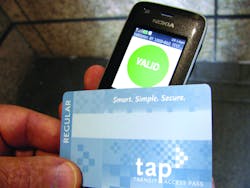
The most recent measuring stick has to be cell phones. It’s not hard to imagine two guys standing there with cell phones in hand one asking the other, “So what can yours do?” With the advent of smart phones and — perhaps more importantly — the eponymous ‘apps’ that are inexorably intertwined with them, phones now do more in many ways than desktop computers.
A recent wrinkle (at least here in the United States) to cell phone technology is near field communication (NFC). NFC-enabled phones are able to transmit data wirelessly over a short distance (~4 inches). Sure this doesn’t sound like a big deal when you have a phone that accesses the Internet and allows you to email and tweet your thoughts to anyone in the world, but for NFC it’s not the distance that matters, it’s the data.
Already in wide use in Asia, NFC-enabled phones have been tested in San Francisco with BART riders as a method of payment. The test phones had a chip placed in them that stored the same information as a fare card. All the passengers needed to do was tap their cards on a BART gate and they could enter the system.
Now the Los Angeles County Metropolitan Transportation Authority (Metro) and the Twin Cities’ Metro Transit are using the same technology in a different way — making sure their riders have already paid the fare.
Both the BART pilot and the L.A. and Twin Cities programs are the result of cooperation with Cubic, using the company’s fare collection technology as the basis, as Jane Matsumoto, Metro’s deputy executive officer, and Metro Transit’s senior manager of revenue operations, Tom Randle, explained to me.
Slimming Down
For both Metro and Metro Transit, using a handheld device for inspecting fare cards isn’t something new — it’s just that the new technology has made their jobs easier.
“This is our second generation handheld validation device,” Matsumoto says. “The original one was bulkier.
“It was cumbersome for our fare inspectors and uniformed law enforcement officers to carry this around. In fact our uniformed officers could not carry it because of its bulk.”
“It kind of looked like the thing stores use when they do inventory and they point this gun at a bar code,” says Bob Gibbons, Metro Transit’s director of customer services.
Both agencies were looking for something smaller and more reliable for their employees to use.
“It is just a far more convenient way to travel around the system with a cell phone device,” Matsumoto says.
“They are quite easy to use,” says Randle.
“They are compact and lightweight and easy to carry. They hold a charge for the working day that the officers need to use them, so they are always available. And they are relatively speedy at reading a card, so they’ve really done well for us.”
“One of the biggest concerns with our uniformed officers is that they just simply do not have real estate on their belt buckles to get anything else on there,” Matsumoto says.
“The older ones were very large. They were probably about 8 inches by about 4 inches and they were about an inch and a half thick so they were just too cumbersome.
“It required you to carry it in your hand. Well, if you are a fare inspector that is part of your job, but if you are a law enforcement officer, your hands have to be free. You can’t have something in your hand.
“Now with the NFC technology with the cell phone they are able to carry it in their pockets. It’s a very streamlined, thin phone. With the older [devices] they probably weighed about 1.5 pounds or more and these are just ounces,” Matsumoto says.
Another benefit both Randle and Matsumoto pointed to was the ability of the new cell phones to download and upload information remotely. The previous handheld devices had to be placed in a base each night to download the information stored in it.
Putting It to Work
While the NFC technology in the phones is what makes all this possible, strangely enough it’s the phone’s color screen that helps Metro the most.
“Our original handheld devices only displayed in black and white, but the cell phone enables us to use [its color screen,] and when a TAP card is tapped to the phone, if it’s an invalid card or somehow compromised, the display screen immediately glows red. If it’s a good validation the officer doesn’t have to read anything, it glows green,” Matsumoto explains.
Matsumoto also says that the new system allows them to check for passengers who have valid fare cards (monthly passes, etc.), but haven’t validated them before entering the system since Metro’s light rail system isn’t gated.
“We are finding that many of our patrons don’t stop to tap their cards because they feel that they don’t have to and then jump on the train,” Matsumoto says.
“When a patron like that is captured on the handheld validators now ... we are modifying [the screen] so that it will shine yellow meaning the patron is actually carrying a valid monthly pass but they failed to tap before boarding. The fare inspectors will instruct that patron to get off the train and go tap it because [capturing ridership] is a very important feature of the system.”
“When the officer reads the card, they relatively instantly receive more data than we did on the previous devices,” says Randle.
“They can tell on the phone where the patron tagged or validated his card, which station he was at, and they can also scroll through and see the last 10 rides the patron has taken as well as the stored value remaining on the card or what type of pass they are using.
“So it helps them depending on the discussion. If there is a question on valid fare, [they can] track the history of that card to see what was going on.”
Advice
Currently Metro has 100 of the new phones in use, but it is acquiring more than six times that amount. Metro Transit has two dozen in use at any time with about six more for spares.
One thing I wondered was if the officers were allowed to use the phones, well, as phones. Neither agency allows its law enforcement officers to use this functionality, but Metro Transit’s conductors can.
“It’s not a technology issue,” Matsumoto says.
“That would be a policy decision because officers are required by their own procedures to communicate by radio. Cell phones are typically personal devices, so we would not want to alter their internal procedures. That's not a technology restriction.”
Are the agencies happy with the NFC technology on the phones? Despite some challenges, the answer is definitely yes.
“It’s worked out well for us,” Randle says.
“We had some challenges. Even though the officers were familiar with the technology, the actual use of the devices was challenging. We seem to have large officers with big hands, so hitting the wrong button was a little bit difficult.”
Matsumoto agrees that the new technology is an improvement for Metro, “I think that this is a far superior alternative to the bulkier handheld devices for all the benefits we’ve talked about.
“In the future this very same cell phone right now is going through the process of enabling it to actually write to the card. So we are actually exploring using these for small transit operators who may not really need a full functioning farebox, for example, with all of the TAP capabilities.
“[These systems] just want to know if somebody jumps on their bus and we have a reciprocal pass agreement with them or an interagency transfer agreement with them.
“When this customer jumps on their bus it may be a small shuttle, it may be a cutaway, it may not be a full fixed-route bus, but if they have one of these NFC-enabled devices, they will be able to certainly verify that the card is valid. Moreover, it will in the future be able to load potentially like a sale of a transfer to it.
“So that’s the reason why I think for other transit agencies I would really recommend this as a kind of the first step. I think that were showing here in L.A. how tap card tech is really a viable fare collection system for a bus-based system.
“Historically automated fare collection has been launched from rail-based systems that were gated,” Matsumoto says.
“Magnetic cards were enabled to get people in and out of fare gates, but in L.A. we have demonstrated that — we're probably the second largest bus fleet in the nation. We have a very complex fare structure, and we are a regional system with multiple regional partners that are all bus-based, and we've been able to demonstrate that smart card tech incorporating things like the NFC validation device can be deployed successfully in a very large regional bus-based program.”