Gannett Fleming – Sounds of Transit
While working with the Florida Department of Transportation (FDOT), Gannett Fleming Inc. evaluated multiple transit technologies for an 85-mile, 28-city corridor. Through the planning process and public outreach, one highly controversial component was the sound impact. FDOT required a solution to convey transit sound samples to stakeholders.
Now communities can hear the difference — literally.
Gannett Fleming designed Sounds of Transit, a computer-based interactive sound information system (ISIS) developed by David Dubbink Associates, for presenting information about noise in the environment. Sounds of Transit is the first application that enhanced the ISIS with video, instead of graphic imagery and animation.
To populate the ISIS, Gannett Fleming developed a library of recorded and calibrated digital audio and video recordings of various transit alternatives; the team collected sound samples for 20 transit and rail technologies.
Sounds of Transit is able to simulate the different train types at several distances from the source, as well as outside and inside environments.
This system revolutionized public involvement in that now there is an audiovisual tool where the public can hear actual transit sounds, helping them clearly understand the sound levels. Communities in the path of infrastructure improvements can accurately experience the auditory effect of a proposed project.
The system conveys sound information in a format that requires no special technical knowledge of noise management strategies as it is independent of language and noise metric systems.
Sounds of Transit can be applied to any transit planning participation setting for decision makers or community members and additional data can be added easily. The application also includes high-speed rail samples from other countries, which could be useful in plans for high-speed rail throughout the United States, as well as areas outside the United States where development of new transportation systems is underway. This tool can help assist agencies and communities to make informed choices related to sound.
“Sounds of Transit is a powerful, revolutionary audiovisual innovation tool that will change the public’s perception of noise.”
-Dr. Ahmed El-Aassar,INCE, ASA, senior acoustical consultant, Gannett Fleming Inc.
Nova Bus – All-Electric Engine Cooling System
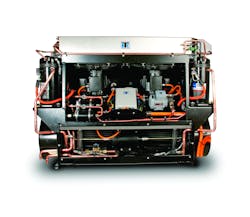
A proprietary, integrated engineering electric engine cooling system improves the buses’ performance through reductions in maintenance costs, fuel consumption and polluting emissions.
The system’s 13 variable-speed brushless fans are designed to last the life of the bus. Improved fuel efficiency affords up to 15 percent fuel economy from the lower overall power draw from the engine. Reduced maintenance costs are seen due to the elimination of the oil cooler and manifold. The system is positioned for the cleanest and coolest air intake.
The all-electric engine cooling system is designed for serviceability and integrated in the Volvo multiplex system for easy diagnostics.
“In developing our product portfolio, we continuously work in partnership with key transit stakeholders to combine the best of manufacturer and operator field expertise. In 2010, we further advanced the electrification of bus components by designing a proprietary, integrated engineering electric engine cooling system. This new system improves transit agencies’ productivity through significant reductions in maintenance costs, fuel consumption and greenhouse gas emissions.”
-Nadine Bernard, Nova Bus marketing director
Thermo King Corp., a business of Ingersoll Rand – Alternator-Powered All-Electric HVAC
While all-electric heating, ventilation and air conditioning for hybrid buses and trolley buses is a well-established technology, Thermo King offers a unique innovative solution that supplies high voltage power to the electric HVAC unit using an alternator driven by the bus engine. The alternator output is conditioned and stabilized before being used to power the electric compressors and fan motors regardless of engine speed.
The alternator-powered all-electric HVAC system provides full capacity at engine idle, constant capacity throughout the speed range of the engine, lower maintenance costs, improved reliability, fuel savings and a control system that optimizes energy management and conservation.
Alternator power can be applied to rear-mount and roof-mount all-electric HVAC systems that feature environmentally sensitive, high-efficiency hermetic scroll compressor technology inside the unit. The HVAC system comes pre-charged with high-capacity refrigerant R-407C. It also features a one-piece design for easy installation. All pipes and fittings are enclosed within the system to help ensure refrigerant remains contained.
The alternator-powered all-electric HVAC system can be used on all diesel engine-driven buses in the transit and coach markets. It can also be used in hybrid bus applications when the available power for an all-electric HVAC system is limited.
“More and more bus manufacturers and operators are seeking solutions for environmentally responsible fleets. The alternator-powered all-electric heating, ventilation and air conditioning (HVAC) technology from Thermo King helps improve performance while increasing sustainability. This innovative technology provides a unique all-electric HVAC solution for a standard diesel-engine-driven bus. Thanks to our advanced inverter technology, the system provides constant capacity through the full range of engine speeds, including idle. Improved fuel economy, increased reliability, lower maintenance and life cycle costs are key benefits of this technology.”
-Martin Duffy, vice president, global bus and rail HVAC, at Thermo King, a business of Ingersoll-Rand
Greater Cleveland Regional Transit Authority – TransitStat
TransitStat requires GCRTA’s management team to use data and information systems to define, measure, analyze, improve and control (DMAIC) operations.
Stat programs are structured, continuous management processes, which entail the frequent gathering, reviewing and analyzing of day-to-day government performance. GCRTA holds weekly meetings led by OMB and an executive team to review performance, understand trends and make necessary adjustments to ensure that immediate and long-term goals are met.
TransitStat affects the entire organization’s culture by signaling that performance and data-driven management is important.
Over the past several years, GCRTA’s business strategy has focused on three goals: A) Maintain financial health, B) Improve customer service, and C) Enhance the image of GCRTA. In order to affect these goals, GCRTA must embrace a performance culture that manages by data. TransitStat enhances GCRTA’s ability to deliver performance needed to reach and exceed its goals.
TransitStat is centered on four principles:
1. Provide timely, accurate and relevant data.
2. Analyze data and develop effective solutions that respond to emerging issues.
3. Deploy resources quickly to address issues.
4. Relentless follow-up and assessment.
TransitStat encourages a culture of data-driven decision-making, identifies cross-functional gaps, and identifies operational issues that often ‘fly under the radar’ of executives, such as absenteeism, overtime and service complaints. TransitStat also identifies negative trends early and creates a solutions-based culture.
TransitStat has aided in managing the areas of the business where underperformance has the largest impact. The work, labor, parts and performance in the Operation’s Departments can all be tracked in UltraMain. Therefore, bi-weekly forums on progress, costs and timelines have proven beneficial to ensuring accountability and high performance. In addition, it forces the management team to utilize UltraMain to manage and control projects. This benefits the department and forces the apprentices to learn and utilize UltraMain for all work functions. For instance, we have recently developed time standards for some maintenance tasks. This creates the forum to analyze and question variation in performance between districts and against the standard.
As TransitStat grew, managers and directors began looking at other areas for process improvements. Areas of improvements include adding special training on 6,000-mile inspections; reducing the NABI bus benchmarks for transmission/oil change (from two hours to 15 minutes) by incorporating this task with another; and reducing the C-Frame replacement benchmark from 30 hours to 10 hours.
Although TransitStat began in the Operations Division, the performance culture circulated throughout the entire organization, creating an increased awareness of the monitoring of data. Total savings over all three years: $23.892 million
“Through TransitStat, a performance management program, GCRTA is continuing to position itself as an industry leader. TransitStat entails weekly performance monitoring forums, embracing the use of data, statistics and metrics as a means to exceed customer expectations, as well as achieve operational excellence. It is a critical link to achieving high-level performance directed towards three of GCRTA's critical goals: Maintaining financial health, improving customer service and enhancing the GCRTA image in the community.
Over the past three years, the TransitStat program assisted team members and staff in reducing costs by more than $22 million at GCRTA.”
Capital Metro – Mirror Awareness Guide
One of Capital Metro’s most common types of collisions was mirror-to-mirror. Surprisingly, more collisions occurred from vehicles overtaking buses rather than from oncoming traffic. To counter this problem, the agency developed its Mirror Awareness Guide (MAG) devices and affixed them to the street-side rear section of its buses. The MAG device is the width of a bus mirror and set to the center height of the street-side exterior mirror.
The premise is simple: when an overtaking vehicle approaches the bus and begins to pass, the driver should notice the protruding MAG device, which focuses their attention on the bus, causing them to pass with a wider safety cushion.
If they fail to notice the device and travel too close to the bus, their mirror will hit the device producing a loud noise without harming their mirror or the flexible MAG. This should encourage them to move away from the bus before striking its mirror.
The MAG devices key features are inexpensive design, quick-and-easy installation and a reduction in mirror-to-mirror accidents.
CTTransit – Hydrogen Garage Modifications
Initially, bus companies testing hydrogen-fueled buses spent millions of dollars building small separate garages or bays for these specially fueled vehicles. These facilities were very expensive as they were designed to contain an explosion should one occur. CTTransit felt this was the wrong strategy and hired a consultant with extensive experience working with hydrogen with sophisticated computer modeling tools.
Hydrogen is the lightest element in the universe, and if released, it disperses quickly. It is only flammable or explosive if concentrated. CTTransit was able to prove to the state facility engineer and fire marshals a better way to handle a hydrogen leak was not to contain it, concentrating it, but dispersing it immediately.
The approved final solution was groundbreaking and inexpensive. CTTransit placed hydrogen leak detectors in its bus and bus bay and connected both to the facility backup electrical power supply should grid power fail. It locked out/tagged out the bus’ hydrogen fuel system before bringing it into the garage and ran it solely on electric power.
Plastic covers were placed over bus bay light fixtures to prevent hydrogen from entering them and eliminating the lights as a possible spark source. Ventilation ducts were lowered from the ceiling so a constant low flow of air would be directed on the bus at all times.
A red and green traffic light was also installed in the bus bay for easy recognition of system effectiveness. If the green light is showing, all systems are working properly and it is safe to bring the bus inside. If the red light is on, something is not working and the bus may not be brought inside.
The total cost of changes to allow a hydrogen-fueled bus into an all-diesel garage: $75,000.
Proterra – EcoRide
Traditionally, the barriers to employing battery-powered buses in large-scale applications were the range and charging needs of batteries. Additionally, the weight of traditional buses has made it difficult to feasibly incorporate a battery with sufficient power and energy storage capacity into coach designs.
Proterra Inc. is unique in that it designs and manufactures an electric bus’ complete system, including its own TerraVolt energy storage system which includes batteries, battery management system and integration system, FastFill rooftop rapid charging system, ProDrive drive system using a UQM PowerPhase 150 motor with three-speed gearbox, and a Continental VDO master control system with custom programming.
The Proterra EcoRide BE 35 is different than most battery drive vehicles where range is dictated by the number of batteries. The Ecoliner can operate 24 hours a day, seven days a week on routes outfitted with fast-charge stations. California’s Foothill Transit is the first agency in the world to deploy Proterra’s technology into heavy-duty transit operations. By 2030, FTA expects commercial availability of zero/near-zero emission, efficient and affordable transit vehicles from domestic suppliers. The Proterra EcoRide BE 35 meets or exceeds the proposed FTA 2030 electric-drive performance criteria today.
The key to this project is the utilization of the fast-charge battery. According to laboratory data, this battery retains its energy reserve and charging profile from 8,000 to 25,000 charge-discharge cycles and can be quick-charged from a 10 percent to a 95 percent charge in 10 minutes or less while the bus is at a layover. The Ecoliner battery utilizes lithium-titanate technology, which is laboratory tested at four to 10 times the usable charge-discharge cycles over conventional batteries and has a shelf life of up to 25 years.
Proterra is beginning to ramp up commercial production. A phase I production facility is already underway employing more than 100 people in Greenville, S.C. A second, state-of-the-art, production facility will begin construction in 2011 on campus at Clemson University's International Center for Automotive Research.
The EcoRide BE 35 offers zero emissions, potential for 90 percent reduction in fuel costs, significant noise reduction, lower maintenance costs and 90 percent regenerative braking energy recapture.
NextBus – NextBus
Used by more than 80 transit properties, including 30 colleges and universities, NextBus’ real-time passenger information systems provide services for city and county transit systems, resort shuttles, hospital and corporate campus shuttles, airport shuttles, and college and university transit systems. The largest transit properties in North America use NextBus, including Toronto (TTC), Boston (MBTA), San Francisco (SFMTA), Los Angeles (LACMTA) and Washington, D.C., (WMATA).
Passengers can access the systems through telephone IVR systems (including 5-1-1 systems), SMS text messaging, mobile smart phone apps, websites and electronic signage located at bus stops. NextBus even provides a publicly accessible XML data feed for use in third-party applications.
NextBus is a tremendous asset for operations, safety, risk and human resources managers. Its reports provide data on metrics such as schedule adherence, bus operator performance, headways and off-route vehicles allowing properties to ensure that any contracted transit service is provided as agreed.
Studies have shown that passenger satisfaction will be maintained, or even increase, in spite of service cuts as long as NextBus is provided to tell the passengers when those remaining buses will actually arrive. The property is able to make smart planning decisions using NextBus reports and AVL data, while preserving customer satisfaction.
The NextBus real-time passenger information system is just one component of a comprehensive Web-hosted transit ITS suite of products and services. NextBus also provides fully integrated automatic passenger counting systems, automated voice annunciation systems (NextStop), mobile data terminals, silent alarms, engine/vehicle telemetry, Wi-Fi hotspots and legacy hardware integration for existing fareboxes, headsigns and other smart bus technology.
NextBus helps transit properties provide exceptional service to their customers. Riders will always know when their bus will arrive. Transit managers will always know where their buses are and if they are operating properly. Truly a win-win situation for everyone involved.