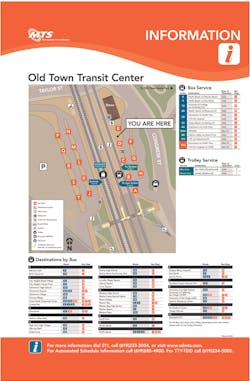
Providing the most basic and fundamental information to the rider so they can use an agency’s system is the first job of every transit agency. Of course without this information, riders wouldn’t know where to begin to use the buses or trains.
There are different tools at their disposal to communicate those services and it depends on the situation of what tool they’re going to use. Along the journey every system has the basic information for riders: showing them the routes and the times to access them.
Some of the most important information the rider gets is that which they get just before getting on the vehicle.
Solving the Riders’ Puzzle
CHK America Inc. President Rick Wood explains some tips on breaking information down to get riders through some of the fundamental processes. CHK America creates designs to provide passenger information for agencies’ riders through wayfinding and passenger information design.
“We did this psychological study on riders and there’s this thing called cognitive load, we all experience it,” Wood says. Cognitive load theory proposed that if bombarded by information with complex instructional materials, the working memory is limited and could result in a cognitive overload, resulting in impaired performance.
Simply put as Wood says, “It’s like when you go to an airport, it’s crazy. Decision-making becomes much more complicated. Humans can only handle a certain amount of cognitive load.
“Everybody has different times when the cognitive load will overwhelm them, when their decision-making becomes impaired,” Wood says. “You can’t feel comfortable in the decision you’re making because you’re overwhelmed.”
Bus stops are one of the places where the highest cognitive load occurs. Information can be designed in a way for agencies to reduce cognitive load.
“Our company did a study in London that indicates after eight seconds if someone can’t understand your information, they’ll stop trying,” Wood explains. And that’s when they will go look for an alternative for information, he adds.
“It’s not that they have to understand the entire thing, it means they have to begin to understand it.
“If they begin to understand it within eight seconds they will continue to search for answers and at the end of that period, if they’re still confused they’ll go ask someone.”
If agencies can get them engaged and start communicating information effectively they will continue to search for answers or go ask someone. “But you have to get them engaged within eight seconds,” Wood stresses.
Catching Them at the Stop
From studies and ridership feedback, Wood says the biggest barrier to ridership, especially new customers, occurs at the stop. It is the last hurdle that a potential rider has to overcome to use a system.
“They can do all their planning, thinking they know what they’re going to do but if they get to the stop and they feel anxious, unsure that they’re making a right decision, they won’t get on the bus or train,” Wood affirms.
There are a lot of at-stop information elements to confirm and encrouage a rider to take the next step. Agencies need to confirm the planning they’ve done is good, they are at the right place, they know where they can go from that stop and they know how long it’s going to take to get there.
“You want to confirm all the stuff they thought was supposed to happen at the bus stop and then make them confident enough to take that next step, which is get on the bus,” says Wood.
Helping riders overcome the barriers is to help people make the decision they need to make to feel confident by take the puzzle of the trip and break it down into manageable tasks. At any certain point, Wood explains, you have to have subtasks that are sovelable. When they solve the subtask, that should lead to the next subtask and when done in a certain order, they’ll have the entire process.
He adds, “I know it sounds esoteric, but that’s how it works.”
One of the comparisons he makes to Europe is that people often find it easier to use because they understand how to use it. And the reason they understand it is because there’s a lot of information at the stop and it has been standardized.
“We’re trying to standardize the information for people in the United States,
he says. “We’re trying to bring the European standard over here.” Being able to travel to any city and knowing how to use the information there is something to help people use systems. “You could do that all around the country; you could go to any system,” Wood says. “It’s incredibly liberating for people.”
New Option for Hearing-Impaired
Another area where it’s big in Europe and could be a way to reach riders in the U.S. stations comes from technology to help people that are hearing impaired.
A telecoil allows those with hearing aides to turn off the normal hearing aid microphone and not hear the surrounding noise, only a magnetic signal, so they can hear what they need to more clearly.
An induction loop allows the sound to be transmitted to the rider by a magnetic field. The current flows in the wire then creates a magnetic field around the wire. A small coil in the hearing aid receives the magnetic field. The listener needs to be within the area of the loop.
Jonathan Zeier of Zeier Associates explains why churches and auditoriums are the easiest place to install a telecoil system. “If you took the piece of wire and you ran it around the whole room and didn’t worry about if it was aesthetically pleasing, that in effect could be your coil.
“Then you just put an amplifier to the front. Those people are going to be sitting down, you know roughly where they are going to be.”
The challenge with public transportation is in not knowing exactly where the people are going to be, he says. “You’re going to have seven feet tall people and you’re going to have people riding in wheelchairs; there’s this huge gap.”
For people to benefit from the amplifier, they have to be in somewhat close proximity. And Zeier explains that it’s in waves, so it’s going to be stronger in one point. “So if you fix it that it’s strongest for someone in a wheelchair at ADA height, the person who is 6’2”, they’re going to have to bend down to get the benefit.
When coming from overhead or on the floor, he explains that there is a curtain-effect. Son instead of it coming out from the wall to hit you, the signal is coming down to cover you, providing for a much bigger diameter to stand within.
As people travel and are using an agency’s system, they typically aren’t paying attention to where they are standing or where their head is or where their ear is cocked.
For the successful implementation, Zeier says agencies have a number of responsibilities.
- Informing riders that the service is available
- Clearly marking areas where the telecoils are located
- Making use of existing infrastructure in older installations
- Arrive at a standard setting and height to meet ADA and NFPA
- Not having to show riders where they have to position their heads for the best reception, but rather an entire area they can feel comfortable in using
When determining where to lay the loop, there are certain areas that make it more effective. Zeier mentions that they can be susceptible to electrical interference or steel.
Right next to trains, for example, the really high voltage destroys the magnetic field in the inductor of the telecoil. Though he adds, “But there are not too many areas where that happens because usually they try to keep people away from there.”
Certain steels will also kill the magnetic field he explains, so you have to watch what type of steel you’re using. But with the testing that’s been done, there isn’t any overhead piping that would interfere with it.
With Europe pushing on it much harder and finally requiring it, according to Zeier, he says that the technology is being looked at now in the United States more. “It usually starts on the east coast or the west coast and then works its way in.”
He also explains that agencies have to look at the volumes of ridership to see where it makes sense. “With that many more people going through New York or going through Boston’s MBTA or going through SEPTA, you’re going to have that many more people so that many more people with hearing problems.
And with the aging population, it will become much more of a concern. Zeier says, “This little hearing aid with a little button on it serves a purpose and as more of these things come through, it is an aging population that is going to dictate that.”