Transportation Center Keeps New Parking Garage Secure
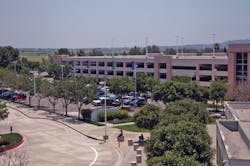
Located in California’s Orange County, the city of Irvine has become a vital rail hub for commuters between Los Angeles, about 40 miles to the north, San Diego to the south and the sprawling Inland Empire to the east.
The Irvine Transportation Center, operated by the Orange County Transportation Authority (OCTA), has become one of the busiest in the nation, serving Amtrak’s Pacific Surfliner route, which stretches from San Diego to Seattle. It also serves two commuter routes; the Orange County line, from Union Station in downtown Los Angeles to Oceanside in north San Diego County; and the Inland Empire Orange County line operating between San Bernardino to the northeast and Oceanside to the south.
The station is also expected to serve as a stop on the California High-speed rail project that will link California’s major cities with trains capable of traveling at speeds of up to 220 miles per hour. Construction of the project is expected to begin in 2011.
The station also serves the OCTA’s bus lines that transport rail commuters. Since opening in 1990, the station has increased ridership from 10,000 passengers in its first year to more than 650,000 today.
But what it did not do well for many years was serve the needs of commuters who drove to the station each day. With only 500 paved parking spots on an uncovered lot, commuters were often forced to park in an auxiliary dirt lot that could become a muddy mess during California’s rainy winters. Many passengers complained that they were unable to quickly find a place to park and missed their trains.
New Structure
Looking to soothe the daily parking headaches, city officials in 2007 approved plans for a 1,500-space, four-level parking garage. Funding for the $27 million project came from the OCTA and the California Department of Transportation (Caltrans).
Fifteen months later, in October 2008, the new garage opened to rave public reviews. “We’ve been counting the days until this opened,” said one regular commuter. “Now you can park your car in a nice, safe lot,” said another.
The new structure offers three stories of covered parking and another open rooftop level. Each level is equivalent to more than two football fields of space. The project took 53,000 combined construction hours, 47 subcontractors, 70,000 cubic yards of dirt and 15,000 cubic yards of concrete.
At the entry, the structure has an LED sign indicating how many open spaces remain on each level, helping drivers to more quickly find a place to park.
The one thing the new parking structure didn’t have was a security system — something that is important to Irvine officials. The city of Irvine has grown dramatically since its incorporation in 1971. It now has a population of about 212,000 people, yet city officials put a very high priority on safety and security that shows in its crime statistics. Last June, the FBI said Irvine has the lowest violent crime rate among U.S. cities with a population in excess of 100,000 people. It was the fifth consecutive year Irvine has claimed to be America’s safety city.
Security Need
Determined to keep the parking center as safe as possible, the city hired a security consultant to help draft specifications for a comprehensive security system. Using the consultant’s recommendations, the city issued a request for bid (RFB) package with highly specific drawings, terms and conditions.
The RFB was not open to negotiations and the challenging nature of the specifications led several security companies that attended a pre-bid meeting that included drawings and terms, to pass on the project.
“The specifications were well designed, but the highly technical nature of the project and the no-negotiation nature of the RFB led to some potential bidders choosing not to bid on the project,” says Paul Slaman, ADT’s national accounts manager.
ADT won with the low bid and was awarded the project, but a technical problem with the bond submittal led to the project going back to bid again. Four companies bid and ADT was awarded the project for a second time. The bid called for the work to be completed within 55 days of the start date in January 2009.
As work began, there were already seven analog cameras in place around the train platform and the ticket office. According to the specifications, they were to remain a part of the security system, along with 40 new IP-based cameras. An encoder was added to allow the analog cameras to work with a new IP-based video management system from DVTel.
In addition to the new cameras and video management system, the plan called for video analytics to provide alarms for unusual behavior or items left behind on the platform and/or tracks. The plan specified 120TB of storage capacity, enough to store months’ worth of video from the cameras. That large storage capacity would give the OCTA or law enforcement officials the ability to retrieve video for liability matters — such as a slip and fall, investigation of criminal activities or even to check for operational issues.
Video from the cameras was to be monitored by a private guard service in a small control center located in the station, while a 10GB fiber cable has ample capability to permit the quick streaming of live video to the Irvine Police headquarters located seven miles away in City Hall.
But before camera installation could begin, the ADT team had to pull cable through the garage. That was made easier since the structure had been designed and built with integrated conduits running to potential camera mount positions. However, not all conduits were positioned for optimal camera placement, so there was additional conduit extension work required.
The 40 IP cameras are a mix of fixed and pan-tilt-zoom units placed throughout the interior and exterior of the parking garage. Some cameras monitor the 16 Code Blue call stations provided for emergency assistance and are situated at the bottom of stairwells on each level of the structure. During normal activity, these cameras record at seven frames per second. When a Code Blue station is activated, the cameras are programmed to record at 15 frames per second to provide a better live view and recording of emergency situations.
Unexpected Problems
As the installation of the security equipment was underway, the city approached ADT asking for help with an unexpected problem. It seems that nearly 7,000 square feet of retail space being finished out adjacent to the garage was attracting a large number of skateboarders. It was time-consuming for the private guard service to regularly check on the area. ADT’s answer was two more cameras — one fixed lens and the other a pan-tilt-zoom — to monitor the site and provide video to the station’s security center. That way, a guard was dispatched only when skateboarders were present.
One of the tougher problems to solve was the coordination of the video analytics linked to four cameras monitoring the train platform and adjacent tracks.
“We spotted a potential problem even before we began work,” says Slaman. “We were concerned that the angle of the cameras wouldn’t allow for the analytics to provide good information regarding movement on the platform or tracks. The way the existing cameras were positioned, some areas of the platform were masked, some areas were not covered at all and late afternoon sunlight could obscure the view of west-facing cameras.”
The answer for this problem was using the pedestrian bridge over the tracks as the base for additional cameras — one looking straight down on the tracks, a second camera viewing the eastbound track and two more monitoring the westbound track. By mounting the cameras underneath the overpass, problems with the sun were resolved and the location was better for overall views of the area. With this configuration, the analytics worked well.
This change added to the total cost of the project, but OCTA officials agreed it was the best way to resolve the problem. The other four cameras called for in the original plans stayed in the project, but now serving without the analytics.
Working directly over the tracks had a problem of its own. The regularly scheduled trains could not be delayed to allow crews to mount and adjust the cameras. Roughly every 30 minutes, work was stopped and equipment removed as a train pulled into the station, boarded passengers and left. The interruptions would last from 10 to 15 minutes each.
“That wasn’t part of our original plan and could have been very costly to us as the contract called for penalties of $2,500 per day for not meeting the agreed upon deadline,” says Slaman. “Our crews made the necessary adjustments and the OCTA was very understanding and helpful with this.”
Despite these delays, the project was completed a week ahead of schedule.
Successful Template
A few months after the security project was completed, the OCTA invited law enforcement officials from six cities along the rail corridor in Orange County to tour the Irvine parking garage. The agency and other cities along the rail corridor are looking at using the Irvine project as a template.
“We’re currently in the planning stages of a new parking garage at the Tustin Metrolink station,” says Lora Cross, project manger for OCTA. “OCTA will act as the project manager for that project.”
She says work is underway to retrofit the Santa Ana station with video surveillance cameras. Also, there are plans to construct a new station and parking garage in Fullerton. The city will serve as the lead for that project, with OCTA providing funding from federal grants.
“I have to give a great deal of credit to the city of Irvine and the OCTA for generating an excellent plan for securing the parking garage and then having the flexibility to make adjustments as the project moved forward,” Slaman says. “That creates an environment in which a security integrator can help achieve the best results.”
Larry Mays has more than 32 years of experience in consulting and the development of transportation industry mission critical information management systems. He has advised mass transit authorities, airlines and freight forwarders about systems integration and network infrastructure. He can be contacted at [email protected].