Maintaining Efficiency Through Proper Planning
As one of the fastest growing U.S. cities with populations over 500,000, Fort Worth, Texas, has created positive planning challenges for the Fort Worth Transportation Authority, known as The T. Now the 17th largest city, Fort Worth has grown from a population of 541,926 in 2000 to 703,000, and is the seat of Tarrant County, also among the country’s fastest growing. Fort Worth’s relatively recent, rapid expansion was fueled by its wide-open developable land with low acquisition costs in a business-friendly state, its integral role in the booming Dallas-Fort Worth Metroplex, and its attractive quality of life that blends small city livability with big city entrepreneurial spirit and culture.
Up until the start of the 21st century, The T had been primarily a bus service for dependent riders, plus an extensive vanpool system to reach its outer-most perimeters. With the influx of new residents and the arrival in Fort Worth in 2000 of its first commuter rail, co-owned with Dallas Area Rapid Transit, there is increasing demand for more rail and expanded bus service, as well as greater interest across all population segments for an expansion of the public transportation system in the greater Fort Worth area and adjacent counties. Today The T operates 40 bus routes, mobility impaired services, carpools and vanpools, the Trinity Railway Express as co-owner and is developing a new commuter railroad that will operate diagonally across most of Tarrant County.
The traditional challenge for The T’s bus transit planners has been how to plan effective and efficient transit service to accommodate the rapid growth, which has been primarily on the low-density edges of the city which extends for 350 square miles. The existing bus network illustrated on The T’s system map shows a strong concentration of service within the Interstate 820 “Loop” but limited in areas outside the Loop. In sum, The T planners have chosen to concentrate service to the denser areas with the strongest transit potential. The T’s bus transit system — with an annual operation cost of approximately $26 million — has proven to be lean and efficient, providing good coverage to the central city and inner-core communities. As with other transit agencies across the country, The T responded to the economic downturn with a “belt-tightening” program in 2009 for administrative items. As the economy continued to constrict, The T planning staff was challenged to identify potential reductions to its already efficient bus service.
To begin the evaluation of what level of bus service to cut, T planners were first provided with a goal from President Dick Ruddell, who directed staff to identify up to $1 million in savings. The planning team then put its existing resources and evaluation tools to work, beginning with a key Route Monitoring Committee that understands the system from the ground level.
Route Monitoring Committee
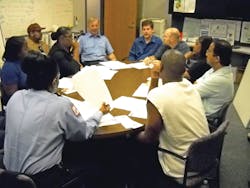
This committee is a group of volunteer operators and customer service representatives who meet monthly with planning and scheduling staff to improve communication between the departments while creating an additional avenue to enhance service quality. Bus operators relay on-the-street operational concerns and help to evaluate proposed route changes. T planning staff took advantage of this operating group’s understanding of existing service to provide an initial brainstorm of potential service reductions. Several ideas were brought forth for further investigation. Because detailed surveys and studies can be very expensive and time-consuming to produce, it is important to gain this observational input before embarking on any empirical analysis.
T planners next put their internal evaluation/tracking tools to work. To track system efficiencies, The T used multiple evaluation tools: route performance index (RPI), farebox passenger counts, boarding and alighting counts, and origin-destination surveys.
Route Peformance Index
RPI is used to objectively measure the performance of a route relative to other routes within the same service classification. The key performance indicators (KPI), passengers per hour, passengers per mile and subsidy per passenger are compared against a standard in each route category (radial, crosstown, feeder, circulator and express). The standard is set based on the previous fiscal year’s average. Once the indices for each performance measure are calculated relative to each individual route, all values are normalized to a value of one (1).
The mathematical explanation of the RPI calculation is as follows:
Route Performance Index =
Index Passenger Per Mile + Index Passenger Per Hour + Index Subsidy Per Passenger
3
Where:
Index Passenger Per Mile =
daily passengers per revenue mile
previous FY passenger per mile average (standard)
Index Passenger Per Hour =
daily passengers per revenue hour
previous FY passenger per hour average (standard)
Index Subsidy Per Passenger =
previous FY subsidy per passenger average (standard)
daily subsidy per passenger
While an RPI of “1” or greater shows that a route is performing well, calculating the standard deviation of RPIs identified the use of 0.4 as the minimum expectation threshold.
Routes with an index number between 0.4 and 0.9 meet the minimum expectations. Those routes that perform below minimum expectations of 0.4 RPI are either targeted for action directed toward improving performance, or in these difficult economic times, considered for service reductions or even elimination. From a purely cost-effectiveness perspective, RPI is a fine tool, but it does not take into account all of the issues and obligations that must be met by public transit. It also has a limitation in that it cannot identify opportunities for improvement in already high-performing routes. This is where other studies and street level information, such as that provided by the Route Monitoring Committee, come into play.
Analysis showed three routes were all slightly to well below the minimum RPI. Two of these, however, were considered “lifeline” routes to economically disadvantaged neighborhoods and thus, it was decided to leave them as they are despite their poor performance.
Route 23 serving one of the city’s business parks, including two trade schools and eight hotels, had been growing rapidly, but stagnated at 0.3 RPI following the economic collapse in late 2008. Because it had initially shown great potential, we wanted to come up with another solution rather than cut service to the area altogether. An origin-destination survey of bus passengers from 2008 revealed that most everyone riding Route 23 was making two transfers per trip and all were passing through the intermodal transportation center in downtown. It was decided to discontinue Route 23 and instead extend Route 11 to serve the business park from downtown. The extension of Route 11 would allow continued service to the industrial park during morning and evening peak travel periods, would reduce the number of transfers required to reach the industrial park, and save substantial cost while also adding much needed recovery time to Route 11.
Farebox Data
Ridership data from fareboxes was evaluated to identify opportunities for frequency reduction. The farebox system keeps track of daily ridership totals, but is also able to stratify boardings by time of day. Route 7, which operated at 30-minute frequency Monday through Saturday until after 10 p.m., was meeting minimum RPI, but overall ridership was comparable to some other routes with only hourly frequency. However, analysis of farebox data indicated that only a handful of people rode after 7:00 p.m. Subsequently, a decision was made to reduce Route 7 to hourly service and eliminate trips after 8:00 p.m. The savings were substantial. Similarly, as farebox information revealed when boardings peaked and declined, it was decided to reduce frequency from half hour to hourly on Route 4 only on Saturdays and on Route 22 weekdays from 9:00 a.m. to 3:00 p.m.
Bus Stop Analysis
Stop-level boarding counts also were used to evaluate portions of routes. Route 25 actually was one of the higher performing routes with an RPI of 1.2. However, on-bus route observation and analysis provided details that allowed planning staff the opportunity to squeeze efficiencies from this route. Temporary staff from a local staffing agency were employed to perform a stop-level boarding and alighting count that confirmed observations that the western portion of the route carried roughly half as many people as the eastern portion. Evaluation of the run-times allowed us to redesign the route so that some buses could turn around at the La Gran Transfer Center, which was approximately the half-way point. That way, they could still provide cross-town service, but effectively reduce frequency to hourly on the western portion where the ridership was lower and leave 30-minute frequency on the eastern portion where higher ridership warranted.
The operational experience of The T’s drivers would also prove indispensable in the effort to cut costs. Route 26 actually showed the second highest RPI of the system at 1.4, but still had room for improvement according to the bus operators on the Route Monitoring Committee. They suggested eliminating service on Route 26 after 7:00 p.m. in the evenings because the highest ridership portions of that route were also covered by Route 2, a larger bus which had excess capacity after 7:00 p.m.
A number of other suggestions from the Route Monitoring Committee and planning and scheduling staff were implemented as well, altogether reducing total bus hours by 4.5 percent and saving approximately $800,000 per year.
Even as The T’s planning team reduced service, it was simultaneously being challenged by residents, developers, its cities and region to continue planning for service expansions for its less dense outlying areas with at least four express bus park and ride stations, eventually to be coupled with train stations and bus feeders for the new commuter rail, which at its northern end will reach the Dallas-Fort Worth International Airport and ultimately connect with the two other transit agencies in the region.
In the meantime, The T’s planners are also taking advantage of stimulus funds and other capital grants to enhance its inner core service through transit signal priority, a new bus transfer center and its first bus rapid transit system, scheduled to start during 2011.
The interest and support by Greater Fort Worth and Tarrant County leaders for transit expansion to address congestion and mobility issues and future growth is so great that one of The T’s planners is currently dedicated to expediting the completion of a new 25-year strategic plan to help ensure an expanded and enhanced transit system for the future.
Curvie Hawkins is the director of planning at the Fort Worth Transportation Authority (The T). Phil Dupler is a service planner III at the Fort Worth Transportation Authority (The T).