With the release of its “Vision for High-Speed Rail in America” the Obama Administration unveiled its plan for a national rail network. With the granting of $8 billion in federal stimulus funds for high-speed rail, the administration put its money where its vision was.
As the United States begins the road to rails, experts across the country have been jetting across the globe to learn from successful high-speed rail systems in Asia and Europe. These systems, some of which have been running for decades, have a lot to teach the burgeoning U.S. network.
In this issue Mass Transit takes a look at three of those systems, their histories and lessons learned.
Tokaido Shinkansen
(((BEGIN BOX)))
Name: Tokaido Shinkansen
Country: Japan
Operator: Central Japan Railway Company (JRC)
Opening date: October 1, 1964
Top speed: 205 mph (330 km/h)
Annual ridership: 149 million
(((END BOX)))
History
The oldest of the three systems here, the internationally renowned Tokaido Shinaknsen high-speed rail line is the main transportation link between Tokyo, Nagoya and Osaka — the world’s busiest high-speed rail corridor. The first high-speed rail system in history, the Tokaido Shinkensen began operations in 1964 under the Japanese National Railways (JNR) and is currently operated by the Central Japan Railway Company (JRC).
In 2007, JRC commissioned the N700 “bullet” high-speed rail system on the Tokaido Shinkansen. JRC operates more than 323 trains per day on the Tokaido Shinkansen, with an average annual delay of a little more than 30 seconds per train. Today, the Tokaido Shinkansen has more than 80 percent market share between Tokyo and Osaka.
Unlike most high-speed rail operators in the world, JRC enjoys substantial profits and requires no government subsidization. JRC’s operating revenues for the fiscal year ending in March 2009 were ~$13 billion.
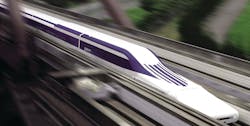
Looking to the future, JRC is constructing a Tokaido Shinkansen “bypass” using superconducting magnetic levitation technology (SCMAGLEV), which holds the world’s speed record of 361 mph. The SCMAGLEV will connect Tokyo to Nagoya (a distance of 213 miles), and ultimately will be extended to Osaka (about 100 additional miles).
JRC is currently marketing the N700-I (the international variant of the N700) and the SCMAGLEV in select U.S. corridors.
Critical High-Speed Issues
“The most critical issue for a high-speed rail line is undoubtedly whether or not it is constructed as a closed system,” says Richard Lawless, CEO of U.S.-Japan High-Speed Rail (USJHSR).
“In Japan, the early decision to maintain the integrity of the Tokaido Shinkansen as a closed system has enabled JRC to develop technologies with unrivalled performance characteristics. It also has allowed JRC to set operating schedules that transport a staggering number of passengers in comfort and safety with virtually no delay.
“Other experience around the world has demonstrated that mixing high-speed rail with freight and conventional passenger operations is, at best, highly inefficient and, at worst, a compromise of safety. If the U.S. is committed to deploying true high-speed rail, this mistaken approach must be avoided from the outset.”
AVE
(((BEGIN BOX)))
Name: AVE ("Alta Velocidad Española" or Spain´s High Speed)
Country: Spain
Operator: RENFE Operadora
Opened: April 9, 1992
Top speed: 186 mph (300 km/h)
Annual ridership: 4.7 million
(((END BOX)))
History
In 1986 the Spanish government chose to modernize transportation in Spain and begun planning the 298-mile Madrid-to-Seville line, which would open in 1992. The astounding success of this line became the foundation for a much larger vision in passenger transportation.
With the goal to link Spain´s two largest cities next, planning was started for a Madrid-to-Barcelona line, covering almost 400 miles. Due to the length and difficulty of the terrain, this line was completed in several stages, opening service to Zaragoza and Lérida in 2003, Tarragona in 2006 and Barcelona in 2008. While this line was being completed, a new line from Madrid northwest to Valladolid was built and opened in 2007.
With the opening of the Madrid-Valencia line later this year, the system will reach 1,386 service miles. Many other segments are under construction or in planning stages throughout Spain. The national transportation and infrastructure plan will build a total of 6,400 miles of high-performance railways by 2020, bringing 90 percent of Spain´s population within 30 miles of a high-speed rail station.
The development of high-speed rail is not only transforming transportation in Spain, it has also reinvigorated its rail industry. High-speed rail; has brought numerous technical developments — gauge width changers, local high-speed rail rolling stock, pioneering development and implementation of signaling and train control ERMTS technology — and launched Spain‘s engineering, construction and equipment companies as world-class players.
The success of Spain’s high-speed operations relies heavily on RENFE´s customer-oriented services and fare policies, as demonstrated by their unique fare reimbursement policies and more than 99 percent punctuality rate.
Critical High-Speed Issues
“Probably, all aspects of high-speed rail are equally critical for its success,” says XXX from XXX.
“The different stages of planning, construction, operation and maintenance are all interdependent to an extent: planning looks into travel patterns and projections, preferred routes and cost analysis, whose accuracy will determine future construction costs and operation features.
“Engineering, construction, and maintenance are equally critical, first and foremost for passenger safety, but also for enabling the full potential of the benefits of high-speed rail.
“Then, operators are the interface of the high-speed rail system with the public, and need to work every day delivering the benefits of the service to passengers.”
ITALO
(((BEGIN BOX)))
Name: Italo
Country: Italy
Operator: Nuovo Trasporto Viaggiatori (NTV)
Opening date: September 2011
Top speed: 186 mph (300 km/h)
Annual ridership: 10 million (projected)
History
NTV was founded in 2006 by Ferrari president, Luca di Montezemolo, Mr Diego Della Valle, owner of luxury brand Tod’s, Gianni Punzo, president of the logistic center Interporto Campano, and NTV CEO Guiseppe Sciarrone.
“The founding partners were later joined by other major stakeholders: Intesa Sanpaolo Bank, Generali Group and the French railways, SNCF,” says Sciarrone.
The first totally private high-speed rail operator in Italy, NTV’s objective is to contribute to the growth of the Italian railway system, capitalizing on the government’s investment in high-speed rail.
“For the first time in the Italian railway history, we will bring competition in to the railway market, since we’ll be competing directly with the State operator, Trenitalia, covering the same lines,” says Sciarrone who believes competition will increase the quality of rail in Italy.
With commercial service slated to begin in the summer of 2011, the ITALO line will open with 25 Alstom AGV high-speed trains and have stops in Italy’s most important destinations, including Turin, Milan, Bologna, Venice, Florence, Rom, Naples and more.
Critical High-Speed Issues
“Being newcomers has both great advantages and risks,” says Sciarrone.
“We’re stepping in to a market that is opening up and will no longer be a monopoly. We will be the first company to compete in this market. And this is certainly an advantage.
“On the other hand, we have to invest a lot without having previous experiences to look at and to use as a reference point or a model.
“We decided to be the first in Italy because in this country there was already a positive experience of liberalization, although only in the freight sector. This experience has taught us that the deregulation works — for the newcomers, quality of service becomes a priority and, if the incumbent doesn’t want to see its market share fall, it must elevate its quality level too. This global improvement allows a growth and a better performance of the market and attracts more passengers,” says Sciarrone.
“NTV’s first objective was to close a framework agreement with the infrastructure manager to guarantee us the infrastructure capacity for our services. To start a railway business of this kind requires massive investments and it’s certainly not advisable to do it if first you haven’t obtained this crucial certainty.
“We are very close to our kick off. We are building a €90 million maintenance depot in Nola, in the South of Italy, and we are already testing with Alstom the first ITALO prototype on the Italian lines for the validation procedure.”